







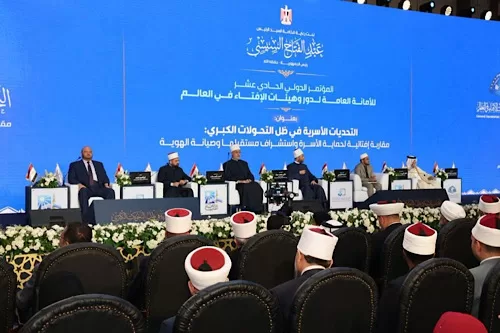
Egypt’s Minister of Awqaf (Charitable Endowments) Osama Al-Azhari attended the closing session of the 11th International Conference of Egypt’s Dar al-Ifta, held under the patronage of President Abdel Fattah El-Sisi.
The minister represented Prime Minister Mostafa Madbouly at the conference, which brought together scholars, muftis, intellectuals and representatives of international institutions to discuss “Family challenges amid major transformations” and ways to protect family cohesion and identity.
Egypt’s Grand Mufti Nazir Ayyad called for the conference’s recommendations to be translated into practical programmes and policies that would help protect families, preserve their identity and strengthen their ability to confront contemporary challenges.
Participants said safeguarding the family was a shared responsibility involving religious and community institutions as well as families themselves.
Singapore’s Mufti Nazirudin Mohd Nasir thanked Egypt for hosting the gathering and praised the role of Dar al-Ifta in addressing issues affecting Muslim communities worldwide. He said families were facing rapid social and technological changes that were influencing values and behaviour.
He urged religious institutions to remain closely connected to families and to develop their tools and expertise to contribute more effectively to reform efforts. He also called for future conferences to assess how recommendations from previous meetings had been implemented in different countries.
Jordan’s Grand Mufti Ahmed al-Hasanat said globalisation, the digital revolution and artificial intelligence were creating growing challenges for families. Social media and smartphones, he said, had in some cases weakened direct communication among family members.
He highlighted Jordan’s launch of the “Protect Yourself” application to help combat pornography addiction and its harmful effects on individuals, families and society.
Hasanat also drew attention to the hardships faced by Palestinian families, particularly in the Gaza Strip, where many have lost homes and access to food and water. He said their resilience represented an example of family cohesion under extreme conditions.
The conference also discussed the situation of families in Jerusalem, facing arrests, home demolitions, displacement and other pressures.
During the closing session, attendees viewed a documentary on the conference’s discussions and recommendations. Several memorandums of understanding were also signed, including an agreement between Dar al-Ifta and Egypt’s State Information Service to strengthen co-operation and exchange expertise.

