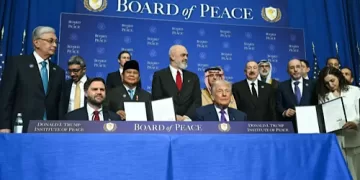






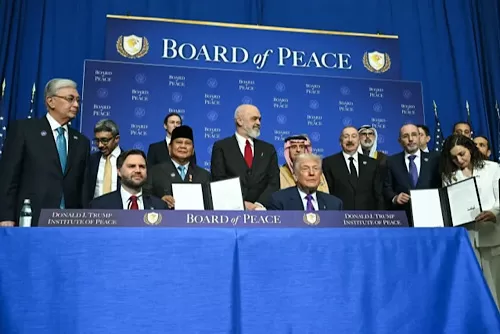
US President Donald Trump’s Board of Peace on Wednesday unveiled a $2.45 billion, six-month plan to rebuild Gaza’s economy and establish a Palestinian civilian administration to replace Hamas.
Presented during the UN General Assembly, the plan includes 66 programmes spanning housing, infrastructure, health, education, economic development and security.
International troops would provide security after Hamas relinquishes control of the territory.
Former British prime minister Tony Blair, a member of the board’s executive committee, said implementing the plan would require the destruction of hundreds of miles of Hamas tunnels and weapons depots.
“This new government cannot govern unless that infrastructure is systematically destroyed,” Blair said. “Hamas have agreed in principle that it should be, and that was a landmark agreement.”
He said the focus over the next year would shift “from preparation to implementation,” adding that Gazans “don’t need a slogan, they need a solution.”
At a briefing hosted by US envoys Steve Witkoff and Jared Kushner, officials appealed for additional donor support but offered no firm timetable for implementation. Israel has yet to accept the phased withdrawals that are central to the plan, leaving its feasibility uncertain.
Witkoff, who also sits on the board’s executive committee, said the group remained committed despite the challenges.
“There is a ceasefire, imperfect as it may be, but it still exists,” he said. “We have no plan B, and therefore, we will all work together to have this plan succeed.”
The recovery programme builds on Trump’s Gaza peace framework, unveiled last year, which calls for Hamas’s disarmament, Israeli withdrawals from the territory and reconstruction under a Palestinian civilian government.
Officials said months of work had gone into establishing financial controls and procurement procedures to reassure donors that funds would be properly used. The board’s chief financial officer said it had secured $18 billion in long-term commitments for Gaza.
Ali Shaath, who heads the UN-mandated National Committee for the Administration of Gaza, said multiple institutions — including the Palestinian Authority, Hamas authorities, municipal bodies, UN agencies and other aid groups — were currently providing overlapping services that needed to be coordinated.
Palestinians should play a leading role in the effort, he said.
“We want them to stay and live in Gaza with hope and prosperity,” Shaath said. “We want them to design and create their future by their own hands.”
The initial six-month phase includes repairs to electricity and water networks, temporary shelters, waste removal, health services and business support. Preparing for winter is an immediate priority, Shaath said.
Officials said an international military force would establish security sector by sector, beginning in Rafah in southern Gaza before moving to central Gaza, Gaza City and the north.
Maj. Gen. Jasper Jeffers, commander of the United Nations International Stabilization Force in Gaza, said an initial contingent of 500 troops from Kosovo and Morocco had been trained for deployment. Additional forces from Albania, Kazakhstan and other countries would follow, he said.
International troops would enter each sector first, followed by the dismantling of Hamas weapons and military infrastructure. The new Palestinian administration and its vetted security forces would then assume control, allowing Israeli troops to withdraw.
Asked whether Hamas weapons would be destroyed or stored, Jeffers said planning was still underway.
“The intent is to neutralise and decommission,” he said.

