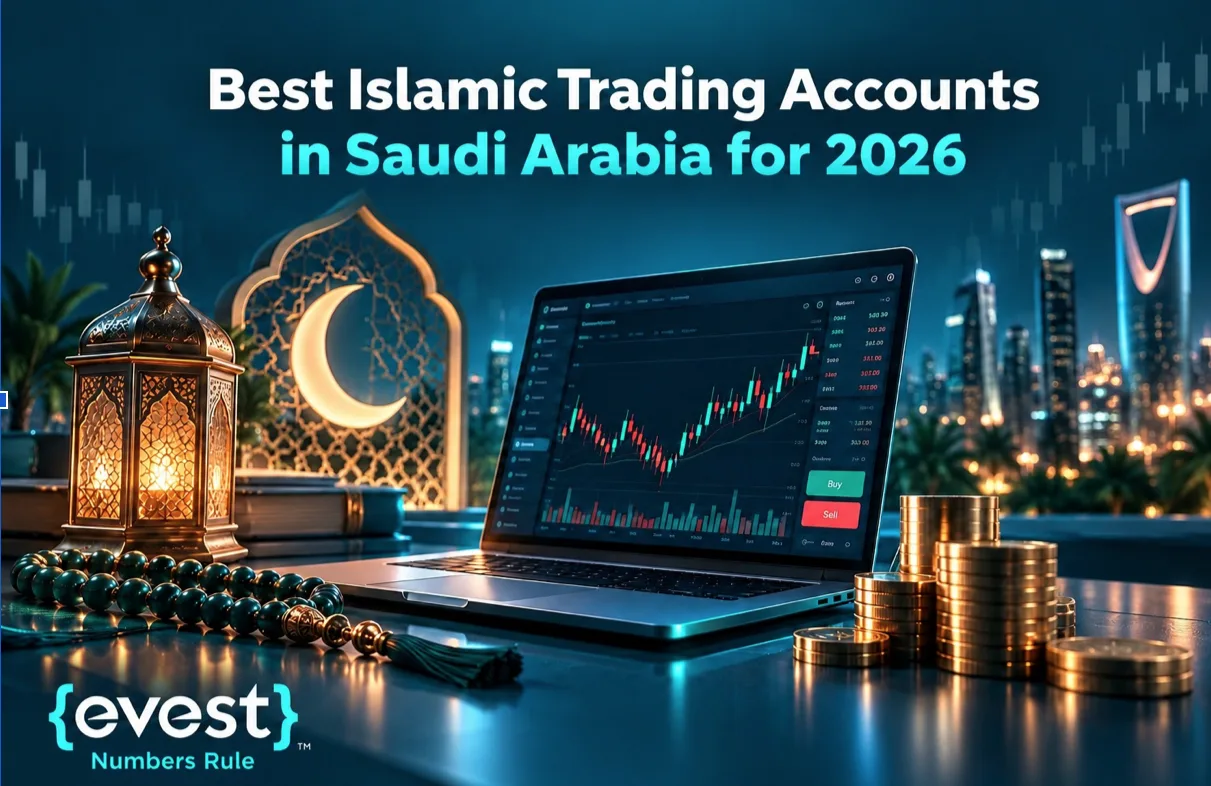









Choosing an Islamic trading account in Saudi Arabia requires more than finding a platform that simply uses the word “Islamic.” Muslim traders need to understand how the account handles overnight charges, what trading costs may still apply, which markets are available, and how effectively the platform supports risk management. In 2026, comparing these factors together can lead to a more informed trading decision.
What Makes an Islamic Trading Account Different?
Before comparing platforms, it is important to understand what an Islamic trading account is designed to offer. This provides the foundation for evaluating different providers and prevents traders from making decisions based only on promotional labels.
The main distinction usually concerns interest-related overnight charges. Conventional accounts may apply swap or rollover fees when certain positions remain open overnight, while Islamic accounts are structured differently to address this issue.
Understanding Interest-Free Trading Conditions
When evaluating an islamic trading account, traders should review the actual terms applied to positions rather than assuming that every Islamic account works in exactly the same way.
Evest states that trades on its Islamic accounts are exempt from overnight SWAP or rollover fees. It currently offers Islamic, Islamic Pro, and Islamic Pro Plus account options, with differences in spreads and Sharia commissions. Evest also notes that a Sharia commission may apply when a trade remains open for three days or more, according to its Islamic account schedule.
This distinction matters because interest-free does not necessarily mean that no trading costs apply. Spreads, commissions, and other account-specific charges still need to be reviewed.
Account Structure and Individual Instruments Are Separate Questions
Another important distinction is between the structure of the account and the instrument being traded. An Islamic account may remove conventional overnight interest, but that alone does not determine whether every available instrument or transaction meets a trader’s individual Sharia requirements.
Evest itself notes that factors such as the underlying asset, contract structure, leverage, additional fees, and execution method may need to be considered separately. Traders who require a religious determination for a particular transaction should therefore consider consulting an independent qualified Sharia authority.
How to Compare Islamic Trading Accounts in Saudi Arabia?
Once the account structure is clear, the next step is comparison. Instead of focusing on one feature, Saudi traders should evaluate the complete environment in which their trades will be executed.
A useful comparison covers account terms, trading costs, market access, platform usability, and risk-management functionality. Looking at these factors together provides a more realistic picture of what the trading experience may be like.
Start With Account Terms and Trading Costs
The first area to review is the cost structure. A swap-free arrangement addresses one specific type of charge, but traders should still investigate spreads, commissions, and any conditions that may apply after positions have remained open for a specified period.
This becomes particularly important for traders who intend to hold positions for several days. A cost that appears minor on one trade can have a larger effect when repeated across multiple positions.
A common mistake many beginners make is treating “Islamic” and “free” as if they mean the same thing. A better approach is to understand the complete cost of trading before comparing platforms.
Compare the Markets You Intend to Trade
After reviewing costs, consider market access. There is little value in choosing an account with a long list of features if it does not provide the markets that match your trading interests.
Evest says its Islamic account provides access to more than 400 financial instruments, including over 300 global stocks as well as currency pairs and commodities.
For beginners, however, having more markets does not mean trading all of them. It is often more practical to focus on a limited number of instruments, learn what influences their prices, and develop a structured approach before expanding into additional markets.
Choosing a Sharia-Conscious Platform for the Full Trading Journey
After comparing account terms and market access, the focus can move to the platform itself. The account determines important trading conditions, but the platform determines how the trader interacts with the market every day.
A sharia-compliant trading platform should therefore be considered as part of a wider process that includes understanding account conditions, reviewing instruments, executing orders, and managing risk.
Evest’s educational content describes its Islamic offering as a swap-free solution intended for Muslim traders seeking access to global financial markets without conventional overnight interest charges.
Platform Usability Matters for Saudi Traders
A platform should make essential trading functions understandable and accessible. Before committing real capital, users should know how to locate an instrument, monitor price movements, place an order, review an open position, and exit the trade.
Evest states that its Islamic account users can access multiple trading environments, including MetaTrader, Web Trader, smartphone web access, and the Evest trading app.
For a beginner, usability matters because operational mistakes can affect a trade even when the original market analysis is reasonable.
Risk Management Should Be Part of the Decision
Islamic account conditions do not remove market risk. Prices can still move against a trader, and poor position sizing can still create significant losses.
For this reason, traders should understand how they will determine position size, set exit levels, and use tools such as stop-loss and take-profit orders where appropriate.
The platform should ultimately support a structured trading process rather than encourage decisions based purely on short-term price movements.
Why Swap-Free Trading Needs Closer Evaluation?
Once the account and platform have been reviewed, traders can examine the swap-free feature in more detail. This is one of the most important characteristics associated with Islamic trading accounts, but it needs to be understood correctly.
A swap-free account addresses the treatment of conventional overnight interest, but traders still need to review the provider’s current terms, costs, and conditions before opening or maintaining positions.
Swap-Free Does Not Mean Cost-Free
Evest states that its Islamic accounts are exempt from SWAP or rollover fees. At the same time, its current terms explain that positions remaining open for three days or more may be subject to a Sharia commission according to the applicable account schedule.
That makes it important to look beyond a single phrase such as “no swaps.” Traders should understand when other charges may apply and how those charges could affect their strategy.
This is especially relevant for traders who typically hold positions over several days rather than opening and closing them within shorter periods.
Where Evest Fits Into the Comparison for Saudi Traders?
After considering account structure, costs, markets, usability, and risk management, Evest can be evaluated within the same framework.
Its Islamic offering combines interest-free overnight conditions with access to hundreds of financial instruments and multiple trading platforms. Evest also provides three Islamic account types, allowing users to review different spread and Sharia commission structures according to the published account conditions.
The best Islamic trading accounts in Saudi Arabia for 2026 should be compared through their account structure, overnight-charge policy, total trading costs, available markets, platform usability, and risk-management features. Evest provides Islamic account options with swap-free overnight conditions and access to multiple global markets, giving Saudi traders an option to consider while reviewing the current terms, applicable Sharia commissions, individual instruments, and trading risks before making a decision.

