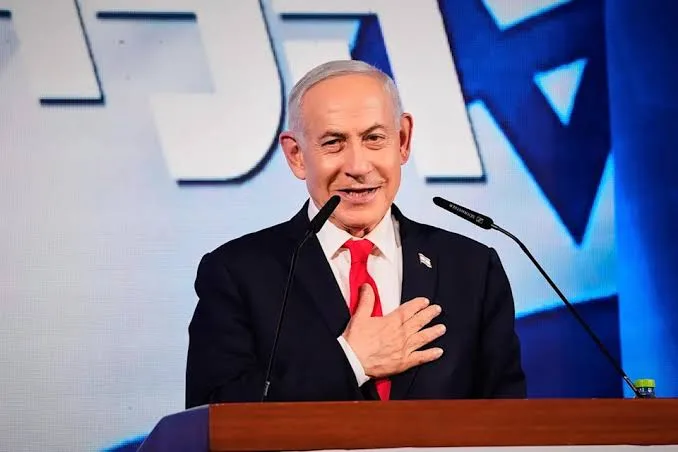






Benjamin Netanyahu’s position in the post-election battle to stay on as Israel’s prime minister weakened on Thursday after an ultra-Orthodox Jewish party withheld support for any nominee and an Arab-led party endorsed his main opponent.
Israel’s president was due to meet Netanyahu and his chief political rival Gadi Eisenkot to decide which of the two men to pick to form a government, after holding consultations with smaller parties.
Israel’s October 27 election ended in deadlock with neither Netanyahu nor Eisenkot, a former military chief, securing a clear path to a majority in parliament.
That has set up a tough task for President Issac Herzog, whose mostly ceremonial role comes with the post-election responsibility of picking a candidate he believes has the best chance to break the deadlock in a deeply divided country.
Herzog has until November 11 to decide. Netanyahu remains prime minister in a caretaker government until a new coalition is formed, or through another election which must be held if no candidate succeeds.
Though Netanyahu outperformed expectations in the vote and his own Likud Party won the most seats, his nationalist-religious coalition lost its governing majority.
In a setback for the prime minister on Thursday, United Torah Judaism, one of two major parties representing ultra-Orthodox Jewish voters and a longstanding Netanyahu coalition ally, declined to recommend any candidate to form a government.
And while Eisenkot, like Netanyahu, has so far ruled out forming a government with Israel’s two Arab-led parties, one of them endorsed Eisenkot on Thursday and the other was expected to do so later in the day.
Herzog will meet separately with Eisenkot and Netanyahu at his residence in Jerusalem on Thursday night, wrapping up party meetings he started on Wednesday after the announcement of official election results.
Netanyahu, at risk of losing power, has seized onto an investigation by election officials into possible vote tampering to cast doubt on the results, accusing Arab-led parties of stealing the vote. Critics accuse Netanyahu and his partners of trying to undermine the results, which he denies.
Israel’s Central Election Committee said on Wednesday that the election’s integrity had not been compromised. The head of the committee, Supreme Court Justice Noam Sohlberg, has called on Israel’s elected officials to protect public trust, rather than shake it.
“This is a real danger. One of the foundations of democracy is the peaceful transfer of power,” Sohlberg told Herzog at his residence on Wednesday. High voter turnout, including among the Arab minority, was a blessing, he said.
Netanyahu’s allies on the far-right, including National Security Minister Itamar Ben-Gvir, have called for the immediate arrest and interrogation of Arab party leaders.

