




Turkey’s government has asked parliament to ratify a mutual defense agreement it signed with Saudi Arabia and Pakistan, bringing the country closer to bolstering Saudi defenses as it faces attacks from Iran-backed Houthi rebels.
Mirroring NATO’s Article 5, the so-called Mecca Joint Defense Agreement commits the sides to view an armed attack against one as an attack on all three.
While Turkey says that it’s considering sending military support to Saudi Arabia, officials have cautioned that the pact is defensive in nature and that no Turkish troops will be deployed to fight in Yemen or attack the Houthis.
Turkish and Pakistani officials have also insisted that the pact isn’t against Iran or any other country, but haven’t said how they would react if attacked by Iran.
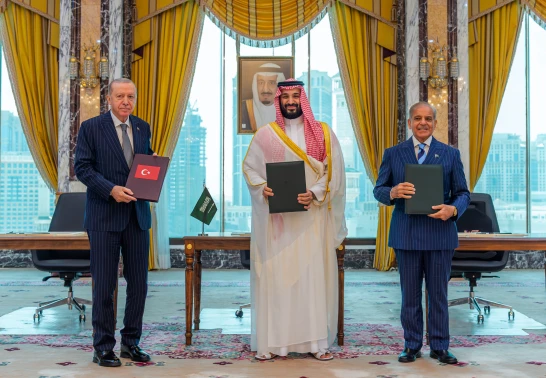
The agreement was signed in the Saudi holy city of Mecca in August by Saudi Crown Prince Mohammed bin Salman, Turkish President Recep Tayyip Erdogan and Pakistani Prime Minister Shehbaz Sharif with the aim of increasing co-operation and deterrence among the three regional heavyweights at a time of increased uncertainty amid the Iran war.
It brings together oil-rich Saudi Arabia and nuclear power Pakistan as well as Turkey, which has NATO’s second-largest army and a rapidly growing defense industry.
It enables the three to take greater charge for their own security at a time of reduced US involvement.
For Pakistan, the Mecca Agreement builds on existing military ties with Riyadh. Saudi Arabia and Pakistan signed a separate mutual defense agreement in September 2025.
Pakistani Foreign Minister Ishaq Dar has repeatedly said that the Mecca agreement doesn’t replace existing agreements and is open to other countries willing to uphold its principles and resolve differences peacefully.

