









Yemen’s Iran-backed Houthi rebels are attempting to build a new advanced medium-range ballistic missile system with the help of Chinese parts, according to a new report released by a group that tracks the use of weapons in conflict zones.
The report by the UK-based Conflict Armament Research group came as the Houthis, in their ongoing war with Saudi Arabia, are demonstrating remarkable ability to wreak havoc on one of the Middle East’s best equipped militaries.
The weaponry under development could help the group more precisely target the Saudis and Israel. By turning to China, it also appears to be a sign of increasing independence.
The Houthis have tried to acquire key parts from Chinese suppliers that could be used to make a version of Iran’s Kheibar Shekan precision-guided missile, according to the report. The Kheibar Shekan has a range of roughly 1,200 miles (2,000 kilometers).
“The local ambition of the Houthis for manufacturing is beyond what was previously assumed,” said Fabian Hinz, a senior analyst at Conflict Armament Research, a research outfit specializing in tracing the flow of arms in war zones around the globe. “These types of parts are very specific, and producing them would have required design information related to the missile.”
They’re “not goods that can be used for a variety of civilian applications,” Hinz said.
Liu Chang, a spokesperson for the Chinese Embassy in Washington, did not address the specific findings of the Conflict Armament report, but maintained that Beijing was fulfilling its “international obligations.”
“China has always adopted a prudent and responsible approach to the export of military products and strictly controls the export of dual-use items,” Chang said in a statement.
China is a major purchaser of both Iranian and Saudi oil and leveraged its ties with both countries to broker a rapprochement in 2023. It has condemned a series of attacks on Saudi airports by the Houthis and called for a de-escalation in the fighting.
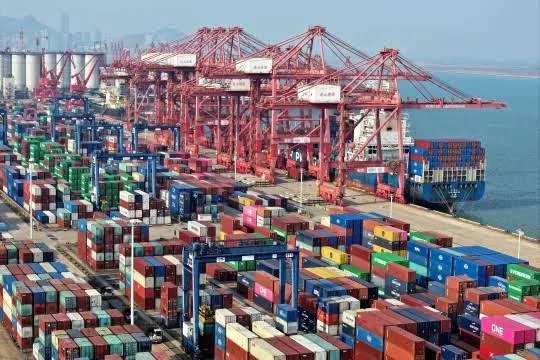
Saudi Arabia and Yemen’s government launched a military campaign last month aimed at driving back the Houthis from the Bab el-Mandeb Strait, a critical Middle East trade route for oil and other goods.
The Conflict Armament report was based on information released by Yemeni government authorities in July after officials interdicted two shipments that included suspicious equipment.
The shipments originated from China and were intended to be delivered to Hodeidah, a Yemeni port that Israeli officials say has been commonly used by the Iranians as a weapons transfer point. China accounts for the largest share of seized shipments destined for the Houthis, according to UN reports.
Components integral to the functioning of a missile were among the parts found in the cargo. They included stabilizing fin cores, rocket motor aft closures with nozzle attachments, and rocket motor igniters.
The cargo also contained phenolic resin, a material used in creating ablative heat shields. These shields protect ballistic missiles from the intense heat associated with atmospheric flight at high supersonic speeds, the report said.
Hinz said that the combination of materials made clear that the Houthis intended to assemble that specific type of Iranian-designed missile.
“This particular type of system is very difficult to smuggle. And you can’t just disassemble and reassemble them,” he said.
The Houthis rose to prominence more than 20 years ago as an insurgent group armed with Soviet-era and North Korean weapons seized from the Yemeni government’s military.
But over the years, the group’s access to advanced weaponry has expanded and so has its ability to menace neighbors.

