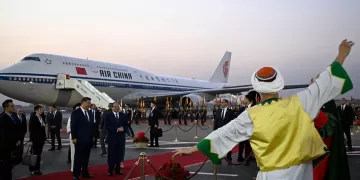





Egyptian President Abdel Fattah El-Sisi is holding expanded talks Wednesday, September 2, at the Ittihadiya Palace with Chinese President Xi Jinping, who arrived in Cairo on Tuesday, September 1, for an official visit, his first in 10 years.
The visit coincides with the 70th anniversary of the establishment of diplomatic relations between Cairo and Beijing.
The talks with Xi in Cairo come amid an announced focus on advancing the Egyptian-Chinese partnership.
According to the Egyptian presidency, the visit includes “following up on the implementation of the comprehensive strategic partnership agreement concluded between the two countries in 2014, as well as consultations on several regional and international issues of common interest.”
Regional and international developments are set to feature on Xi’s agenda in Cairo and in his meeting with Sisi, particularly Gaza, the Middle East, the Red Sea, and the Nile River.
The future of the international system and relations among countries in the Global South are also expected to be featured.
The timing of the visit is sensitive for Cairo, which is operating in a turbulent regional environment stretching from Israel’s war on Gaza and its repercussions to Sudan and the Red Sea, as well as the continuing dispute with Ethiopia over the Grand Ethiopian Renaissance Dam.
At the same time, Egypt is seeking to expand its international room for manoeuvre by strengthening its relations with China and other powers, without abandoning its strategic partnership with the United States.
The Palestinian issue appears to be the most prominent regional file bringing the Egyptian and Chinese positions together, which will be reflected in Xi’s talks in Cairo.
This comes as Egypt has a direct role in mediation and arrangements concerning the Gaza Strip, while China occupies a different position as a permanent member of the UN Security Council.
In an article translated into Arabic and published by Egypt’s Al-Ahram newspaper on Tuesday on the occasion of the visit, Xi wrote that “both sides firmly support the just cause of the Palestinian people in restoring their legitimate rights and seek political solutions to hot-button issues and the achievement of peace and stability in the region.”
Egyptian sources told The New Arab that Sisi and Xi will discuss developments in Gaza, the future of political and security arrangements in the Strip and reconstruction.
They will also discuss the repercussions of regional conflicts on maritime security and developments related to Iran and the Gulf.
The war in Sudan will also be discussed, as it is a crisis that intersects with the security of the Red Sea and the Horn of Africa, according to the sources.
Maritime stability is a direct interest for both countries.
Egypt is concerned with protecting the Suez Canal and its interests in the Red Sea, while China relies on the region as a major route for its trade with Europe.
On the Nile and the Ethiopian Grand Ethiopian Renaissance Dam, the issue most directly related to Egyptian national security, Sisi was keen, in an article published in Al-Ahram on Tuesday, to point to the Chinese position calling for the avoidance of unilateral measures.
He wrote that “Egypt highly appreciates China’s position, which affirmed its recognition of the vital importance of the Nile River to Egypt as its main lifeline and renewed the importance of refraining from taking unilateral measures and strengthening co-operation in good faith to achieve mutual benefit and win-win co-operation.”
The message takes on significance ahead of Xi’s talks in Cairo because of China’s close relations with Ethiopia.
This makes Beijing an important international party for Cairo in its efforts to establish the principle of not harming the water interests of downstream countries.
Cairo does not appear to be seeking an explicit Chinese alignment against Ethiopia as much as it seeks to strengthen the Chinese position, calling for negotiations, consensus and the rejection of imposing a fait accompli.
This position could provide Egypt with diplomatic leverage in any future move concerning the Nile waters.
Although Sudan does not appear to be a main theme of the visit, its geographic location makes it part of Egyptian and Chinese calculations regarding the Red Sea and Africa.
Egypt is concerned with preserving Sudan’s unity and stability and preventing the repercussions of the war from reaching its borders and interests.
China, meanwhile, has economic and political interests in Sudan and the African continent.
According to experts, Cairo has maintained its strategic relations with Washington in recent years while expanding its relations with Beijing, Moscow, Europe and other powers.
However, Xi’s visit to Egypt allows Cairo to strengthen what Sisi calls “strategic balance” by developing deeper relations with a major international power.
It also allows Egypt to benefit from China’s permanent membership of the UN Security Council and its economic and political weight.
In his article on Tuesday, Sisi wrote that Egypt had adhered to “a policy of strategic balance as a direction for Egyptian foreign policy at a time when waves of polarisation and competition are rising, affirming its independent foreign policy and calling for the international community to coordinate its efforts to overcome global challenges that have come to threaten the entire world.”
In the same article, Sisi stressed that Egypt and China had become “partners contributing together to strengthening the role of the Global South in the global system in a way that achieves greater justice and fairness for developing countries.”
In this regard, the future of the international system is likely to be one of the issues raised during Xi’s talks in Cairo.
The issue is important for Cairo because of its membership in the BRICS group, founded in 2006 by Brazil, Russia, India and China.
Egypt, the UAE, Iran, Ethiopia and Indonesia joined the group during 2024 and 2025.
Cairo is also engaged in various multilateral frameworks, while Beijing sees Egypt as a partner that can help expand Chinese co-operation with the Arab world and Africa.
In this regard, former Egyptian ambassador to Beijing Ali El-Hefny told The New Arab that the importance of the visit and Xi’s talks in Cairo was not linked only to the strength of bilateral relations but also to the circumstances facing the region and the world.
He explained that there was a clear convergence between the Egyptian and Chinese visions regarding the importance of stability in the region.
El-Hefny added that the repercussions of wars and conflicts in the Middle East do not stop at the borders of the countries where they take place but extend to the global economy and the interests of international powers, including China.
In his view, Egyptian-Chinese relations can form an important basis for supporting stability.
He noted that the partnership between the two countries should not be limited to the economic sphere, but could be expanded to include technology, industry, investment, infrastructure and other sectors that serve development plans.
El-Hefny stressed that maintaining stability is the condition through which these ambitions can be achieved.
For his part, former Egyptian assistant foreign minister Mohamed Hegazy said the Chinese president’s visit to Egypt carries political and economic importance, particularly amid growing international polarisation and rising regional tensions.
He said these circumstances create a need to expand areas of co-operation without becoming involved in specific alliances or blocs.
Hegazy told The New Arab that what distinguishes relations between Cairo and Beijing is their historical foundation, which has allowed them to continue and develop despite changing international circumstances.
He considered China’s current rise in influence to be, in part, a return to a global position it had historically occupied.
He added that Egypt’s geographic location, political weight and ties with the Arab world and Africa give it a particular ability to develop its partnership with China.
This means the partnership does not have to remain confined to the bilateral framework but can extend to Egypt’s regional surroundings.
In his view, the challenge during the next phase is to turn seven decades of trust and understanding between the two countries into more influential practical partnerships.
Such partnerships can offer a more balanced model for co-operation among countries around the world.

