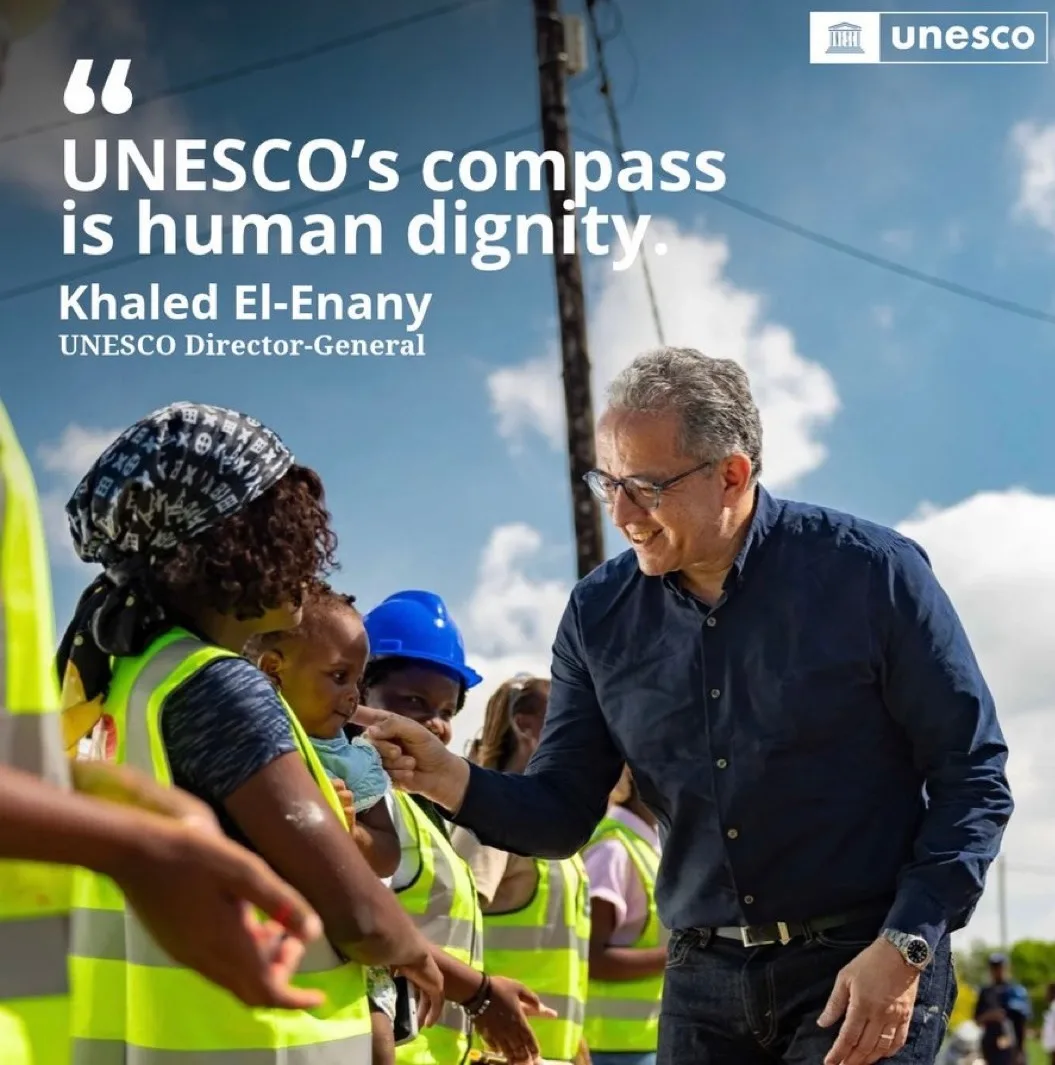







UNESCO Director-General Khaled El-Enany has reaffirmed the organisation’s role in promoting peace, fostering dialogue and boosting international co-operation, stressing that human dignity must remain at the heart of its work.
In an interview marking the 80th anniversary of UNESCO’s Constitution, El-Enany said the organisation’s mission was to turn its founding principles into practical action that improves people’s lives.
He recalled that his relationship with UNESCO began in the early 1990s, when he worked as a tour guide in Egypt. Visits to Abu Simbel, which he described as his favourite temple, gave him first-hand insight into the power of international cooperation.
The temple is among the most prominent achievements of UNESCO’s International Campaign to Save the Monuments of Nubia, launched between 1960 and 1980. The experience inspired El-Enany to devote his master’s thesis to the Ramesside temples of Nubia and explore the organisation’s global impact.
He later worked alongside UNESCO professionals as an academic, museum director and minister. These experiences strengthened his belief that the organisation’s greatest strength lies in translating its ideals into tangible results.
Reflecting on UNESCO’s achievements since its establishment in 1946, El-Enany said it had become a global platform for knowledge, dialogue and international co-operation. Its work has helped expand access to education, combat illiteracy, protect cultural heritage, defend press freedom and promote scientific research.
He highlighted landmark initiatives, including the International Campaign to Save the Monuments of Nubia, the establishment of the Pacific tsunami early warning system, and programmes addressing biodiversity and water resources.
He also pointed to UNESCO’s international conventions on cultural and natural heritage, describing them as essential tools for protecting humanity’s shared legacy.
Addressing the rapid development of artificial intelligence, El-Enany said UNESCO must help ensure that technological progress serves humanity and does not deepen existing inequalities.
He cited the organisation’s 2021 Recommendation on the Ethics of Artificial Intelligence, noting that UNESCO was working with nearly 80 member states to translate its principles into practical policies.
He stressed the importance of digital education, media literacy and public awareness. Particular attention, he said, must be given to protecting children and young people while enabling them to benefit from technological advances.
Looking ahead, El-Enany said UNESCO would focus on helping societies address technological, environmental, demographic and geopolitical changes. Its priorities include strengthening inclusive education, supporting scientific research, promoting culture as a driver of social cohesion and defending freedom of expression and access to information.
He also underlined the importance of closer cooperation with member states, civil society, the private sector and international partners.
UNESCO’s global network includes more than 10,000 Associated Schools, research centres, UNESCO Chairs, Creative Cities and Learning Cities, as well as around 2,300 sites inhabited by nearly 900 million people.
El-Enany concluded that UNESCO’s mandate was more important than ever. He pledged to make the organisation more integrated, responsive and closely connected to communities, with a stronger focus on delivering tangible improvements to people’s lives and advancing peace and humanity.

