



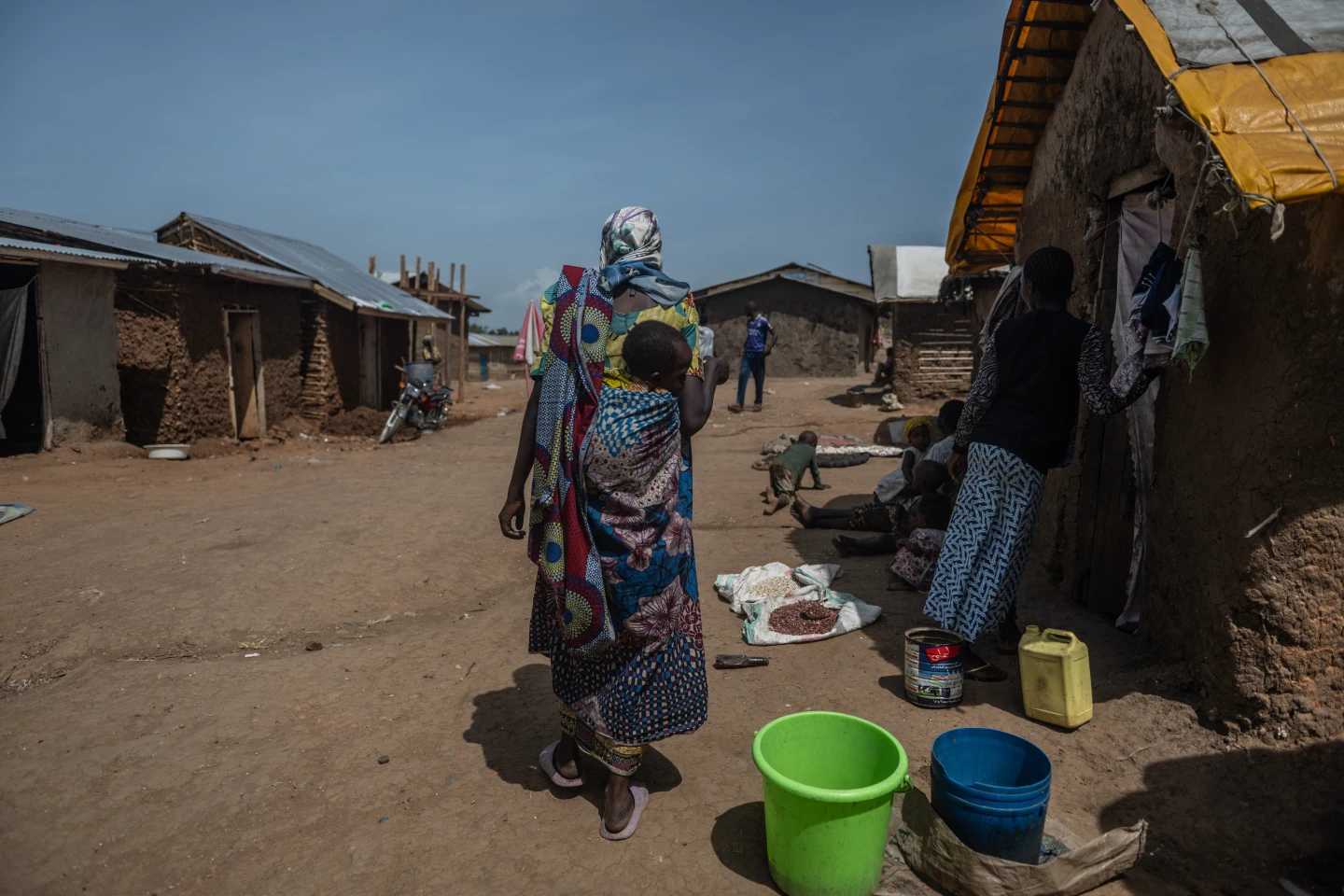
There is one handwashing station and one infrared thermometer to fight the Ebola epidemic in a camp for 10,000 displaced people in Bunia, a city at the heart of the outbreak in eastern Congo.
Camp leaders say they tell residents to wash their hands before eating — with soap for the lucky ones who have it. For the rest, the advice is to use oatmeal or sand.
“My fear is that we are here with nothing to protect ourselves. We have no protection, no water or soap, and we live near garbage,” Francine Leve Janguzi, a resident of the so-called ISP camp told The Associated Press, as she opened an empty tap in a sea of tarpaulin roofs.
Supplies are being rushed to Ituri province as aid groups and healthcare workers try to stem an outbreak of the infectious disease that has been declared a global health emergency.
But front-line responders are concerned the disease might spread to the large displacement camps located near Bunia, where thousands of people are crammed into limited space, without access to basic hygiene.
“Eastern DRC’s years of conflict and displacement have left health systems on their knees, and that makes containing this outbreak all the harder,” said Heather Kerr, Congo director with the International Rescue Committee.
Almost a million people have been displaced from their homes by conflict in Ituri, according to the UN.
That means this Ebola outbreak is “unfolding in communities already facing insecurity, displacement and fragile healthcare systems,” said Gabriela Arenas, a regional coordinator at the International Federation of Red Cross and Red Crescent Societies.
The majority of residents of the ISP camp — which owes its name to its proximity to the Higher Pedagogical Institute, or Institut Superieur Pedagogique in French — were forced to leave their villages in the Djugu territory following attacks by CODECO, one of the multiple armed groups which operate in the region.
“I’ve been here for eight and a half years. Now we’re hearing about Ebola,” camp resident Janguzi said. “Look at the state of where we’re sleeping. We don’t have any help whatsoever. We don’t have soap or water, yet we’re told to wash our hands regularly and be clean.”
There is no vaccine or treatment for the rare Bundibugyo type of Ebola, which has been spreading undetected for weeks in eastern Congo. Standard tests struggle to detect the Bundibugyo.
Over 1,000 suspected cases and at least 220 deaths had already been recorded as of Tuesday, including seven confirmed cases in Uganda. But the World Health Organization and aid groups on the ground say the outbreak is much larger.
Ebola is a highly contagious virus and can be contracted from bodily fluids such as vomit, blood or semen. The disease it causes is rare but severe and often fatal. Symptoms include fever, headache, muscle pain, weakness, diarrhea, vomiting, stomach pain and unexplained bleeding or bruising.
Eastern Congo has for years seen attacks by dozens of separate rebel and militant groups, some of them with links to foreign countries or the extremist Islamic State group.

