

• Latest
  • Trending
  • All
  • Egypt
  • Business
  • Local
  • World
Moon-forming region seen around planet in another solar system

Moon-forming region seen around planet in another solar system

July 23, 2021
Hezbollah, Israel, drones

Hezbollah adopts a new weapon: Fiber-optic drones

April 30, 2026
Trump hails new Iraq ties; invites PM to Washington

Trump hails new Iraq ties; invites PM to Washington

April 30, 2026

UK terror threat raised to ‘severe’ after stabbings

April 30, 2026
UK terror threat raised to ‘severe’ after stabbings

UK terror threat raised to ‘severe’ after stabbings

April 30, 2026
Hegseth: Opposition at home is Trump’s greatest adversary in Iran war

Hegseth: Opposition at home is Trump’s greatest adversary in Iran war

April 30, 2026
Egypt&global trade

Egypt strengthens position in global trade network

April 30, 2026

President Sisi inspects NERC factory

April 30, 2026
US sends 6,500 tons of arms to Israel in 24 hours

US sends 6,500 tons of arms to Israel in 24 hours

April 30, 2026
Gaza flotilla: 211 kidnapped, 22 boats seized by Israel

Gaza flotilla: 211 kidnapped, 22 boats seized by Israel

April 30, 2026
Minister of Labour

Egypt expands job creation, prepares digital employment platform

April 30, 2026
  • Advertise
  • Privacy & Policy
  • Contact
Friday, May 1, 2026
  • Login

Editor-in-Chief

Mohamed Fahmy

Board Chairman

Tarek Lotfy

Egyptian Gazette
No Result
View All Result
  • HOME
  • EGYPT
    • Local
    • Features
  • World
    • National Day
  • Technology
  • BUSINESS
    • Real Estate
    • Automotive
  • SPORTS
  • ENTERTAINMENT
    • Arts
    • Health
    • Lifestyle
    • Travel
  • Skyward
    • Snippets from EgyptAir history
  • MORE
    • Multimedia
      • Video
      • Podcast
      • Gallery
    • OP-ED
  • HOME
  • EGYPT
    • Local
    • Features
  • World
    • National Day
  • Technology
  • BUSINESS
    • Real Estate
    • Automotive
  • SPORTS
  • ENTERTAINMENT
    • Arts
    • Health
    • Lifestyle
    • Travel
  • Skyward
    • Snippets from EgyptAir history
  • MORE
    • Multimedia
      • Video
      • Podcast
      • Gallery
    • OP-ED
No Result
View All Result
Egyptian Gazette
No Result
View All Result
Home Technology

Moon-forming region seen around planet in another solar system

by News Wires
July 23, 2021
in Technology
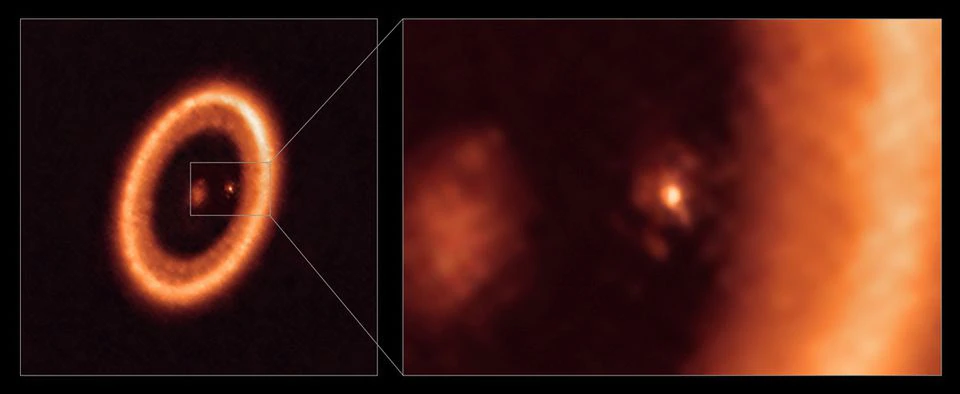
An undated image, taken with the Atacama Large Millimeter/submillimeter Array (ALMA), in which the European Southern Observatory is a partner, shows wide (left) and close-up (right) views of the moon-forming disc surrounding PDS 70c, a young Jupiter-like planet nearly 400 light-years away. The close-up view shows PDS 70c and its circumplanetary disc center-front, with the larger circumstellar ring-like disc taking up most of the right-hand side of the image. The star PDS 70 is at the center of the wide-view image on the left.

An undated image, taken with the Atacama Large Millimeter/submillimeter Array (ALMA), in which the European Southern Observatory is a partner, shows wide (left) and close-up (right) views of the moon-forming disc surrounding PDS 70c, a young Jupiter-like planet nearly 400 light-years away. The close-up view shows PDS 70c and its circumplanetary disc center-front, with the larger circumstellar ring-like disc taking up most of the right-hand side of the image. The star PDS 70 is at the center of the wide-view image on the left.

Share on FacebookWhatsapp

Scientists for the first time have spotted a moon-forming region around a planet beyond our solar system – a Jupiter-like world surrounded by a disk of gas and dust massive enough that it could spawn three moons the size of the one orbiting Earth, Reuters reported.

The researchers used the ALMA observatory in Chile’s Atacama desert to detect the disk of swirling material accumulating around one of two newborn planets seen orbiting a young star called PDS 70, located a relatively close 370 light years from Earth. A light year is the distance light travels in a year, about 5.9 trillion miles (9.5 trillion km).

It is called a circumplanetary disk, and it is from these that moons are born. The discovery, the researchers said, offers a deeper understanding about the formation of planets and moons.

More than 4,400 planets have been discovered outside our solar system, called exoplanets. No circumplanetary disks had been found until now because all the known exoplanets resided in “mature” – fully developed – solar systems, except the two infant gas planets orbiting PDS 70.

“These observations are unique – so far – and have been long waited for, in order to test the theory of planet formation and directly observe the birth of planets and of their satellites,” said astronomer Myriam Benisty of the University of Grenoble, who led the study published on Thursday in the Astrophysical Journal Letters.

In our solar system, the impressive rings of Saturn, a planet around which more than 80 moons orbit, represent a relic of a primordial moon-forming disk, said study co-author Stefano Facchini of the European Southern Observatory.

The orange-colored star PDS 70, roughly the same mass as our sun, is about 5 million years old – a blink of the eye in cosmic time. The two planets are even younger.

Both planets are similar (although larger) to Jupiter, a gas giant that is our solar system’s biggest planet. It was around one of the two planets, called PDS 70c, that a moon-forming disk was observed. Researchers previously had found initial evidence of a disk around this planet, but now have confirmed it.

Both planets are “still in their youth,” Facchini said, and are at a dynamic stage in which they are still acquiring their atmospheres. PDS 70c orbits its star at 33 times the distance of the Earth from the sun, similar to the planet Neptune in our solar system. Benisty said there are possible additional so-far undetected planets in the system.

Stars burst to life within clouds of interstellar gas and dust scattered throughout galaxies. Leftover material spinning around a new star then coalesces into planets, and circumplanetary disks surrounding some planets similarly yield moons.

The dominant mechanism thought to underpin planet formation is called “core accretion,” said study co-author Richard Teague of the Harvard-Smithsonian Center for Astrophysics.

“In this scenario, small dust grains, coated in ice, gradually grow to larger and larger sizes through successive collisions with other grains. This continues until the grains have grown to a size of a planetary core, at which point the young planet has a strong enough gravitational potential to accrete gas which will form its atmosphere,” Teague said.

Some nascent planets attract a disk of material around them, with the same process that gives rise to planets around a star leading to the formation of moons around planets.

The disk around PDS 70c, with a diameter about equal to the distance of the Earth to the sun, possesses enough mass to produce up to three moons the size of Earth’s moon. It is unclear how many will form, if any.


Tags: EarthJupiterMoonPlanet

Discussion about this post

ADVERTISEMENT
egyptian-gazette-logo

The Egyptian Gazette is the oldest English-language daily newspaper in the Middle East.
It was first published on January 26, 1880 and it is part of El Tahrir Printing and Publishing House.

Follow Us

Gazette Notifications

Would you like to receive notifications on our latest news ?

  • Advertise
  • Privacy & Policy
  • Contact

Copyrights for © Egyptian Gazette - Administered by Digital Transformation Management.

Welcome Back!

Login to your account below

Forgotten Password?

Retrieve your password

Please enter your username or email address to reset your password.

Log In
No Result
View All Result
  • HOME
  • EGYPT
    • Local
    • Features
  • World
    • National Day
  • Technology
  • BUSINESS
    • Real Estate
    • Automotive
  • SPORTS
  • ENTERTAINMENT
    • Arts
    • Health
    • Lifestyle
    • Travel
  • Skyward
    • Snippets from EgyptAir history
  • MORE
    • Multimedia
      • Video
      • Podcast
      • Gallery
    • OP-ED

Copyrights for © Egyptian Gazette - Administered by Digital Transformation Management.

This website uses cookies. By continuing to use this website you are giving consent to cookies being used. Visit our Privacy and Cookie Policy.