


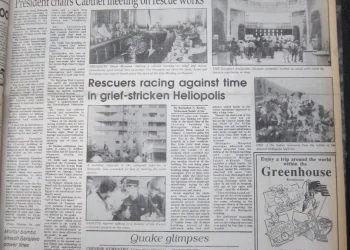
Death toll rising: Mubarak inspects ill-fated Heliopolis tower
CAIRO, Oct. 14, 1992 — President Hosni Mubarak chaired a Cabinet meeting on relief efforts yesterday, cutting short his Asian ...
Editor-in-Chief
Board Chairman

CAIRO, Oct. 14, 1992 — President Hosni Mubarak chaired a Cabinet meeting on relief efforts yesterday, cutting short his Asian ...
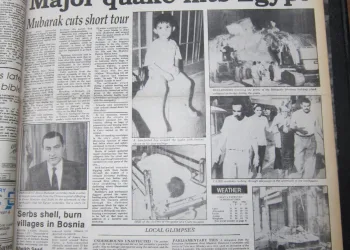
Cairo, Oct. 12, 1992 — The most powerful earthquake in Egypt's history struck Cairo, killing 241 and injuring 2,000, with ...
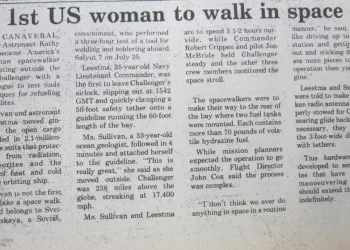
CAPE CANAVERAL, Oct. 11 — Astronaut Kathy Sullivan became America's first woman spacewalker today, floating outside Shuttle Challenger with colleague ...

At the entrance to the weapons square at the 6th of October Panorama, visitors quickly realise they are standing before something unusual. Large tanks, artillery pieces and other military equipment once used by Israel now stand silent. They no longer move or fire. Instead, they tell the story of a war through their presence. The weapons are displayed tilted towards the ground, a scene that carries a meaning beyond history. These machines were built for movement and attack. Today, they stand still as reminders of the 1973 October War. The manner of display also carries symbolic meaning in military tradition. A weapon raised upwards is often associated with strength, readiness and pride. One turned towards the ground suggests the opposite: it can symbolise the end of fighting and the loss of combat capability. A tank that once moved across Sinai as part of a combat formation now stands motionless before visitors. An artillery piece that once fired on the battlefield has become a historical exhibit that can be viewed up close. The weapon is no longer an instrument of war. It has become a record of history. From battlefield to memory The Panorama’s weapons square houses a collection of Israeli military equipment captured during the 1973 October War. The exhibits include M60 and M48 tanks, 155mm towed howitzers and anti-tank recoilless rifles. The site also displays the remains and wreckage of Israeli aircraft linked to battles during the War of Attrition and the October War. For generations born after the war, it can be difficult to grasp the scale of the conflict through books and history lessons alone. Standing before a tank that actually took part in the war makes the story more tangible. Its size, firepower and physical presence offer a clearer sense of the battlefield and the scale of the fighting. The weapons square has thus become an open-air military archive, preserving part of a war that remains an important chapter in Egypt’s modern history. A visit to the Panorama offers a glimpse into a story that began before October 6, continued through the War of Attrition and reached its defining moment with the crossing of the Suez Canal and the campaign to reclaim Sinai. Opposite the captured weapons stand Egyptian military vehicles and weapons used during the war, displayed upright and prominently. The contrast is striking. One side shows weapons that were brought to a halt on the battlefield. The other recalls the soldiers who carried their weapons and fought with determination and a willingness to sacrifice. In the silence of these weapons, the story of the crossing continues to be told.
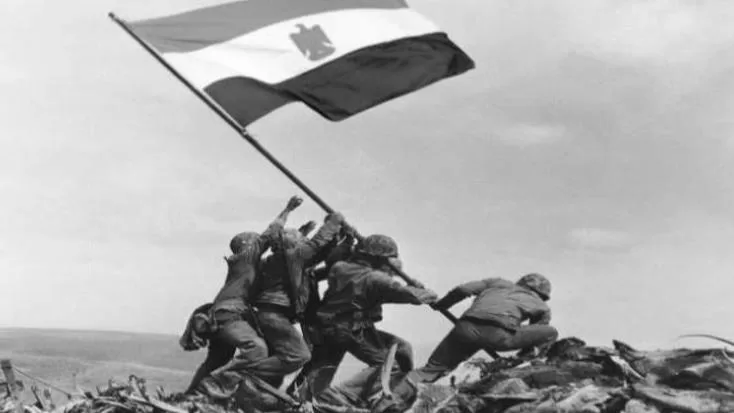
What the secret files finally reveal The pages of The Egyptian Gazette reveal documents and records that were kept strictly secret for decades. They include papers signed by Field Marshal Mohamed Abdel Ghani El-Gamasy, then Deputy Chief of Staff of the Armed Forces and Chief of the Operations Authority, as well as official reports sent to the Military Intelligence and Reconnaissance Administration and the Ministry of War. The Gazette publishes these records to tell the story as it was documented at the time, from attacks on Egyptian villages and cities to the strategic planning behind the crossing and detailed combat records. Attacks on civilians and vital facilities Egyptian villages, cities and public facilities across several governorates were hit by Israeli air and artillery attacks. Secret telegrams documented details of these attacks. Israeli forces launched machine-gun attacks and air raids using bombs and booby traps against the villages of Sheikh Gabil, Beni Ayoub, Al-Wafin, Muslim, Al-Hamaida, Al-Rifai, Al Wishah and Kafr Hafez in Abu Hammad, Sharqia Governorate. The attacks killed and wounded men, women and children and set fire to agricultural land. The records listed six 700-pound bombs and one 1,000-pound bomb that failed to explode. Residents of the villages of Manshiyet Abu Omar, Om El-Hosn, Om Azzam and Kafr El-Husseiniya were also killed or wounded in an air raid on El-Salheya in Faqous. Two houses in Faqous were destroyed, killing a woman and her three children. Bombs were also found buried in rice fields following raids on El-Salheya and El-Husseiniya. In Daqahlia Governorate, the village of Manshiyet Abdel Rahman in Dikirnis was hit by an air raid that destroyed 30 houses, started fires and killed and wounded civilians. Bombs also exploded in Al-Abrak village in Mansoura, causing deaths and injuries and damaging telephone lines. Air raids targeted Lake Manzala, hitting a number of fishermen and civilians. Other attacks caused deaths and injuries in the areas of El-Senbellawein and Baltas. In Beheira Governorate, bombs were dropped on Ezbet Gelousa in Shubrakhit, damaging houses and telephone lines. Missiles and unidentified objects that failed to explode fell on the villages of Al-Qaraya Al-Bahariya, Wakae, Danal and Al-Sharatwa in Abu Hommos. Shells also fell near Kafr El-Zayat. Israeli forces bombed Ismailia, particularly the village of Nafisha, where four houses were destroyed. Houses in the Ain Ghosain area were also bombed. The areas of Al-Dawawis and Al-Basalwa were targeted with bombs and surface-to-surface missiles, causing deaths and injuries and damaging agricultural land. The air raids were particularly heavy, followed by low-level flights and machine-gun fire against civilian targets. In Port Said and Port Fouad, the bombing damaged and cut the main drinking-water lines supplying Port Said near El-Gamil and along the Ismailia road. Continuous air and artillery attacks lasting 11 hours, using 1,000-pound bombs and incendiary missiles, targeted the Investment Tunnel, the petroleum station, the naval shipyard dock and the General Hospital. Fire broke out at the Minya Police Station, while buildings in the Arab District were destroyed. In Port Fouad, heavy bombing destroyed two fire engines and wounded firefighters and civilians. In Gharbia and Menoufia governorates, 750-pound bombs fell on agricultural land in Mahalla El-Kubra. Bombs also hit Kafr El-Zayat and Basyoun, while civilians were killed in Tanta and Mahalla El-Kubra. In Quesna, Menoufia, 30 time bombs were found. Their fragments had been designed to cause maximum human casualties. The bombing also caused deaths and injuries. In Damietta, enemy missiles targeted Ezbet El-Borg, Sheikh Dargham and Ras El-Bar, destroying bakeries, ambulances and Ras El-Bar Hospital. A wooden box containing jars of sulfuric acid was also found on the Damietta coast. The substance released toxic gas when heated. Two aircraft fired four missiles at the Zaafarana area in the Red Sea, causing deaths and injuries. Suez was also subjected to heavy bombing, which damaged El Nasr Fertilisers Company, petrol stations and the Suez cold-storage facility. Enemy tanks advanced as the bombing continued, while ambulances were prevented from entering the area. Israeli forces also stopped the water supply and filled in the Ismailia Canal in an attempt to put pressure on the city. They seized vehicles belonging to the Suez Canal Authority and the petroleum company and forcibly displaced residents from the villages of El-Ganayen, Geneifa, Fanar and Abu Sultan. Breaking the myth of the Bar Lev Line Documents from the Operations Authority reveal the military planning behind overcoming the complex defensive barriers. The objective was not limited to a military operation. It also involved creating political and economic conditions by using oil and economic relations, isolating Israel internationally, deepening its disputes with Washington and strengthening Arab unity. The aim was to force Israel to abandon its theory of “secure borders.” The ceasefire period that began in August 1970 was also used to build a network of anti-aircraft missiles. ...

WASHINGTON, Oct. 4, 1973 — President Nixon applied polite but firm pressure on Austria over its decision to close the ...
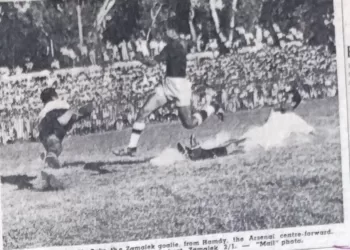
CAIRO, Sept. 29, 1956 — Arsenal, playing at home yesterday, beat Zamalek 2-1. The picture shows a splendid save by ...
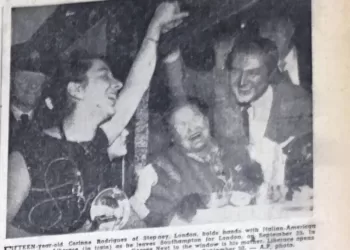
LONDON — Fifteen-year-old Corinne Rodriguez of Stepney, London, holds hands with Italian-American pianist Lee Liberace as he leaves Southampton for ...
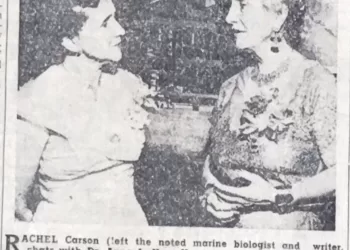
Sept. 26 — Rachel Carson, the noted marine biologist and writer, chats with Dr. Anna L. Rose Hawkes, president of ...
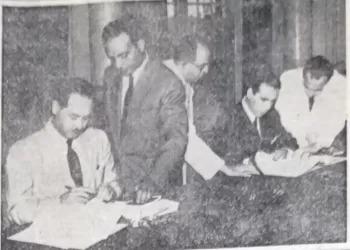
CAIRO, Sept. 24, 1956 — The modified trade agreement between Egypt and Libya was signed yesterday at the Foreign Ministry. Abdul ...


The Egyptian Gazette is the oldest English-language daily newspaper in the Middle East.
It was first published on January 26, 1880 and it is part of El Tahrir Printing and Publishing House.