




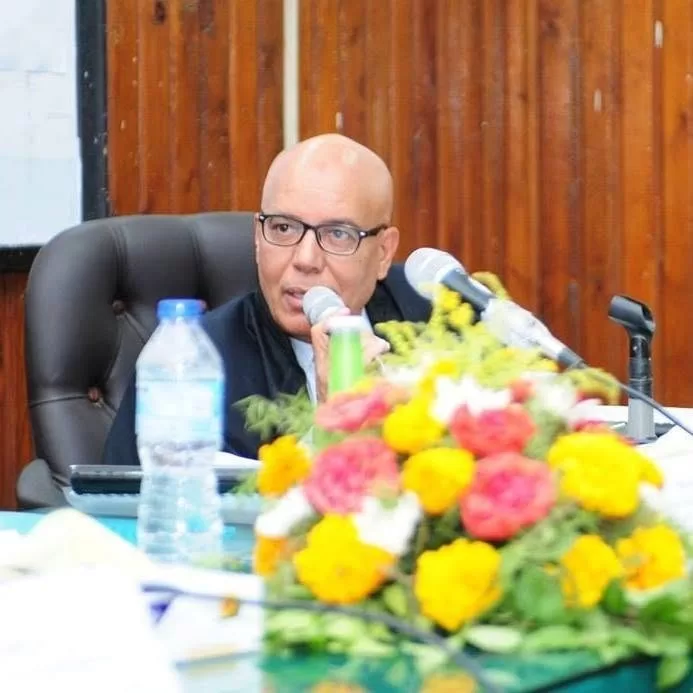
Professor Mahmoud Kamel
Artificial intelligence is no longer standing outside the translation classroom. It has already entered it. Students are using ChatGPT to translate, rewrite, correct and evaluate texts, while teachers are increasingly facing a new question: Should AI be considered a threat to translation education, or can it become a useful teaching assistant?
Chapter Five of Translation Studies in the Age of Artificial Intelligence, edited by Sanjun Sun, Kanglong Liu and Riccardo Moratto, offers an interesting answer to this question. Written by Simin Xu, Yifeng Sun, Yanfang Su and Kanglong Liu, the chapter presents an AI-powered translation platform that integrates ChatGPT into translation training, editing and feedback.
The importance of the chapter is that it does not discuss AI only in theory. The authors designed a practical platform and tested one of its main functions with translation students. The objective was not simply to show that ChatGPT can translate, but to investigate how students actually use AI feedback when revising their own translations.
From translation tool to teaching assistant
The platform has been designed for three connected purposes: translation practice, post-editing and translation evaluation. It is also intended to support empirical research in Translation Studies and to reduce part of the workload of teachers.
The platform has two main interfaces. The first is designed for students, while the second is intended for teachers and researchers. The student interface offers three main functions: English-Chinese translation, editing and translation evaluation. Students can compare the outputs of Google Translate, Youdao Translate and ChatGPT instead of depending on only one machine translation system. They can then select an output, edit it and use back-translation to compare the result with the original text.
This is an important change in the traditional use of machine translation. The student is not simply told: “Here is the translation.” Instead, the student is encouraged to compare, question, edit and evaluate.
The platform also allows students to give ChatGPT specific instructions. They can select goals such as grammar, cohesion, coherence, collocation, formality and intent. They can also identify the type of text, such as business, legal, news, academic or email, and specify the language direction. Additional prompts can be added for more personalised feedback.
In other words, the student is learning not only how to translate, but also how to communicate with an AI system.
The teacher is still in the picture
The administrator interface gives teachers and researchers a wider view of the students’ work. It can record the source text, the prompts given to ChatGPT, the target text, machine analysis and the students’ actions and time spent during the task. It can also bring together machine, teacher, peer and ChatGPT feedback.
This is particularly useful because feedback has always been one of the most important elements in translation education. A student does not improve simply by receiving a mark. The student needs to understand why a particular expression is weak and how it can be improved.
The platform, therefore, attempts to create a multi-layered feedback system. A student may receive feedback from a machine translation system, ChatGPT, classmates and the teacher. Such an approach can make students active participants in evaluation rather than passive receivers of corrections.
A small experiment with a big lesson
Perhaps the most interesting part of the chapter is its pilot study. Only two students participated, both enrolled in a Master’s programme in Translating and Interpreting at a university in Hong Kong. They were asked to translate a 173-word Chinese travel article within 70 minutes. One day later, they returned to the platform, read the ChatGPT-generated feedback and revised their translations. Their revision processes were recorded, followed by interviews about their experiences.
The two students did not use ChatGPT in exactly the same way.
Student A received 32 feedback points but used only 10 of them. He found some comments too general and felt that he needed more specific guidance. More importantly, when ChatGPT suggested translating a Chinese cultural term as “farmhouse restaurants”, he did not accept the suggestion immediately. He searched online and compared the alternatives before making his decision.
This is perhaps the kind of behaviour that translation education should encourage: Use AI, but do not surrender your judgement to it.
Student B had a different approach. She received 24 feedback points and followed most of the suggestions. She believed that ChatGPT had been trained on a large amount of data and could, therefore, deal with many genres, including travel writing. Unlike Student A, she did not use online sources to check the suggestions and did not make revisions beyond the feedback provided.
The difference between the two students is important. The effectiveness of AI does not depend only on the machine. It also depends on the learner.
Where ChatGPT performs well — and where it does not
Both students found ChatGPT useful mainly for surface-level linguistic problems. They mentioned spelling, formatting, sentence structure, word choice, morphosyntax and genre-related issues.
This is an area where AI can save teachers considerable time. Instead of correcting every spelling mistake or grammatical problem in a large class, the teacher can allow AI to provide an initial layer of feedback and then concentrate on more important issues.
But the study also exposes an important weakness. ChatGPT was not considered effective enough in dealing with cohesion and coherence. These are not merely grammatical matters. They concern how ideas are connected, organised and developed across a whole text.
The difference is fundamental. A machine may tell a student that a sentence is grammatically correct, but translation is not only about producing correct sentences. A good translation must also preserve meaning, context, tone, cultural references and the communicative purpose of the original. The chapter, therefore, argues for a balanced model in which AI deals with some lower-level problems while human teachers remain responsible for higher-order and creative aspects of translation.
The danger of trusting the machine too much
The students’ responses also reveal another problem: ChatGPT can sometimes provide incorrect or inconsistent feedback. Student A expressed reservations about its reliability, while Student B pointed to the importance of writing better prompts and interacting with the system more than once.
This means that “prompt engineering” may become part of translator education. Future translators may need to know not only how to translate a text, but also how to formulate precise instructions for AI, evaluate its answer and decide whether to accept, modify or reject it.
This changes the nature of translation competence. In the traditional classroom, students learn to produce translations. In the AI classroom, they must increasingly learn to select, evaluate and improve translations produced with technological assistance.
And here the human teacher remains essential.
A new partnership, not a replacement
The chapter does not present ChatGPT as a replacement for teachers. On the contrary, its conclusion calls for human oversight and warns against over-reliance on AI. The authors identify continuing problems with coherence, cohesion, consistency, creative texts and the emotional and motivational dimensions of learning.
A machine can provide immediate comments. It cannot fully understand the student’s anxiety, frustration or lack of confidence. It can identify a linguistic problem, but it cannot always explain the cultural reason behind a translation choice in the way an experienced teacher can.
For this reason, the future translation classroom may not be a classroom without teachers. It may instead be a classroom in which teachers and AI perform different but complementary functions.
AI can translate, compare, suggest, analyse and provide preliminary feedback. The teacher can explain, challenge, contextualise, motivate and make the final pedagogical judgement.
The real question, therefore, is not whether ChatGPT will replace the translation teacher. The more important question is whether translation teachers will learn how to use ChatGPT intelligently.
Chapter Five suggests that the answer should be yes – but with caution. AI should enter the translation classroom, but it should enter as a partner under human supervision, not as the new teacher.
By Dr Mahmoud Kamel
Professor at the Academy of Arts

