




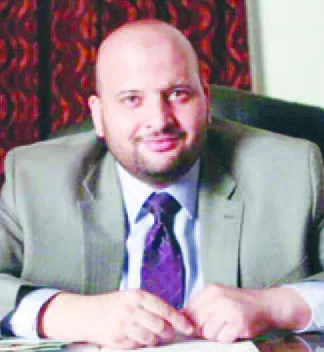
Ibrahim Negm
Since the fall of the last territorial strongholds of the so-called Islamic State in Iraq and Syria, a comforting illusion has quietly settled into global consciousness: that violent extremism is, at last, in retreat, and that the world can turn its attention to other emergencies. An honest reading of the last several years suggests the opposite. What we are witnessing is not the decline of extremism, but a full-scale redrawing of its map. The danger has not diminished – it has migrated, mutated, and taken on forms that are far more subtle, and considerably more difficult to confront.
Geographically, the epicentre of armed terrorism has shifted from the Middle East to Africa’s Sahel and its surrounding belt. In its most recent briefings, the United Nations Security Council has stated openly that the Sahel now accounts for nearly half of all terrorism-related deaths worldwide. Groups such as Jama’at Nusrat al-Islam wal-Muslimin, Islamic State West Africa Province and Boko Haram continue to expand their reach, forcing the closure of more than fourteen thousand schools, disabling hundreds of health facilities, and displacing millions of civilians.
Yet while this armed threat consolidates in the world’s most fragile spaces, another face of extremism has surged in the world’s most stable democracies. Across Europe and North America, far-right and populist movements are no longer a fringe phenomenon; they enter governments, shape coalitions, and pull mainstream parties into ever-harsher rhetoric against migrants and Muslims. Institutional hatred has become normalised.
Language once whispered at the margins is now spoken from parliamentary podiums.
We are, therefore, confronting a double-headed phenomenon: armed groups reproducing themselves in zones of state failure, and “institutional” hatred advancing at the heart of liberal democracies. Between these two wings, the moderate Muslim citizen finds themselves besieged — expected to answer for extremists who speak in the name of their faith while simultaneously enduring xenophobia that targets them for that same faith. This is not the picture of a defeated ideology. It is the picture of an ideology that has learned to travel.
A grave methodological error underlies much current policy: the tendency to conflate the dismantling of an armed structure with the dismantling of a worldview. It is true that ISIS lost its “state”, its major commanders, and much of its logistical apparatus. But it retained the one asset that mattered most — a distorted doctrinal system, and the ability to recruit through screens rather than through frontlines.
Institutional monitoring of anomalous fatwas and radical online content — including the work of Egypt’s Dar al-Ifta and its Global Fatwa Index — confirms that the ISIS narrative has metamorphosed into what is best described as a “low-intensity virus”. It circulates in short-form videos, anonymous posts, and “fatwas” published under pseudonyms, waiting to be absorbed by young minds burdened by economic pressure, cultural dislocation, or a crisis of meaning.
Militarily, the organisation has receded. Semantically, it has expanded. An idea, once released into a vacuum, does not require its original carrier to survive.
The most consequential transformation, however, is the fusion of this drifting extremist narrative with the tools of generative artificial intelligence. Recent reports by the UN Office of Counter-Terrorism document how extremist movements — from white-supremacist networks in the West to jihadist remnants in conflict zones — now deploy large language models and deepfake technologies to manufacture bespoke propaganda. They generate fake identities, translate incitement into dozens of dialects, and personalise their appeal with almost zero cost. The organisation no longer addresses a “public”; it now speaks to the specific teenager in Cairo, the university student in Tunis, the migrant in Berlin, and the marginalised youth in Bamako, each with a message tailored to their vulnerabilities. This “algorithmic propaganda” is arguably the most serious threat facing collective consciousness since the advent of satellite broadcasting, precisely because it does not merely persuade — it reshapes how the individual perceives themselves, their community, and their place in the world.
Confronted with this compounded threat, the traditional toolkit collapses. Security measures alone cannot suffice. Sermons alone cannot suffice. Seasonal media campaigns cannot match algorithmic engines that operate every hour of every day. What is required is an integrated civilisational response — an alliance in which the responsible religious institution supplies grounded, mainstream jurisprudence; the security establishment provides pre-emptive intelligence; the media builds credible counter-content in the digital languages of the young; and families and schools cultivate the moral immunity of the next generation.
The battle of our era will not be won solely in mountains and valleys. It will be won — or lost — in the quiet moment when an ordinary Muslim opens their phone and finds an anonymous “mufti” generated by an algorithm, offering an answer that no human scholar has ever spoken. Our responsibility, in religious and civic institutions alike, is to ensure that a wiser, more human voice reaches them first.
By Ibrahim Negm
Senior Advisor to the Grand Mufti of Egypt

