






Feeling Egypt’s living history
By Zhao Wencai
Even after more than two years in Egypt, I often feel different centuries unfolding simultaneously around me – not simply living in the present, but dwelling inside history itself.
Beyond the millennia-old pyramids and obelisks, Cairo alone offers an extraordinary journey through time. From the ancient walls of Babylon Fortress in Old Cairo to the Citadel dating back to the Ayyubid era, and then to the traditional Arab houses of the Ottoman period, the city seems to have found a way to slow down the passage of time.
Even first-time visitors can sense that history here moves to a different rhythm.
“Egyptians are rather set in their ways,” some of my friends have remarked. “Life here seems to have barely changed over time.”
Whenever I hear such comments, I usually smile and tell them: “Perhaps you just haven’t got to know Egypt well enough.”
Egypt does have a seemingly timeless side. Its ancient buildings, historic neighbourhoods, and customs handed down through generations all speak to a remarkable continuity of life.
But that is only half the story. There is another Egypt, one that is changing, evolving, and embracing modernity. And I have witnessed some of that change during my time here.
New Cairo bustles with modern shopping malls and commercial developments. Broad highways stretch across the landscape. New urban rail services have come into operation, while digital infrastructure and internet connectivity are steadily improving.
Look a little closer, and it becomes clear that, despite being situated in a region often beset by turbulence, Egypt is pressing ahead with its modernisation, with the fruits of development increasingly reaching ordinary people. Egypt, in other words, is anything but a country stuck in the past.
So what should we make of the Egypt that seems unchanging?
The answer, I believe, lies precisely in what gives the country its distinctive charm and what it has every reason to take pride in: its determination to keep history alive in its cities and in the everyday lives of its people.
History and cultural heritage help give a nation and a city their soul. If a nation’s development is a flourishing tree, its history is the root system beneath the surface, drawing sustenance from the past and providing the foundation upon which the future is built.
At a time when modern cities around the world are increasingly characterised by towering skyscrapers, sprawling shopping malls, and luxury hotels, it is a city’s historical legacy that ultimately lends it its distinctive character and sense of identity.
Egypt’s endeavor to preserve its historical heritage and keep it woven into the fabric of everyday life resonates deeply with my own country, China.
Also a nation whose civilisation stretches back thousands of years, China is seeking to chart its own course toward modernisation without severing its historical roots.
Through a series of policies and initiatives aimed at strengthening the integration of cultural heritage protection into urban development, the Chinese government has consistently called for the preservation of historic sites and buildings, while firmly discouraging short-sighted and destructive redevelopment.
Each year, considerable resources are devoted to the restoration and preservation of historic buildings and cultural relics across the country. This approach to urban development, one that seeks to preserve history rather than sweep it aside in the name of progress, has increasingly struck a chord with the public.
Just as growing numbers of visitors travel to Cairo to experience the grandeur of ancient Egyptian civilisation through its monuments and historic architecture, increasing numbers of people in China are drawn to historic buildings, museums, and heritage sites scattered across the country, where they can appreciate the ingenuity, craftsmanship, and cultural legacy of generations long past.
During my stay, I have seen Egypt commit to pursuing that same balance.
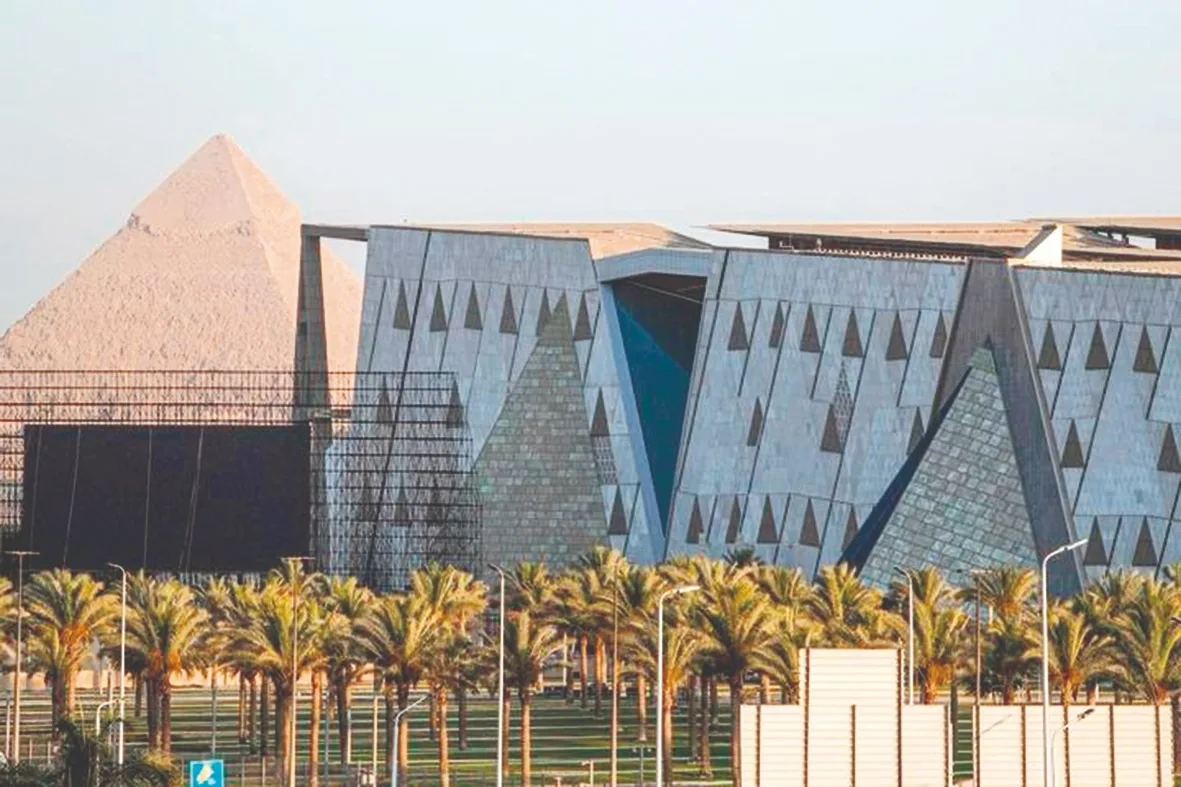
At the inauguration of the Grand Egyptian Museum (GEM) a year ago, Egyptian President Abdel Fattah El-Sisi spoke of how the museum “narrates for generations the story of a nation whose roots are profoundly anchored in the depths of human history, and whose branches continue to shade its present, ensuring its enduring contribution to the service of humanity.”
His words capture the very essence of why we preserve history and strive to keep it alive in our cities. Heritage is not merely a record of where a nation has been; it is also a wellspring of inspiration for where it is going.
Even after countless visits, I never tire of wandering through Cairo’s old quarters. I linger over a cup of coffee at a traditional cafe in Khan el-Khalili, where celebrated Egyptian novelist Naguib Mahfouz was once a regular, or savor a spoonful of Om Ali, the time-honoured Egyptian dessert, in one of the countless sweet shops tucked away in the city’s winding alleyways.
It is in these seemingly ordinary moments that the timeless and the contemporary cease to be contradictions. The past breathes alongside the present. The ancient and the new share the same streets, the same light, the same air. And I find myself connected to Egypt’s past and, just as deeply, to its future.
Zhao Wencai is an editor at the Middle East Regional Bureau of China’s Xinhua News Agency
and a researcher at the Xinhua Institute.