







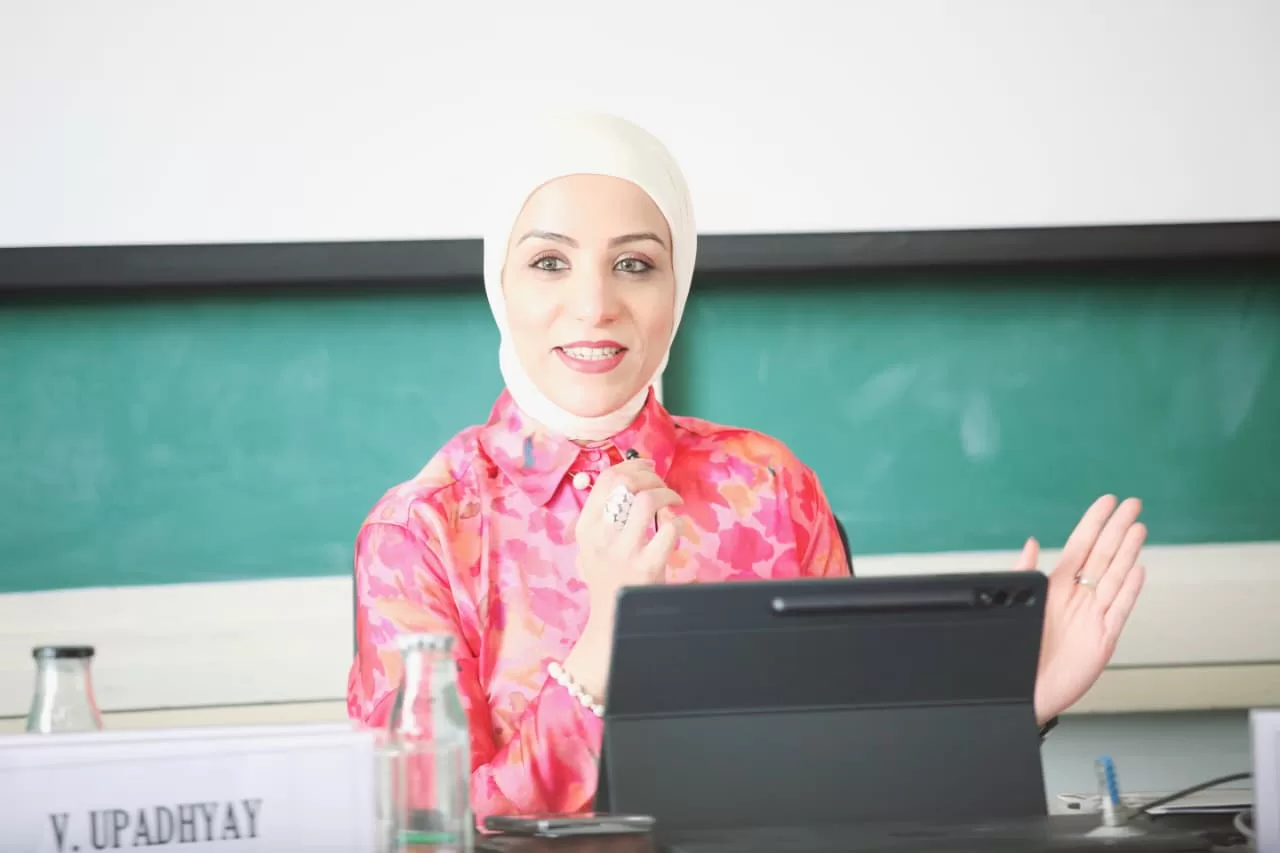
By Prof. (Dr.) Hebatallah Adam
The Bandung Conference was seventy-one years ago when it gave a platforum to the emerging nations of Asia and Africa to assert their political agency in the bipolar world of the great powers’ competition. In 1955, twenty-nine governments from Asia and Africa met in conference, and the Non-Aligned Movement that resulted from this more general political awakening held its first summit in Belgrade in 1961. In between those moments was another assertion of sovereignty happening in Egypt: When Gamal Abdel Nasser nationalized the Suez Canal Company on July 26, 1956. The world of the 2026 is a very different one, but the question is almost identical: how can political independence be converted into economic agency in the countries of the Global South? And Egypt might have a very significant answer.
The new Global South isn’t being built just in Summit Halls. It is built up through long-term investments in human and capital developments. In this new geopolitical landscape, Egypt is important not only because it is a part of BRICS, Africa or the Arab world; but because it is a country where several economic worlds converge. It is for this reason that President Abdel Fattah El-Sisi’s recent statement about Egypt’s role in the BRICS summit in New Delhi is noteworthy. He did not say that it is sheer location that makes Egypt influential. Geography can be turned into influence by that infrastructure, technology, manufacturing, finance and connectivity. That what really matters.
Suez – beyond geography: Economic power
The word “Suez” has been synonymous with Egypt’s strategic significance for generations. But the lessons of recent years are that one does not equal the other: strategic waterway equals strategic resilience. The disruption of the Red Sea very much highlighted that vulnerability. The dollar revenues of the Suez Canal have bounced back by 23% in fiscal 2025–26 to approximately $4.67 billion, though still far from the pre-disruption highs. Previously, it was estimated that Egypt lost about $7 billion in canal earnings in 2024 due to the current regional turmoil. That shock, in fact, makes a case for the direction that Egypt’s leadership has taken. The strategic goal must not be only to get the tolls from the ships between Asia and Europe. It is to convince more of the goods, capital, technology and industrial activity that pass through that corridor to halt and settle in Egypt. This is why the expansion of the ports and transport corridors and the Suez Canal Economic Zone is so significant beyond the symbolic aspect of the canal. In May 2026, President El-Sisi met with CMA CGM to discuss expanding investment in the semi-automated container terminal the company is working on in Egypt at Port Sokhna. The SCZone itself shows a 640,000m² container terminal space at Sokhna.
During the BRICS summit 2026, President El-Sisi made a clear connection between Egypt’s port and transport development and trade efficiency, regional integration and supply-chain stability. The more ambitious offer from the Egyptians is that “Suez” is not just a maritime route, but an industrial ecosystem. This should be particularly interesting for emerging countries, like India. The potential of a manufacturing investment in Egypt is that it can be integrated with Egypt’s proximity to the Suez route in addition to Egypt’s connection to the Arab, African and European markets. Recently, President El-Sisi and Prime Minister Narendra Modi have reaffirmed the target to increase bilateral trade to $12 billion, and have agreed that manufacturing, technology, clean energy and cars are priority areas for Indian investments.
Expanding trade to building productive capacity
The next battle will be over production, finance and technology. In 2025, Egypt’s trade with the BRICS economies amounted to $53.5 billion, increasing from $45 billion in 2024. In the first half of 2026 alone, Egypt-BRICS trade reportedly reached $36.7 billion, 25.5% higher than a year earlier. However, there is a significant warning in those numbers: Egypt imported about $30.2 billion from the BRICS economies in the first half but exported about $6.6 billion. That’s why the leadership’s focus on local manufacturing and technology localization is crucial. A successful Global South policy cannot simply be a policy of tradeoffs for import dependency. It must mean moving Egypt higher in value chains. The areas that President El-Sisi has targeted with India – pharmaceuticals, electronics, automotive components, renewable energy, green hydrogen, and information technology – provide opportunities to attain higher value chains. The target is not just selling more to Egypt; the ambition should be Indian, Chinese, Gulf, and other international capital producing from Egypt, using Egyptian talent, and involving Egyptian suppliers increasingly. Encouraging signs are already present. In 2026, China-Egypt merchandise trade totaled approximately USD 11.3 billion, with Egyptian exports to China seeing a significant increase from a low level. Even after FDI normalized from the record-breaking level in 2024 following the Ras El-Hekma deal, Egypt continued to be Africa’s leading FDI recipient in 2025, receiving approximately $15 billion in FDI based on UNCTAD data. Another instrument is introduced by BRICS. The New Delhi 2026 summit reiterated the call for the increased presence of the emerging economies in global financial institutions and enhanced cooperation in local currency transactions, interoperable payments and development finance. The New Development Bank provides an additional source of financing for infrastructure and development to the members. The current Egyptian leadership has wisely focused on the ability of these institutions to fund rather than on the BRICS membership as a geopolitical trophy.
Strategic balance importance in a fragmented world
The other benefit of Egypt is less tangible but nonetheless significant: it can be a bridge without a camp. The Global South is not a single uniform bloc. The BRICS bloc has countries that have very different security orientations, economic systems and relations with Washington, Beijing and Moscow. That diversity may be more important than ever in Egypt, where President El-Sisi has spoken of “strategic balance” that he defined in an article he published in the Economic Times on September 12 as “preserving independent national decision-making, diversifying partnerships and maintaining balanced relations with different powers”. He also said that Egypt and India view BRICS as a forum for cooperation and development; it is not against any other group of countries. This is the kind of “Global South” connector that Egypt should be instead of a “camp follower”. Not many countries have an African identity, strong ties with the Arabs, a Mediterranean location, the central heart of an important shipping route, growing ties with Asia and long-established ties with Europe and the USA. Egypt can thus bring together opportunities in Africa with manufacturing in Asia and capital from the Gulf with the rest of the world beyond BRICS and beyond Suez. This is not only an outcome from Egypt’s geography and its diplomatic orientation, but it is also in line with the strategy that Cairo has clearly stated. Stability in the Red Sea, the Horn of Africa and West Asia are also economic policy for Egypt, not just foreign policy. Disruptions to shipping routes result in losses to Egypt’s national revenues, as well as losses to supply chains. Cairo’s consistent diplomatic focus on de-escalation thus has an economic logic in addition to a political logic.
The Real Challenge is Implementation
None of this is easy for Egypt. Suez Canal revenues have been vulnerable to conflicts outside Cairo’s control. BRICS trade is growing, and heavily skewed in favor of Egyptian imports. The 2025 figure for FDI was significantly lower than the unprecedented 2024 figure generated by the Ras El-Hekma deal. Egypt is also struggling with debt and with inflationary and external financing pressures; the IMF, which reached an agreement with Cairo in June 2026, applauded the improved growth and fiscal performance but still pressed for exchange-rate flexibility, macroeconomic discipline, and more rapid reforms to promote the growth of the private sector.
However, these constraints do not undermine the viability of Egypt’s approach. They make it clearer. The key to being vulnerable is diversification. The answer to import dependence is productive investment. The answer to geopolitical uncertainty is balanced partnerships. The answer to dependence on Suez transit income is to create an industrial, logistical and technological economy around Suez.
This is what President El-Sisi has stated: ports and corridors, manufacturing, technology localization, BRICS, and strategic balance, should not be considered an unconnected set of measures, but rather components of a larger national project. He pointed out at New Delhi BRICS Summit 2026 that cooperation should not be measured merely by declarations, but by projects, investments and concrete cooperation. That can be the most significant litmus test of the Global South itself.
Bandung was about the right to self-determination of the developing nations. The next chapter will be whether they can do that and do it on terms that give that voice material weight by building, financing, trading and innovating. In Egypt, there is something which few countries have, geography that links several worlds. In its current leadership, its more significant goal is that Egypt will not just be a space between worlds but a space that will be a connecting link between worlds. In the new Global South, influence will not continue to be held by the greatest powers. It will also be a part of the countries that make a fragmented world work. This is why Egypt is more important than ever.
Prof. (Dr.) Hebatallah Adam
Full Professor of Economics
Academic Dean, Jindal School of International Affairs
Founder and Director of Jindal Centre for the Global South
O.P. Jindal Global University, India
Founder and President of Global South Research Foundation (GSRF)
Email: [email protected], [email protected]

