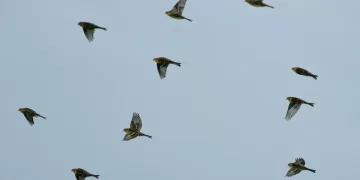







Bird populations in North America have dropped by 15 per cent in the last 40 years, according to a study published in the Science journal.
The same story is playing out across Europe, and it’s been going on for decades, Euronews reported.
Euronews Green spoke with Anna Staneva, Head of Science, Species and Site Conservation at BirdLife Europe, to understand what’s happening and why it matters far beyond the birds themselves.
Data has been gathered since the 1980s, when scientists began systematically tracking bird populations across Europe.
“Birds are declining in Europe as well, at quite a steep pace,” Staneva says.
Farmland birds have been hit the hardest – like sparrows, skylarks and lapwings that once filled the countryside. “The figures that we have consistently show declines, especially among farmland birds, where the declines for Europe reach almost 60 per cent for the last four decades,” Staneva explains.
It isn’t just farmland species. Forest birds, water birds, long-distance migrants – the losses are widespread. In parts of Central Europe, the Red-backed Shrike – a small, sharp-eyed predator that was once a common sight – has declined by over 92 per cent in just 30 years.
Climate change is partly to blame for declining bird populations as it is shifting the timing of seasons and scrambling the cues birds rely on to breed. But the biggest driver is more down to earth.
“Numerous studies show consistently that one of the largest, most significant threats for birds in Europe is intensive farming,” Staneva says.
Modern industrial agriculture has reshaped the countryside at a speed and scale that wildlife can’t adapt to. Hedgerows have been ripped out. Fallow fields – once a patchwork of habitat across farmland – have given way to vast, bare monocultures. And then there are the chemicals.
Pesticides and fertilisers, Staneva notes, are “harmful to birds directly, but they also influence their ability to reproduce and for their populations to continue to exist.”
Part of the problem is indirect but devastating. When pesticides wipe out insects and other invertebrates across the landscape, they take away the food that parent birds need to feed their chicks.
As with many parts of nature, human health is interconnected with wildlife.
“Birds are a very good indicator of the health of the environment,” Staneva says. “By losing very large numbers of birds… we are losing functions in the ecosystem, and these link to the food production and the ability of our ecosystem to adapt to climate change.”
Birds do things for us that we’ve largely stopped noticing. They eat crop pests. They spread seeds. They keep the system running. When they disappear, those services go with them and we end up relying more heavily on the very pesticides that are driving the decline in the first place.
There’s a human cost that’s harder to measure, too. Research consistently shows that being in nature – and simply hearing birdsong – reduces stress and anxiety. The quieter our countryside gets, the worse it is for us, not just for them. “When we talk about declines in birds, we need to be mindful that this is an indication of the health of the environment overall,” Staneva says.
The good news is that we know conservation works. Vultures have returned to European skies. Dalmatian pelicans are recovering. Targeted efforts, given time and resources, can bring species back from the brink.
But those victories are still small and scattered. Staneva makes it clear that the crisis is a systemic one. “The overall decline… indicates an issue which is not just regional, it is a systemic issue.” Fixing it means changing, fundamentally, how we grow food.
“A systemic and transformative change in the way we produce our food, the change in the way we work our land” is what’s needed, she says.

