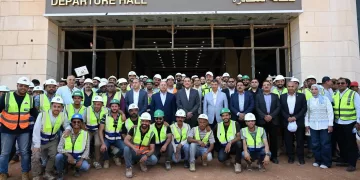








Prime Minister Mostafa Madbouly and his accompanying delegation inspected the first line of the high-speed electric rail network, “Ain Sokhna/Alamein/Matrouh,” to review construction progress and adherence to the scheduled timelines for operation.
The visit comes as part of President Abdel Fattah El-Sisi’s directives to accelerate the implementation of modern mass-transit projects.
At the start of the tour, Madbouly said the project is one of the most prominent examples of the ability of the New Republic to implement major transportation projects according to the latest international standards.
The project is not merely a modern means of transporting citizens; it is a new development artery that is reshaping Egypt’s development map, connecting regions and opening new horizons for investment, urban development, industry, tourism and trade. It combines speed, safety, comfort and sustainability, he said.
Madbouly added that the high-speed electric rail network is being implemented as part of a vision to establish a modern, integrated, and sustainable transportation system that represents a long-term investment in the country’s future, contributes to attracting investment and enhances Egypt’s competitiveness.
He affirmed the state’s continued support for and monitoring of modern mass-transit projects.
He explained that the high-speed rail network will mark a milestone in the history of Egypt’s transportation system and represent a step toward world-class infrastructure and safe, modern and sustainable transportation services, while creating new opportunities for development and investment across Egypt.
For his part, Minister of Transport Kamel el-Wazir said the high-speed electric rail network is one of the largest transportation projects in Egypt’s history and represents an integrated development project that will reshape patterns of mobility, development, urbanisation and investment.
The project consists of four lines with a total length of 2,250 km and 60 stations. It will include 41 high-speed trains, 94 regional trains, and 41 locomotives for freight transport.
Wazir added that the first three lines, totaling 2,000 km, are currently under construction. The first line, “Ain Sokhna/Alamein/Matrouh,” is 660 km long and includes 21 stations and a control and command centre, as well as 15 high-speed trains, 34 regional trains and 14 freight locomotives.
He said that Egypt is not simply building a new railway, but rather a modern transportation system befitting its status and the future of the Egyptian state.
He noted that the various sections of the project are being implemented in parallel, with completion dependent on the final activity in order to avoid scheduling gaps.
Wazir stressed that the project’s entry into this phase represents a qualitative and decisive step forward, with continued monitoring of construction, electromechanical, systems and finishing works to ensure readiness in accordance with the highest standards of safety and efficiency.
The project will serve the industrial, tourism, urban-development, and agricultural sectors; contribute to attracting investment and creating jobs; reduce travel times and transportation costs; connect new cities with existing ones; support freight transportation; and maximise the benefits of Egypt’s ports.
He explained that implementation of the network aims to usher in an era of smart, green and sustainable transportation by reducing emissions and supporting sustainability, in addition to the speed, safety, comfort, and efficiency provided by high-speed electric trains.

