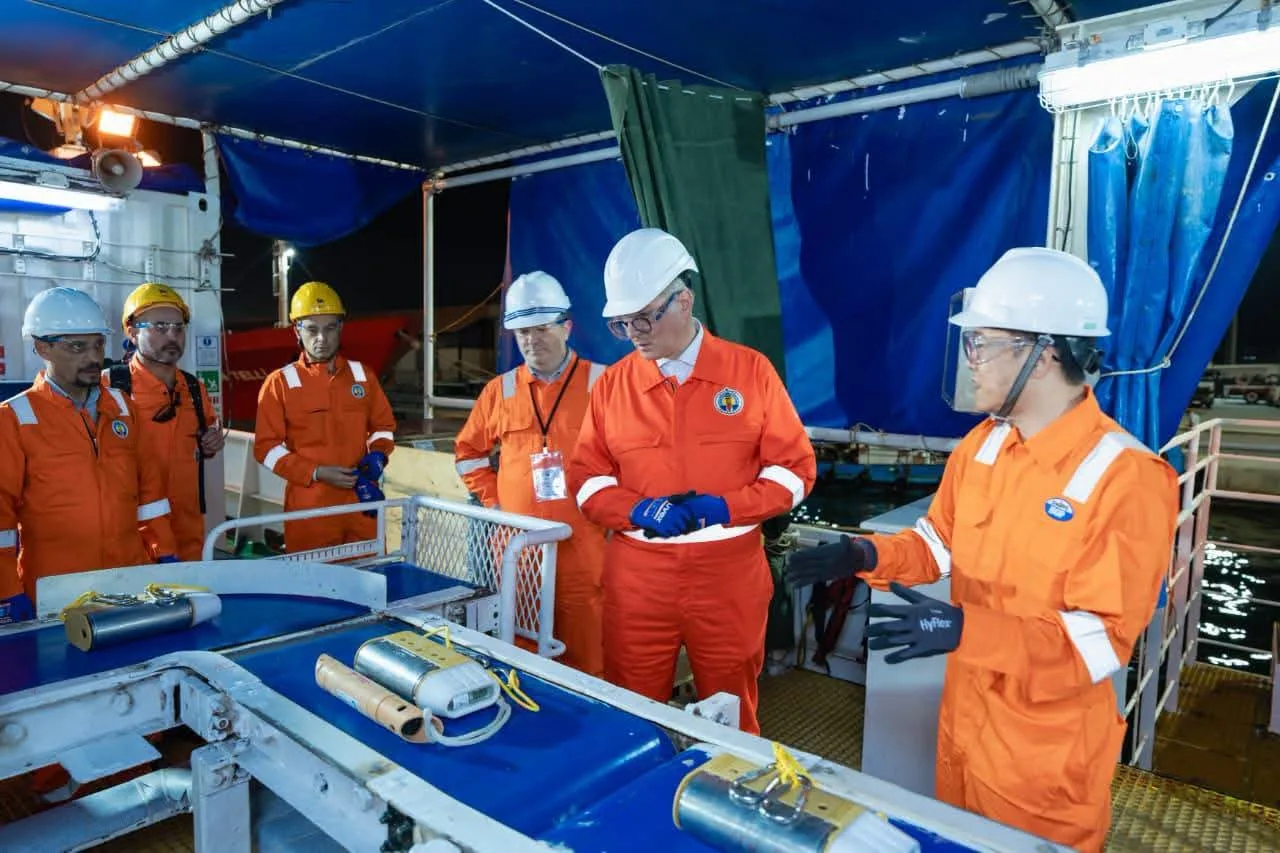



Egypt’s Minister of Petroleum and Mineral Resources Karim Badawi has reviewed final preparations for the launch of one of the region’s largest offshore seismic survey projects using Ocean Bottom Node (OBN) technology, scheduled to begin on October 30 in Egyptian waters in the Eastern Mediterranean.
During an inspection of the Commander vessel at Port Said On Monday, Badawi highlighted the role of advanced seismic technology in improving exploration accuracy, reducing operational risks and costs, and attracting new investment.
He cited the success of OBN technology in the Gulf of Suez, where drilling success rates rose from 26 per cent to 80 per cent, underscoring its potential to improve the selection of drilling targets and enhance investment efficiency.
The project is being implemented by the Egyptian Natural Gas Holding Company (EGAS) in partnership with global companies SLB and Fairfield.
Representatives of Eni and BP also attended the inspection.
Fairfield Chief Executive Officer and Board Member Henning Berg highlighted the company’s extensive international expertise, noting that it had undertaken approximately 80 per cent of OBN seismic survey projects worldwide, including comparable operations in the United Arab Emirates and Saudi Arabia.
The survey will generate high-resolution geological data to identify promising natural gas-bearing structures, guide exploration priorities and support investment decisions.
The commander will lead the operations, with two additional vessels scheduled to join the project.
The initial survey phase will cover approximately 300 square kilometres in the Denis area, off Port Said, and the Ras El Bar area.
This phase is expected to be completed by the end of 2026, while preparations for subsequent phases in 2027 are already under way.
Badawi emphasised the importance of adhering to the project’s timetable, maintaining close co-ordination among partners and accelerating data processing and analysis.
He also highlighted the importance of integrating seismic data from the Eastern Mediterranean, the Gulf of Suez and the Nile Delta to improve geological assessments, reduce exploration uncertainty and encourage international oil companies to invest in Egypt’s promising exploration prospects.

