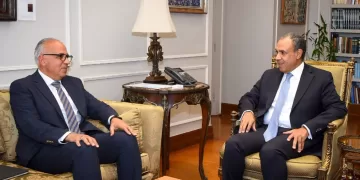





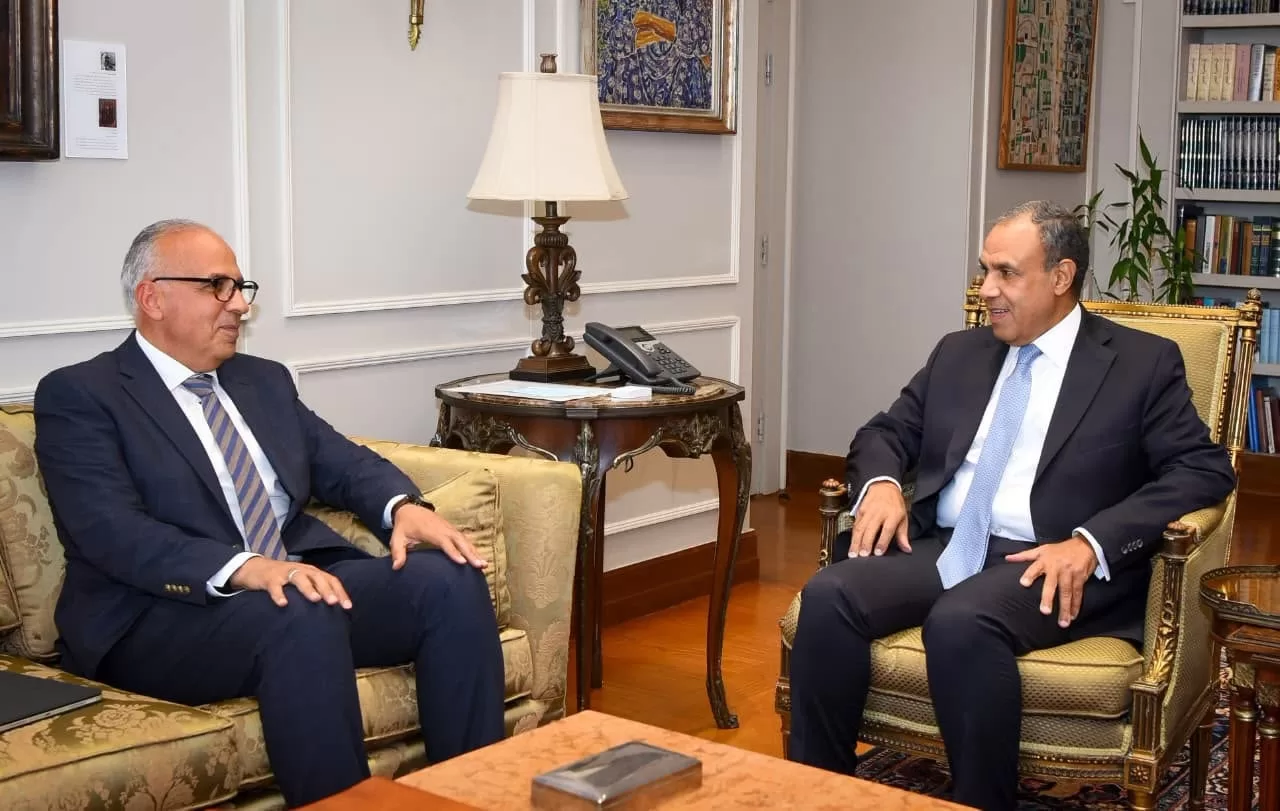
Minister of Foreign Affairs, International Co-operation and Egyptian Expatriates Badr Abdelatty and Minister of Water Resources and Irrigation Hani Sewilam affirmed that Egypt’s foreign policy toward Nile Basin countries is based on co-operation, development, shared interests and mutual benefit.
The remarks came during Abdelatty’s meeting with Sewilam on Tuesday as part of ongoing coordination between the two ministries.
They stressed that Egypt’s position is grounded in the firm belief that water security and development are complementary rather than conflicting objectives, and that transboundary water resources should serve as a field for co-operation and integration among peoples in accordance with international law.
According to a joint statement, the meeting addressed ways to strengthen Egypt’s relations with fellow Nile Basin countries, advance development co-operation programmes, expand Egyptian projects supporting development and water security in Africa, and coordinate Egypt’s positions and actions on water-related issues at the regional and international levels.
The two ministers reviewed the status of Egyptian co-operation projects in Nile Basin countries, particularly dam projects, most recently the giant Julius Nyerere Dam project in Tanzania. They also reviewed projects involving solar-powered groundwater stations and wells, river ports, underground water reservoirs, a rainfall forecasting centre, a water-quality analysis laboratory, aquatic weed control and flood protection, as well as training and capacity-building programmes.
They highlighted the continued progress of Egyptian development-financing mechanisms in Nile Basin countries, particularly a financing mechanism launched by Egypt with initial allocations of $100 million to study and implement projects, including dams in the southern Nile Basin countries in accordance with their priorities.
The ministers also noted the role of the Egyptian Agency of Partnership for Development and the Egyptian Initiative for the Development of Nile Basin Countries in capacity building, skills development and implementing bilateral memoranda of understanding between Egypt and fellow Nile Basin countries.
They said these efforts reflect Egypt’s vision of translating co-operation into projects on the ground that generate a direct development impact for partner countries while benefiting all parties, in line with Africa’s Agenda 2063 and the Africa Water Vision 2063.
The ministers stressed that preserving Egypt’s water security does not conflict with the development aspirations of fellow Nile Basin countries.
They underscored that the Nile is a shared water resource that must be managed in accordance with international law, particularly the principles of causing no harm and co-operation through prior notification, consultation and agreement.
They reiterated Egypt’s categorical rejection of unilateral measures that violate international law in the Eastern Nile Basin, stressing that Egypt will take all measures guaranteed under international law to protect its rights and the vital interests of its people.
Egypt continues to play an active role in preparations for the conference, including co-chairing with Japan the third interactive dialogue, “Water for the Planet,” and working to develop practical, implementable initiatives.
The ministers also welcomed Egypt’s unanimous selection to host the 18th session of the Conference of the Parties to the UN Convention to Combat Desertification (UNCCD COP18) in 2028.
They agreed to continue coordination with relevant national bodies to advance an integrated vision linking efforts to combat drought and desertification with water and food security, particularly in fellow African countries.

