



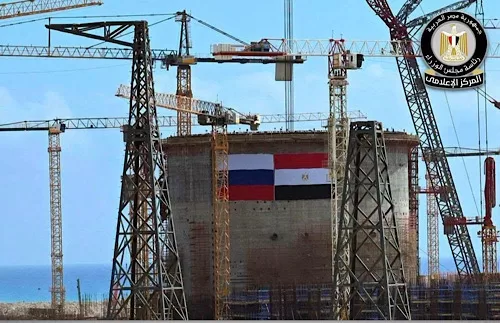
Egypt’s Nuclear Power Plants Authority (NPPA) has reaffirmed its commitment to the highest internationally recognised standards of nuclear safety and security in the construction of the El Dabaa nuclear power plant, the Cabinet’s media centre said.
The statement was issued in response to what it described as inaccurate and unbalanced claims circulating on social media about safety standards and construction quality at the project.
The authority said all construction, engineering and installation works were being carried out according to international quality standards and were subject to continuous inspection by its supervision teams.
It added that work proceeded only after regulatory procedures had been completed and the necessary approvals obtained from Egypt’s Nuclear and Radiological Regulatory Authority (ENRRA), the country’s independent nuclear regulator.
Any engineering observations or apparent defects, particularly those involving concrete works, are addressed through formal “non-conformance reports”, the authority said. No construction phase is approved or accepted until the required technical remedies have been completed and hydraulic and structural tests carried out.
Safety at nuclear projects, it added, could not be assessed through personal opinions or visual observations, but through a comprehensive system involving risk assessments, work permits, lifting plans, equipment approvals and continuous regulatory supervision.
The authority said the project operated under an integrated system covering industrial safety, occupational health, safety culture and construction quality, in cooperation with Russian contractor Atomstroyexport.
It said all reportable incidents were documented in line with applicable regulations and that technical or procedural observations were addressed immediately through contractual and regulatory monitoring mechanisms.
The four-reactor El Dabaa plant, being built on Egypt’s Mediterranean coast, uses Russia’s Generation III+ technology and incorporates multiple safety barriers and passive systems designed to operate using natural forces such as gravity, the authority said.
The design also includes a core catcher and a double-walled containment vessel intended to withstand extreme events, including the impact of a heavy commercial aircraft, tsunamis, earthquakes and hurricanes, it added.
The authority stressed that the project was subject to independent and continuous oversight by ENRRA, as well as technical support and periodic visits by the International Atomic Energy Agency (IAEA).
It also cited the findings of an IAEA Integrated Regulatory Review Service mission, which it said completed its work in Egypt in June 2026 after reviewing ENRRA and the El Dabaa site. The mission concluded that Egypt had a comprehensive and robust regulatory framework for nuclear and radiological safety, and praised the regulator’s preparedness and professionalism, according to the statement.
The Cabinet’s media centre urged social media users to rely on information issued by official authorities and avoid unverified conclusions about the strategic project.

