
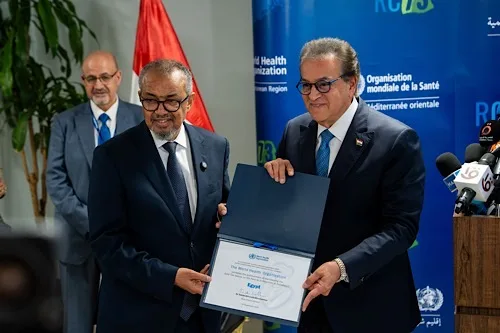










Egypt’s Minister of Higher Education and Scientific Research, Abdel Aziz Konsowa, has reaffirmed the ministry’s commitment to a comprehensive strategy aimed at consolidating the country’s position as a leading regional hub for higher education, scientific research, and innovation.
The minister stated that the strategy seeks to maximise the return on state investments in the sector while supporting Egypt’s transition towards a knowledge-based economy, in line with directives from the political leadership and Egypt’s Vision 2030.
The minister explained that the strategic roadmap is built upon three core pillars: the internationalisation of Egyptian education, the transition to a knowledge economy, and the development of infrastructure alongside institutional and human capacities to align educational and research outputs with modern labour market demands.
Infrastructure development will focus heavily on modernising national and technological universities, enhancing faculty capabilities, and improving overall academic and administrative performance.
Egypt’s strategy includes upgrading university hospitals to strengthen their dual roles in public healthcare and clinical scientific research.
Minister Konsowa stressed that the ministry attaches particular importance to expanding private and technological universities, viewing them as modern educational models uniquely capable of responding to national development priorities.
These private institutions are designed to offer cutting-edge interdisciplinary programmes, promote financial sustainability, and expand international partnerships through dual-degree schemes.
Crucially, they will focus on directing academic research toward practical industrial and societal applications.
The minister added that technological universities represent a qualitative leap in applied education through specialisations such as artificial intelligence, robotics, renewable energy, smart manufacturing and smart supply chains, while adopting a dual education model based on 50 per cent academic study and 50 per cent practical training in industry.
He revealed that the state aims to increase the number of technological universities to 27 by the 2030/2031 academic year.
Around 48,883 students are currently enrolled in technological universities, alongside 18 public colleges and 68 academic programmes, while new universities are under construction in Banha, Menoufia, Sohag, Suez, South Valley, Arish, Kafr El Sheikh, Damietta and Minya.
Konsowa also highlighted the ministry’s efforts to strengthen human capacities through a comprehensive project to modernise faculty development centres, with a pilot phase currently being implemented in 11 universities with the support of specialised expert committees.
Regarding healthcare, the minister said that work is under way to automate 79 university hospitals across 12 public universities, with 19 hospitals already operational, 23 undergoing pilot operation and 37 being prepared for launch.
The programme aims to improve governance, unify medical records, establish research databases and create a national health map of diseases, while strengthening integration with the Universal Health Insurance system through phased implementation across several governorates.

