



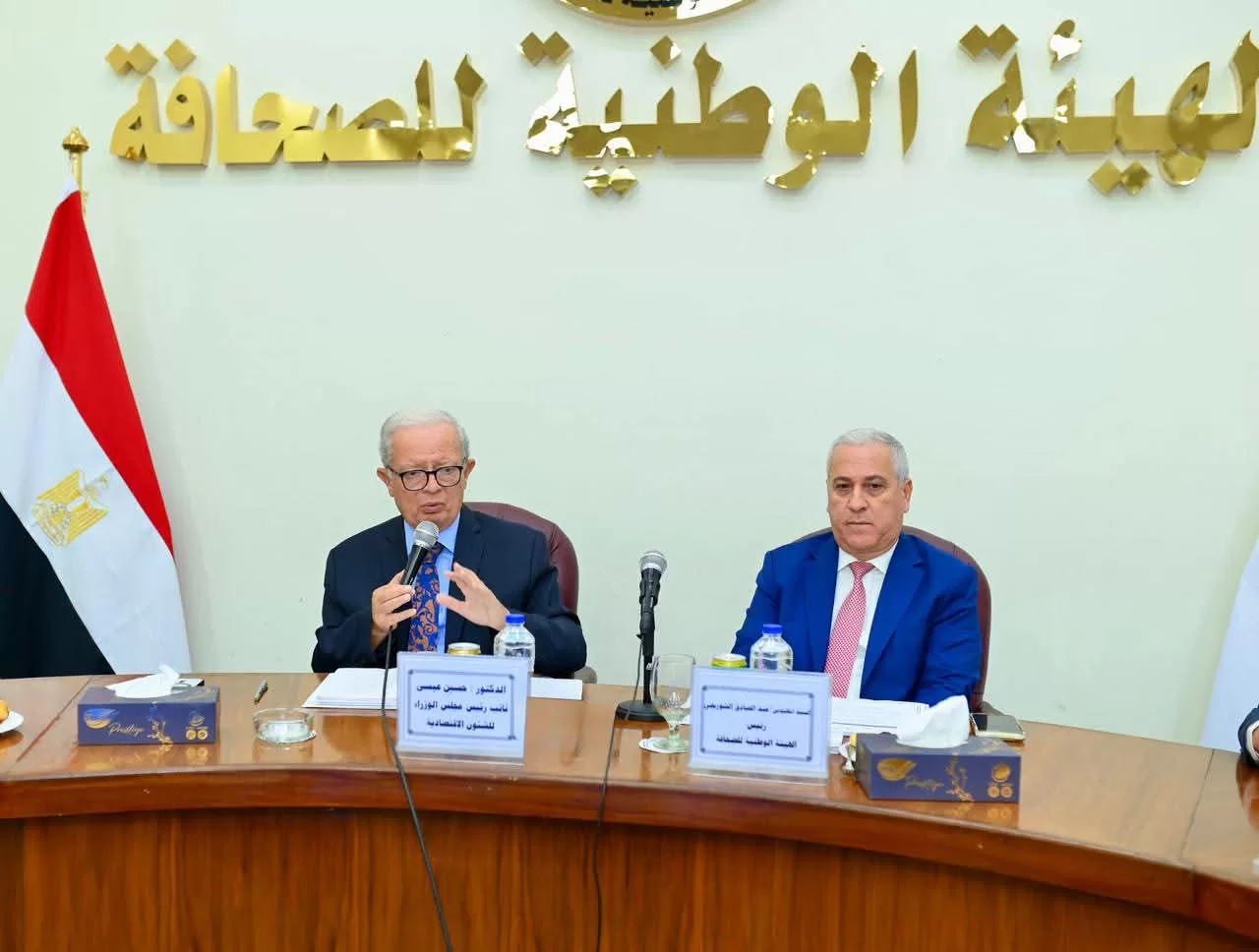
Deputy Prime Minister for Economic Affairs Hussein Eissa has held two separate meetings at the headquarters of the National Press Authority (NPA) to review restructuring and development plans for the Rose al-Yusuf and Dar al-Hilal press institutions, with a focus on financial sustainability, operational efficiency and asset optimisation.
The meetings were attended by Chairman of the National Press Authority Abdel-Sadek El-Shorbagy, Deputy Chairman Alaa Thabet, Secretary-General Marwa El-Sisi, Authority member Hamdi Rizk, Chairperson of the Rose al-Yusuf Foundation Heba Sadek and Chairperson of the Dar al-Hilal Foundation Omar Sami.
According to an NPA statement, the meetings examined the institutions’ financial positions, outstanding obligations, operational challenges and proposed development programmes.
For his part, Deputy PM Eissa stressed the state’s commitment to preserving and revitalising national press institutions, describing them as longstanding platforms for public awareness and enlightenment and an integral part of Egypt’s history, cultural heritage and national memory.
He noted their contribution to Egyptian and Arab intellectual life, their role in developing generations of journalists and thinkers, and their importance as a component of Egypt’s soft power.
He also said that restructuring would be based on comprehensive financial and operational plans designed to settle accumulated debts, achieve financial balance, improve performance, maximise asset returns and prevent the recurrence of future liabilities.
Particular attention would be given to resolving debts owed to commercial banks, tax and social-insurance authorities, as well as sovereign obligations in coordination with the Ministry of Finance and the National Organisation for Social Insurance.
Efforts to address long-standing debts in co-operation with the National Media Authority were also reviewed.
The deputy prime minister also highlighted the need to strengthen revenue-generating activities, make better use of institutional assets, invest in human capital and accelerate digital transformation, while maintaining the integration of print and digital journalism.
For his part, NPA chairman outlined ongoing initiatives to maximise asset returns, modernise content, expand digital platforms, diversify publications and supplements, strengthen specialised and local journalism, and improve workforce capabilities through continuous training and the adoption of modern technologies.
The meetings concluded with an emphasis on developing a sustainable model combining financial remediation, operational restructuring, revenue growth, content development, digital transformation and investment in human capital, while preserving the historic media and societal role of Egypt’s national press institutions.

