







Minister of Petroleum and Mineral Resources Karim Badawi affirmed that Egypt is expanding hydraulic fracturing and horizontal drilling as key pillars of the petroleum sector’s five-year plan to increase domestic production, revive declining wells and maximise the utilisation of oil and gas resources.
Badawi said the ministry, in co-operation with investment partners and leading international service and technology companies, had launched a comprehensive initiative to access unconventional resources previously uneconomical to extract using conventional methods.
The technologies have proved successful in the United States, Saudi Arabia and several other countries, while delivering positive results in Egypt, particularly in the Western Desert.
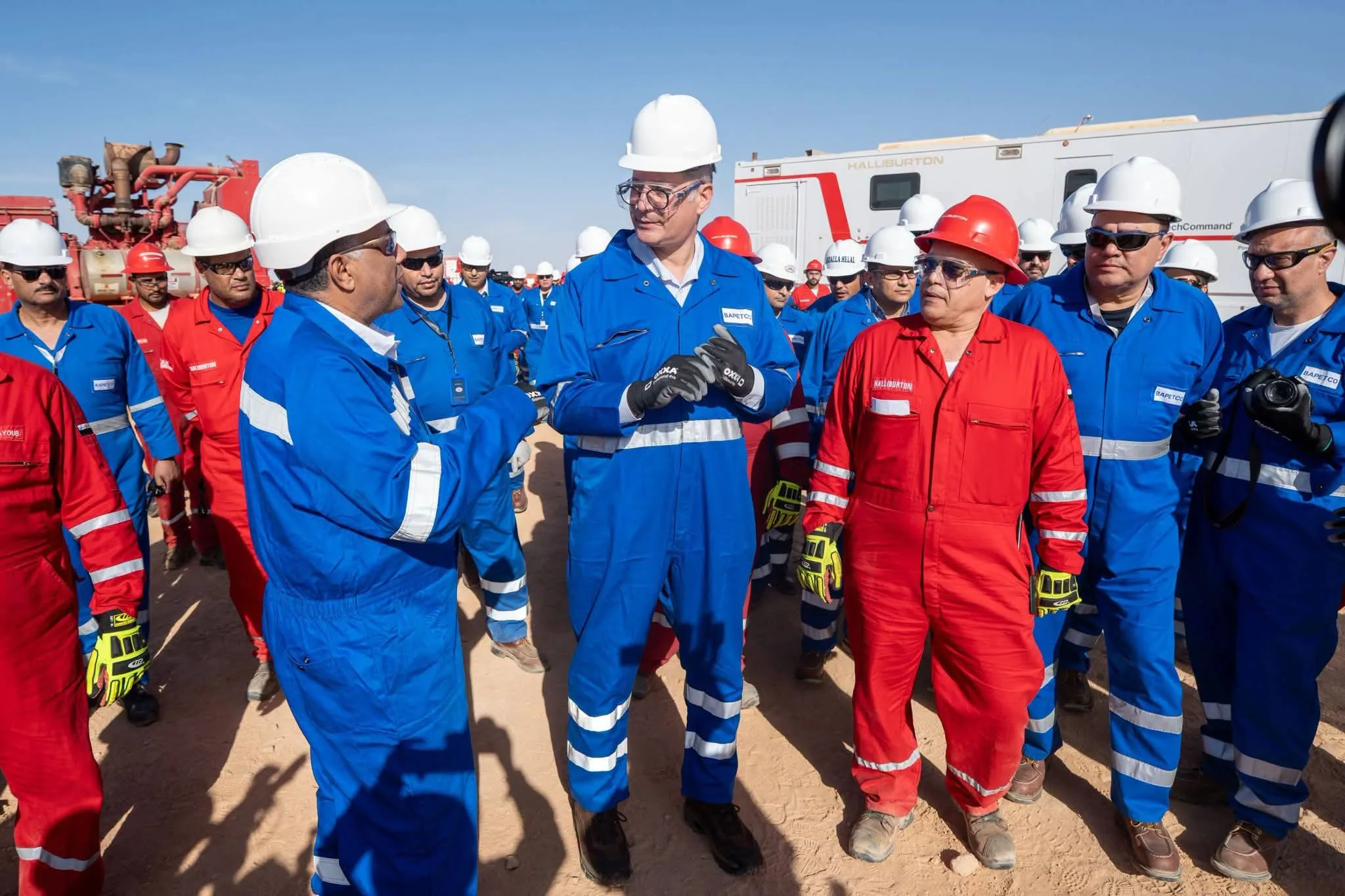
The minister made the remarks during an inspection of hydraulic fracturing operations at the Al-Ubayyid H-18 well, operated by Badr El-Din Petroleum Company (Bapetco).Multi-stage fracturing aims to quadruple daily gas production from three million to 12 million cubic feet, restoring output after technical challenges that conventional methods failed to overcome.
Hydraulic fracturing creates pathways within rock formations to facilitate hydrocarbon flows, while combining it with horizontal drilling provides access to larger reservoir areas.
Meanwhile, NESR, which operates in 15 countries and has experience developing unconventional gas resources at Saudi Arabia’s Jafurah field, presented a preliminary study estimating potential additional unconventional oil production of 50,000 to 100,000 barrels per day in the Western Desert, subject to technical and economic assessments.
Regarding horizontal drilling, 15 wells have been drilled in Sinai fields operated by the General Petroleum Company (GPC), with four more under development.
Several have outperformed conventional vertical wells. Petrobel has also drilled the SIDRI-48 horizontal well, while two additional wells are planned at GPC’s Nees field.
The Egyptian General Petroleum Corporation (EGPC) is overseeing implementation in coordination with EGAS, Ganope, production companies and partners.
Technical data from 38 companies have been reviewed to identify economically viable opportunities and determine equipment and technology requirements.
Technical studies commissioned from SLB and Halliburton are assessing three opportunities in GPC-operated Abu Roash reservoirs, with results expected progressively during the third quarter of the 2026/2027 fiscal year.
Assessments and contractual procedures for other opportunities are also being finalised.
The ministry is developing investment incentives and contractual models, including performance-based, integrated-service and turnkey contracts, alongside flexible fracturing-cost payments, faster capital recovery, agreement renewals and concession-area consolidation.
The next phase will extend implementation across onshore and offshore areas, using previous operational and seismic data to identify further production opportunities.

