




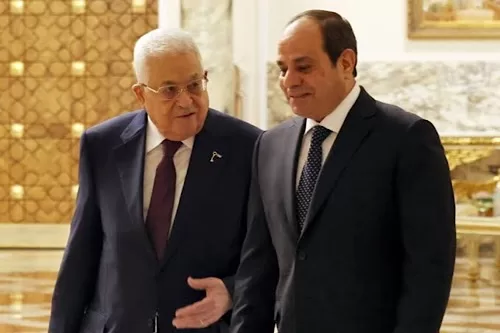
Palestinian President Mahmoud Abbas is visiting Egypt today to meet with President Abdel Fattah El-Sisi at a particularly sensitive moment. The meeting comes as political efforts intersect with one of the most challenging periods for the Palestinian cause, while attention remains focused on the ongoing war between the United States and Iran.
The talks are expected to address efforts by Egypt, together with regional and international partners, to protect and assist the Palestinian people, rebuild areas destroyed during the ongoing war and reject any attempts to forcibly remove Palestinians from their land.
For 1,074 days since the beginning of Israel’s offensive on the Gaza Strip, Egypt’s leadership, government and people have opposed attempts to displace Gaza’s population, eliminate the Palestinian cause and undermine a political solution leading to the establishment of an independent Palestinian state with East Jerusalem as its capital.
Since the first days of the offensive, Cairo has intensified efforts to halt the fighting, prevent further loss of Palestinian lives and facilitate the delivery of aid to Gaza.
Since October 7, 2023, Egypt’s message under Sisi has remained “clear” at local, regional and international events: no displacement of Palestinians, no liquidation of their cause and no imposition of a new reality by force.
Cairo has also pursued those objectives diplomatically, while continuing efforts to secure a truce in Gaza. It hosted the Sharm el-Sheikh Peace Summit on October 13, 2025, where a document was signed to guarantee and support a ceasefire agreement and end the war in Gaza.
Throughout the 1,074 days, Sisi has repeatedly described displacement as a “red line.”
On October 17, 2023, while receiving German Chancellor Olaf Scholz in Cairo, Sisi warned that continued military operations in Gaza could lead to a mass displacement of Palestinians. He said moving Palestinians to Sinai would transfer the idea of resistance and fighting to Sinai, adding that Egypt would not allow the Palestinian cause to be liquidated at its expense.
During the Cairo Peace Summit, convened by Egypt on October 21, 2023, with broad international participation, Sisi delivered a forceful statement reflecting Egypt’s longstanding position. He said Egypt categorically rejected the liquidation of the Palestinian cause and the forced displacement of Palestinians, stressing that the solution lay in ending the war and reviving the peace process.
On October 25, 2023, Sisi received French President Emmanuel Macron and stressed the need to prevent the conflict from spreading. He rejected the idea of forcibly displacing Palestinians and said the Palestinian issue should be resolved through the establishment of a Palestinian state.
A truce in Gaza began on November 24, 2023. Sisi welcomed the ceasefire and the exchange of prisoners and detainees, while stressing that humanitarian aid must continue to enter the territory.
In February 2024, Sisi continued to reject displacement and support the Palestinian cause. During the African Union summit in Addis Ababa, he called for an immediate end to the war in Gaza, the protection of civilians and the rejection of any attempts to displace Palestinians outside their territories. In international meetings and telephone calls, he also reiterated the need for a ceasefire and the delivery of aid, while opposing the displacement of Palestinians from Gaza.
On April 25, 2024, during celebrations marking the 42nd anniversary of the liberation of Sinai, Sisi referred to Israel’s war on Gaza and Egypt’s clear position from the outset rejecting any displacement of Palestinians from their land to Sinai or anywhere else. He said this was necessary to prevent the Palestinian cause from being liquidated and to protect Egypt’s national security.
He also stressed Egypt’s determination to work intensively to secure a ceasefire, deliver humanitarian aid and advance efforts to establish an independent, sovereign Palestinian state so that the Palestinian people could obtain their legitimate rights.
At an emergency humanitarian response conference for Gaza held in Jordan’s Dead Sea region on June 11, 2024, Sisi called for an end to the war and the entry of aid. He assigned Israel major responsibility for the catastrophic humanitarian situation in Gaza and called for Israel to be compelled to end the blockade and stop using starvation as a weapon against the territory’s residents.
Strengthening the humanitarian response in Gaza
In December 2024, Egypt hosted the Cairo Ministerial Conference to Strengthen the Humanitarian Response in Gaza under Sisi’s patronage.
Egypt’s Foreign Minister Badr Abdelatty described the situation in Gaza as an ongoing, unprecedented humanitarian tragedy. He said Israel’s offensive had exceeded all limits, with Israel continuing to commit atrocities in full view of the world for more than a year.
Abdelatty said Israel was using starvation and blockade as weapons and displacement as collective punishment against Palestinians, in flagrant violation of international humanitarian law and international law.
On January 29, 2025, during a news conference with Kenyan President William Ruto at Cairo’s Ittihadiya Palace, Sisi said deporting or displacing the Palestinian people was an injustice in which Egypt could not participate. He said Egypt could not allow displacement because it would threaten its national security.
On February 7, 2025, Sisi received a telephone call from UN Secretary-General Antonio Guterres, during which he stressed opposition to emptying Gaza of Palestinians and to attempts to displace them. He said Gaza’s residents must remain on their land and that reconstruction should begin in a way that restores normal life.
On February 19, during a news conference with Spanish Prime Minister Pedro Sánchez in Madrid, Sisi presented the idea of rebuilding Gaza without displacing its residents. He said the Palestinian people remained attached to their land and homeland and stressed the need for humanitarian aid to enter Gaza to save its residents from the difficult conditions they faced.
Sisi also praised Spain’s decision to recognise the Palestinian state and the legitimate rights of the Palestinian people. Sánchez, for his part, said he fully agreed with Egypt’s categorical rejection of Palestinian displacement.
At an emergency Arab summit held in Cairo on March 4, 2025, Sisi called for support for an Arab plan to rebuild Gaza while keeping Palestinians on their land. He rejected any plan to displace the population or alter the demographic composition of the territory, saying Israel’s offensive had sought to destroy and depopulate Gaza, an outcome Egypt opposed and would not participate in.
At the 34th Arab Summit, held in Baghdad on May 17, 2025, Sisi said Palestinians had faced systematic crimes and brutal practices for more than a year and a half aimed at erasing and destroying them and ending their presence in Gaza.
He said the territory had suffered extensive destruction aimed at making it uninhabitable and pushing its residents to leave under the horrors of war. He stressed that establishing an independent Palestinian state along the June 4, 1967 borders was the cornerstone of regional stability and that there could be no genuine peace without it.
On September 15, 2025, during his address to an Arab-Islamic emergency summit in Doha, Sisi reaffirmed Egypt’s complete rejection of attacks on civilians and the policies of collective punishment and starvation practiced by Israel against Palestinians in Gaza. He said those policies had resulted in tens of thousands of innocent civilian casualties over the previous two years.
In October 2025, Egypt hosted the Sharm el-Sheikh Peace Summit to sign a document on a ceasefire agreement and the end of the war in Gaza. The document was signed by Sisi, US President Donald Trump, Qatar’s Emir Sheikh Tamim bin Hamad Al Thani and Turkish President Recep Tayyip Erdogan.
Despite the region’s tensions and developments, Sisi reiterated the need for a just settlement of the Palestinian issue based on international legitimacy during a meeting with Chinese President Xi Jinping during his visit to Cairo earlier this month.
Sisi also stressed Cairo’s efforts to advance the implementation of the second phase of the agreement to end the war in Gaza. He praised China’s support for Palestinian rights and for the two-state solution as the only path to achieving a just and lasting peace for the Palestinian and Israeli peoples and the wider region.
During a joint news conference with Greek Prime Minister Kyriakos Mitsotakis and Cypriot President Nikos Christodoulides in New Alamein City, held during a trilateral co-operation summit hosted by Egypt on September 8, Sisi again rejected any attempts to displace the Palestinian people from their land.
He said a just and comprehensive peace in the region could be achieved only through the establishment of a Palestinian state.
On the sidelines of the 18th BRICS summit, held in the Indian capital New Delhi, Sisi and Indonesian President Prabowo Subianto affirmed the centrality of the Palestinian issue in the region.
The two leaders stressed the need for a just settlement guaranteeing the establishment of a Palestinian state along the June 4, 1967 borders, with East Jerusalem as its capital.
They also rejected the displacement of Palestinians from their land and stressed the need to implement the ceasefire agreement in Gaza and facilitate the entry of humanitarian aid into the territory. The two presidents further underscored the importance of ending practices against Palestinians in the West Bank.
Humanitarian aid
Egypt’s efforts have not been limited to political initiatives and firm positions in support of the Palestinian people and Gaza. It has also taken the lead in providing urgent humanitarian assistance to the territory’s residents.
Egypt launched the “Zad al-Ezza — From Egypt to Gaza” convoy. So far, 278 aid convoys have been sent, carrying various forms of humanitarian assistance, including food baskets, flour, relief and medical supplies, medicines and fuel needed to operate hospitals and vital facilities in Gaza.
The Egyptian Red Crescent has been present on the Gaza border since the beginning of the crisis. Its logistics centres have remained on standby, while its teams have intensified efforts to prepare and deliver humanitarian and relief assistance to the territory.
The total amount of aid delivered has exceeded one million tonnes, with the participation of more than 75,000 volunteers from the Egyptian Red Crescent.
Ultimately, Egypt’s firm position and the messages of its political leadership have demonstrated that its response was not merely reactive, but part of a strategic vision.
That vision recognised that displacing the Palestinian people was more than a humanitarian crisis: it was a plan to liquidate the Palestinian cause. It also recognised that any threat to the sovereignty of Sinai and the stability of Egypt’s borders was a “red line” that could not be negotiated or compromised.

