




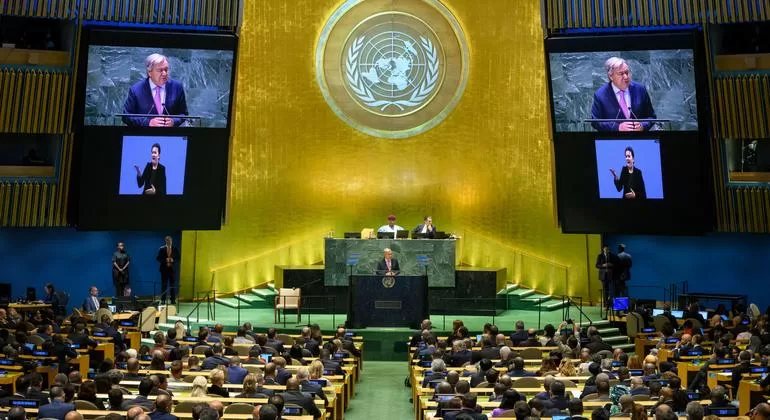
World leaders will gather in New York next week for the opening of the 81st session of the United Nations General Assembly, with wars in Ukraine and the Middle East, artificial intelligence and climate change expected to dominate discussions.
The annual high-level debate begins on Tuesday, bringing together representatives of the 193 UN member states, as well as the Holy See and the State of Palestine, which have observer-state status. The European Union may also address the assembly.
Brazil traditionally speaks first, a practice dating back to the early years of the UN, when it volunteered to open the debate as other countries were reluctant to do so. The United States, which hosts the UN headquarters, follows.
Heads of state generally speak before other senior officials. Speakers are asked to limit their remarks to 15 minutes, although past addresses have far exceeded that duration. Former Cuban leader Fidel Castro spoke for around four and a half hours in 1960, while Libya’s Muammar Gaddafi spoke for more than 90 minutes in 2009.
This year’s theme is: “Restoring Trust, Managing Transformation: A United Nations That Delivers for All.”
Artificial intelligence is expected to feature prominently in discussions after technology leaders warned that rapid advances in the field could outpace human control.
UN Secretary-General Antonio Guterres has called for countries at the forefront of AI development to establish “common guardrails” and avoid a race that could lead to a global disaster. The Security Council could also hold an informal meeting on AI, diplomats said.
Iranian President Masoud Pezeshkian is scheduled to address the assembly on Wednesday, although uncertainty remains over whether members of his delegation will receive US visas.
The United States and Israel went to war with Iran seven months ago. US President Donald Trump, Israeli Prime Minister Benjamin Netanyahu and leaders involved in mediation efforts are also expected in New York, though diplomats see little prospect of a breakthrough in the stalled negotiations.
Ukrainian President Volodymyr Zelensky is due to address the assembly on Wednesday as Kyiv seeks to maintain international support while Washington pushes for an end to Russia’s military operation.
Russian Foreign Minister Sergei Lavrov is scheduled to speak on Saturday. The Security Council is also expected to hold a high-level meeting on Ukraine, although Russia’s veto power has prevented the body from taking substantive action.
Netanyahu is due to address the assembly on Thursday. He is wanted by the International Criminal Court over alleged war crimes and crimes against humanity in Gaza, accusations Israel denies.
Palestinian President Mahmoud Abbas is not expected to attend in person after the United States again declined to issue him a visa. He is likely to address the assembly by video.
A meeting promoting a two-state solution is also expected, although diplomats do not anticipate significant progress.
The UN has begun preparations to select a successor to Guterres, whose second five-year term ends on December 31, 2026.
The Security Council must agree on a candidate before the General Assembly can elect the next secretary-general. The council’s five permanent members — Britain, China, France, Russia and the United States — all have veto power.
Sudan’s conflict is also expected to receive high-level attention. The war between the army and the paramilitary Rapid Support Forces has displaced more than 14 million people and created one of the world’s worst humanitarian crises.
Climate change will remain another central concern, particularly for small island states and other vulnerable countries. Leaders are expected to renew calls for action to limit global warming to 1.5 degrees Celsius above pre-industrial levels, the target set by the 2015 Paris climate agreement.

