




The US military early Wednesday reimposed a blockade on Iranian ports over Tehran’s attacks on ships trying to pass through the Strait of Hormuz, sparking new strikes on nations hosting American forces as an interim deal to end the war further unraveled.
Days of retaliatory strikes across the Middle East by Iran — and both nations’ attempts to assert control of the waterway through which a fifth of the world’s oil and natural gas trade passes during peacetime — threaten to push the region back to all-out war.
In Iran, more than 260 people were wounded in the latest round of overnight strikes alone, according to the Health Ministry, suggesting an intensification in the bombing. More than 30 people have been killed over “recent days,” Iranian government spokesperson Fatemeh Mohajerani said, without elaborating.
The US first imposed the blockade in mid-April and then lifted it in mid-June, a day after signing the interim deal that set a 60-day period for negotiations over issues like Iran’s nuclear programme, but talks have stalled as fighting over the strait has intensified.
Iran’s paramilitary Revolutionary Guard threatened Wednesday to halt all energy exports from the Middle East over the blockade.
“The export of oil and gas from the region will be either for everyone or for no one,” it said.
When US President Donald Trump announced the return of the blockade Monday, he also said he would impose a 20% fee on ships passing through the strait. But he dropped the plan to collect fees hours before resuming the blockade, citing requests from allies in the Persian Gulf.
The US carried out another wave of strikes as it reimposed the blockade, striking dozens of targets over seven hours, the US military’s Central Command said Wednesday.
Hossein Kermanpour, a spokesperson for the Health Ministry, gave Wednesday’s casualty figure, without specifying how many people had been killed. Kermanpour’s figures reported far more people injured than in any other round of recent violence between Iran and the US.
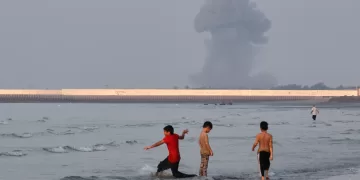
Authorities offered no immediate explanation, though initial local reports suggested a significant strike hit Iran’s southeastern Sistan and Baluchestan province on the Gulf of Oman.
Missile alert warnings went out in Bahrain and Kuwait early Wednesday morning as they faced incoming Iranian fire, something that’s been a daily occurrence, further straining a ceasefire in the war. Jordan also said it shot down three incoming Iranian missiles. Iran claimed attacks on the three nations.
US Navy Adm. Brad Cooper, who leads Central Command, said in a statement that Iran had launched dozens of missiles and drones at neighboring Gulf Arab countries.
“US forces are holding Iran accountable for unwarranted aggression that continues to endanger innocent lives,” Cooper said.
There are at least 19 US warships in the Arabian Sea, including two aircraft carriers and an amphibious assault ship with more than 1,000 Marines aboard. Central Command also said in a social media post that there are “hundreds of military aircraft operating across the Middle East.”
When the US and Israel launched the war on Iran on Feb. 28, Tehran effectively shut the passage by attacking and threatening ships. That sent the price of oil, fertilizer and other goods soaring.
Iran has more recently attacked ships moving through the strait on a route near Oman overseen by the US military that is outside Tehran’s control, setting off the recent violence. The US has threatened to reopen the strait by force — but experts say that would require a much bigger armada if not tens of thousands of ground troops.
Iran’s ambassador to the United Nations, Amir Saeid Iravani, criticized America’s ongoing attacks targeting his country.
“The US is the aggressor, not the victim,” he wrote to the world body’s leader, according to the state-run IRNA news agency.

