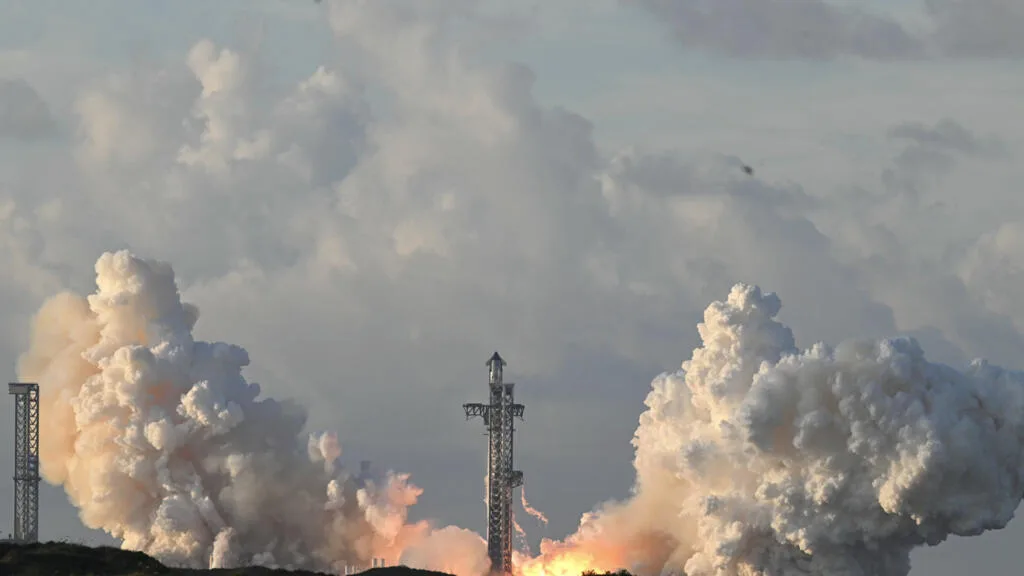












SpaceX’s latest Starship flight planned for Friday will include its first attempt to catch the spacecraft at its Texas launch site rather than discarding it in the ocean, a key test of Elon Musk’s bid to make a fully reusable rocket system.
The 407-foot-tall (124 m) Starship rocket is scheduled to launch at 4:45 pm CT (22:45 GMT) from SpaceX’s Starbase launch facilities in South Texas for its 15th flight since 2023 and the second to carry a batch of operational Starlink satellites.
That makes the mission both a revenue-generating endeavor for its satellite connectivity business and a high-stakes test for a rocket still in development.
SpaceX as of Friday morning had not received a launch license from the US Federal Aviation Administration.
The FAA, which has typically issued licenses a day prior to past Starship launches, did not immediately respond to a request for comment.
Musk’s space and AI colossus views the next-generation Starship rocket as crucial to expanding its Starlink network with more satellites and, in the future, deploying a vast swarm of AI data-processing satellites called Starmind, as the company increasingly positions itself as an infrastructure giant.
SpaceX last launched Starship in September, taking the rocket and its satellites to orbit for the first time despite some engines shutting down mid-flight.
That mission, planned to last 10 hours, ended after roughly 3 hours with an intact splashdown in the Pacific Ocean.
For Friday’s mission, the company expects to return to Texas both Starship’s Super Heavy booster and the Starship upper stage it launches to space.
The upper stage – the top half of the rocket that serves as the spacecraft – will return some 22 hours after launch.
SpaceX has said it would be a “breakthrough moment in making Starship a reliable, rapidly reusable rocket” if all goes as planned.
SpaceX has returned the 236-foot tall Super Heavy booster three times to its launchpad after sending Starship to space, falling back vertically into large mechanical arms fixed to its launch tower some 10 minutes after launch.
The last such “tower catch” was in March 2025.
For the 15th mission, SpaceX will need to move the Super Heavy booster off the launchpad to make way for Starship, which is expected to fall from space after completing 14 orbits around Earth. That sets up the debut Starship catch to occur around 2:45 pm CT (20:45 GMT) on Saturday.

