




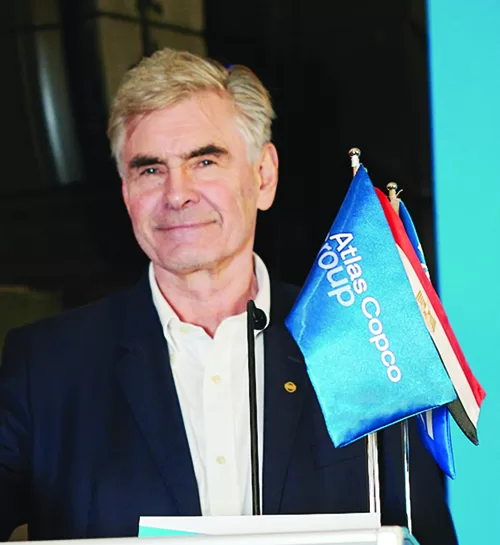
By Robert Koeck, General Manager, Atlas Copco Egypt
As Sweden marks its National Day on June 6th, we celebrate more than a national identity—we celebrate a legacy of innovation, responsibility, and a forward-looking approach to sustainability.
At the heart of Swedish industry lies a deep commitment to addressing one of the most critical challenges of our time: climate change. Increasingly, this commitment is being realised through the adoption of circular economy principles.
Circularity represents a fundamental shift in how we think about resources. Rather than the traditional “take, make, waste” model, circularity prioritises reducing resource use, maximising efficiency, and continuously reusing energy and materials. For industry, this is not only an environmental imperative but also a powerful driver of competitiveness and resilience.
In Egypt, where industrial growth and energy demand continue to rise, circular solutions can play a transformative role. By improving how energy and resources are used, industries can significantly reduce their carbon footprint while enhancing productivity and cost efficiency. At Atlas Copco Egypt, we are proud to bring Swedish innovation to support this transition and help our customers integrate circularity into their operations.
A key example of circularity in practice is energy recovery. In many industrial processes, large amounts of energy are lost in the form of heat. Our Energy Recovery product is designed to capture and reuse this energy – up to 94% of the electrical energy used in compressors can be recovered and repurposed for applications such as water heating or space heating. This not only reduces overall energy consumption but directly contributes to lowering greenhouse gas emissions.
Beyond energy recovery, our technologies are engineered to ensure that energy is used only when it is truly needed. Variable Speed Drive (VSD) compressors, for example, automatically adjust their performance to match real-time demand, eliminating energy waste and reducing unnecessary consumption. This dynamic approach improves efficiency while extending equipment lifespan – another important aspect of circular thinking.
Circularity also extends to other areas of our portfolio. Our vacuum solutions, widely used in sectors such as food, beverage and electronics, are designed for optimal energy efficiency and reduced environmental impact. By integrating intelligent control systems, these technologies minimise power usage and contribute to more sustainable production processes.
Equally important is how we manage the lifecycle of our products. At Atlas Copco, we emphasise durability, serviceability, and long-term performance. Through advanced service agreements, upgrades, and optimisation programs, we help customers extend the life of their equipment, reducing the need for new materials and minimising waste. This lifecycle approach ensures that value is preserved for as long as possible – one of the core principles of a circular economy.
Digitalisation further strengthens circularity by enabling smarter decision-making. Through connected systems and real-time monitoring, industries can track energy usage, identify inefficiencies, and optimise performance continuously. Predictive maintenance ensures that equipment operates at peak efficiency while avoiding unnecessary breakdowns and resource loss. In this way, data becomes a critical enabler of both energy efficiency and climate action.
The link between circularity and climate change is clear. By reducing energy consumption, reusing resources, and extending product lifecycles, circular solutions directly lower carbon emissions and ease the pressure on natural resources. For countries like Egypt, this approach aligns closely with national sustainability goals and supports the transition towards a greener, more resilient economy.
However, achieving meaningful progress requires collaboration. Governments, industries, and technology providers must work together to accelerate the adoption of circular practices. At Atlas Copco Egypt, we are committed to partnering with our customers to identify opportunities, implement innovative solutions, and drive measurable impact.
Sweden’s leadership in sustainability has long been rooted in the belief that economic growth and environmental responsibility go hand in hand. As we celebrate Swedish National Day, we reaffirm this belief and our commitment to advancing circular solutions that address climate change.
By embracing circularity, we have the opportunity not only to reduce our environmental footprint but to redefine how industries operate – creating systems that are more efficient, more resilient, and ultimately more sustainable.
At Atlas Copco Egypt, we are proud to contribute to this journey – bringing Swedish innovation to support climate action and helping build a future where growth and sustainability are truly aligned.

