




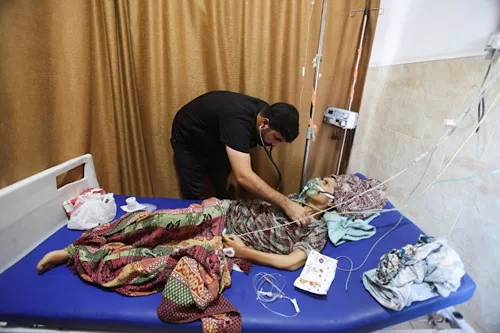
As power cuts cascade through one of Gaza’s largest functioning hospitals and patients wait for treatment in sweltering wards, medics warn that shortages of engine oil and spare parts are causing generators to seize up, putting lives at risk.
The crisis is spreading beyond hospitals, where soaring costs for oil and diesel are making electricity from neighbourhood generators increasingly unaffordable for families that depend on it.
Gaza has been without grid electricity since the start of Israel’s offensive in the territory. Israel halted electricity supply and restricted the import of fuel as well as engine oil, describing them as measures to punish Hamas.
Those restrictions have continued despite an October 2025 US-brokered ceasefire that brought an end to full-scale fighting but has failed to halt Israeli attacks, secure Hamas’ disarmament or relieve Gaza’s humanitarian and energy crises.
Ahmed Al-Nabris, an internal medicine specialist at Nasser Hospital, said shortages of fuel, engine oil and spare parts had forced the hospital into an austerity plan that includes rotating power cuts between buildings.
“Patients are in severe danger, because any power cut puts their lives at serious risk,” said Nabris.
One of the hospital’s four generators is now out of service, and the largest two of the remaining three are under strain, he said. Normally, engine oil in generators should be changed every 250 operating hours, but shortages have forced technicians to extend that interval to around 1,000 hours.
Al-Nabris said the hospital’s electrical system had suffered repeated damage since an Israeli military raid in early 2024. A solar energy system was destroyed and never replaced, while both a main and backup generator were lost. Israel has accused Palestinian militants of using Gaza hospitals as bases.
Fatima Abu Taima, a patient at Nasser Hospital who suffers from pulmonary fibrosis, says those needing to be hooked to a ventilator or nebuliser have to wait as electricity is rotated among departments.
“We keep waiting, counting down the seconds and minutes,” she said. “You have to wait for the electricity to come back.”
The mother of four said her condition had worsened since the outbreak of war in 2023, forcing her to move into the hospital.
Medical charity Médecins Sans Frontières (MSF) said in a statement in August that thousands face greater risks of illness and death because restrictions on the entry of engine oil and spare parts are undermining hospital generators, ambulances, water pumps and water trucks.
Dwindling supplies had forced humanitarian groups to turn to the local market, it said, where locals say prices have surged to $1,300 per litre from about $3 before the war.

