




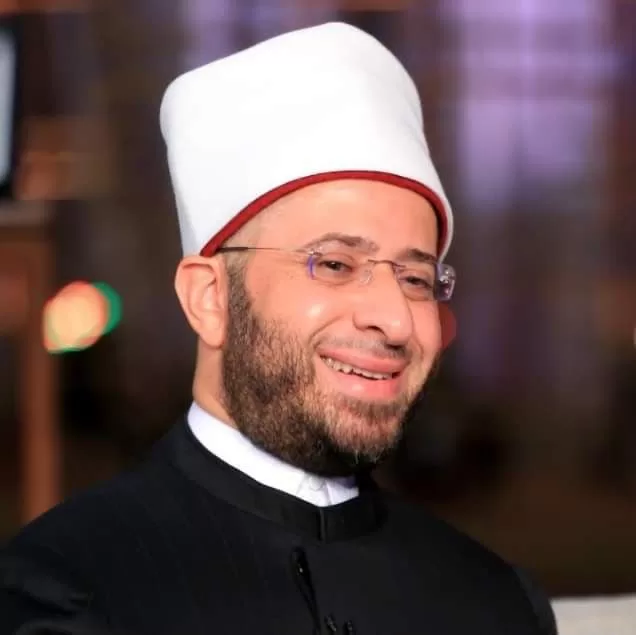
Dr Osama Al-Azhari
Minister of Awqaf
(Charitable Endowments)
Sayyid Qutb is the one who transformed Hassan al-Banna’s idea from its vague and hesitant framework into an explicit confrontational project based on takfir (labelling someone as an apostate) and societal rupture. While al-Banna planted the first seed by mixing religion with politics and making government a fundamental principle of creed, Qutb brought it openly as a complete theory legitimising violence and bloodshed.
Discussing Qutb’s thought is not an attack on his person, but a scholarly deconstruction of ideas still influencing our reality. Schools of thought do not die with their founders; everyone raising arms in our Muslim world today traces their ideas – directly or indirectly – back to what Qutb wrote; I regard him as the primary mine from which extremist currents have emerged in the name of religion.
His thought rests on a sweeping vision that portrays modern Muslim societies as living in a state of jahiliyah (ignorance/pre-Islamic belief) outside the fold of Islam, and that sees the establishment of a government rued by Allah’s Shari’ah as achievable only through confrontation and revolution – not through da’wah, knowledge, and reform.
We emphasise that criticising ideas does not mean attacking individuals; rather, it is a scholarly and religious duty. Just as the hadith scholars would critique the narrations of their own teachers and even their fathers without that diminishing their rank, my aim here is to examine the methodologies that have produced violence in the name of religion—not to disparage the deceased or settle historical scores.
In the light of the philosopher ‘Abd al-Rahman Badawi’s analysis, Sayyid Qutb represents a model of the “anxious personality,” one that generated a sharp intellectual split between those who saw him as a reformer and renewer, and those who regarded him as a source of doctrinal turmoil. Unlike scholars such as Imam al-Nawawi, about whose knowledge and piety the Ummah is unanimously agreed, other figures – like Ibn Taymiyyah and Sayyid Qutb – have had strands of thought arise from their writings that tend towards extremism and conflict.
Qutb started his career as a literary critic close in outlook to Taha Husayn and al-‘Aqqad, without clear religious orientation, until he joined MB after the July Revolution in search of an intellectual leadership role. However, his actions, which culminated in long imprisonment and a harsh life experience, became the major turning point that crystallised the doctrines of takfir (labeling someone as apostate) and jahiliyyah (ignorance/pre-Islamic belief) in his two most famous books: Fi Zilal al-Qur’an (In the Shade of the Qur’an) and Ma’alim fi al-Tariq (Milestones).
Qutb wrote most of his works in prison. That is why describe his output as a kind of “Fiqh al-Sujun (prison fiqh)” – a fiqh that cannot be relied upon, for a person in confinement lives in a state of turmoil and anger, and it is not sound to build absolute religious judgements on what is produced in such a condition.
Among his works is Fi Zilal al-Qur’an (In the Shade of the Qur’an). Despite the beauty of its style and literary eloquence, it contains passages steeped in dangerous ideas: he portrays Muslim societies as living in a state of jahiliyyah, saying, for example, that “Islam has ceased to exist for centuries,” and that “the one who gives the adhan) the Islamic call to prayer) today is more sinful than a disbeliever, because he repeats the two testimonies without any real meaning.” Such statements laid the first bricks of declaring Muslim societies disbelievers, and from them emerged all the groups that later took up arms.
As for Ma’alim fi al-Tariq (Milestones), it is essentially a condensed and intensified version of the ideas in Fi Zilal al-Qur’an. It became a primary reference for almost all extremist currents, from Takfir wa’l-Hijrah ((labelling society as an apostate and immigrating from it) to al-Qa’idah and IS. The mistake made by many religious and cultural institutions was that they focused their refutations on Ma’alim while neglecting al-Zilal, which is the deeper root of this takfir-oriented ideology.
Among the most dangerous things Sayyid Qutb wrote is his statement: “Islam ceased to exist from the moment the government by Allah’s Shari’ah was cut off over the entire earth.” This, in practice, amounts to declaring the Ummah disbelievers across the centuries and denying the Prophet’s hadith, “Goodness remains in me and in my Ummah until the Day of Judgment.” The implication of such a claim is that humanity now needs a new prophet, which directly contradicts the doctrine of the finality of prophethood and the continued existence of the Muhammadan Ummah until the Day of Resurrection.
Indeed, some leading figures within MB itself – such as Shaykh Yusuf al-Qaradawi – have acknowledged that Sayyid Qutb ultimately arrived at “ideas not in line with the methodology of Ahl al-Sunnah wa’l-Jama’ah,” and that his thought inspired extremists like Ayman al-Zawahiri and Shukri Moustafa, who found in his writings a supposed religious justification for violence.
The Prophet Muhammad (PBUH) precisely described this phenomenon in a noble hadith: “What I fear most for you is a man who recites the Qur’an until its grace and radiance are seen upon him and he becomes a support for Islam. Then he changes into whatever Allah wills for him, so it is stripped from him, and he casts it behind his back. He then goes after his neighbour with his sword, accusing him of shirk (polytheism).” This had’ith portrays a person who recites the Qur’an with apparent zeal and jealousy for the religion, yet turns against its essence and becomes a source of tribulation, takfir, and aggression.
The crisis, then, does not lie in the texts but in the souls that read them. How many memorisers of the Qur’an or preachers possess eloquent speech, yet are harsh in their conduct, transgressive toward people, untruthful in their words, and severe in their judgments.
This split between the outward appearance of religiosity and the inner reality of mercy is what allowed the emergence of “devout takfirists” – from Hasan al-Banna and Sayyid Qutb to IS and Boko Haram – where the Qur’an was torn from its Prophetic, merciful context and thrust into a context of extremism and violence.
In conclusion, confronting terrorism cannot be achieved by force of arms alone; it requires dismantling its ideological roots and subjecting its leading figures to the scales of knowledge and Islamic Legal Theory. Ideas do not die with those who espouse them; they persist unless they are exposed and refuted. Sayyid Qutb has not “died” in this sense, for his thought still guides many who raise weapons in the name of Islam in various places. A critical re-reading of his legacy is not an attack on the past, but a defence of the Ummah’s present and future, and of religion’s right to remain a mercy rather than a curse, a light rather than a sword.

