









On this day in 1799, a collapsing wall changed history.
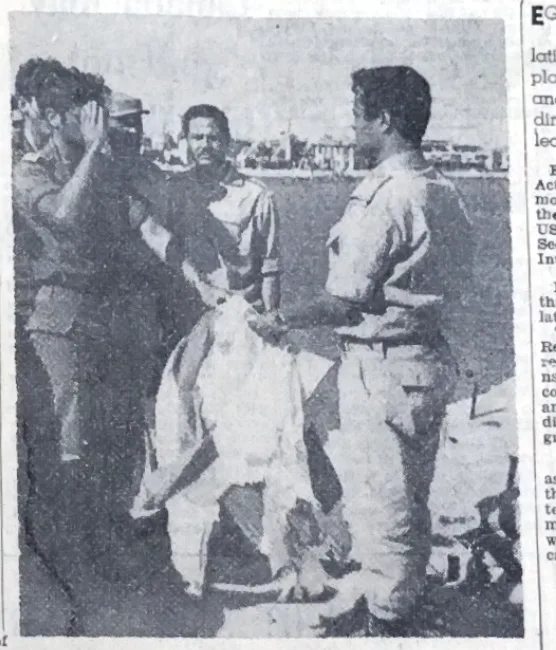
Exactly 227 years ago, French soldiers strengthening the old fortifications at Fort Julien near the Nile Delta town of Rosetta made an unexpected find.
As they cleared rubble, they pulled out a heavy, dark slab that would become one of the most famous artefacts in the world.
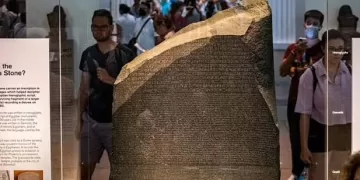
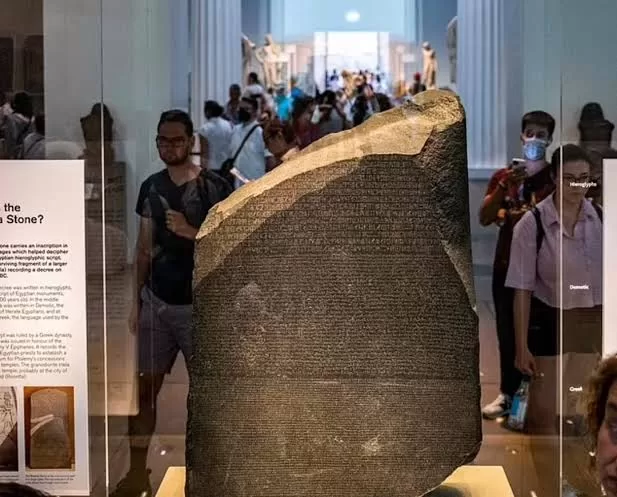
Under the supervision of officer Pierre-François Bouchard, the troops uncovered an irregular block of granodiorite, standing just over a meter tall and weighing around 760 kilograms.
At first, no one grasped its importance. But the stone carried three different inscriptions that would eventually reopen a lost chapter of human history.
The text was a decree issued in 196 BC by priests in Memphis, honouring the young Greek ruler Ptolemy V.
It appeared in hieroglyphs, in Demotic, the everyday script of ancient Egyptians, and in Ancient Greek, the language of the ruling class. Two languages, three scripts: the perfect key to cracking a forgotten writing system.
By the fourth century AD, Egypt’s ancient scripts had gone silent as Christianity spread and temples closed.
For nearly 1,500 years, scholars stared at hieroglyphs without understanding them, often seeing them as mystical symbols rather than a real language with sounds, syllables, and meanings.
However, the Rosetta Stone gave them their first solid chance to decipher it.
News of the discovery quickly reached Europe, where copies of the inscriptions sparked a fierce race among scholars.
British polymath Thomas Young made important early strides, identifying phonetic signs in royal names.
Nonetheless, the decisive breakthrough came in 1822, when French linguist Jean-François Champollion declared he had solved the puzzle.
Drawing on his deep knowledge of Coptic and other ancient texts, he sent his brother a thrilled note: “Je tiensl’affaire!” – “I’ve got it!”
That moment marked the birth of modern Egyptology.
The decipherment did far more than translate a script. It let ancient Egypt speak again after 3,000 years.
Temple walls, tombs, papyri, and monuments suddenly revealed stories of religion, medicine, royal decisions, and everyday life, from spells in the Book of the Dead to marriage contracts and tax records. The civilization came alive in its own words.
The decree on the stone also offers a window into a turbulent time. It celebrates Ptolemy V’s victory over a major revolt in the Delta, a conflict whose physical traces archaeologists have since found.
The tensions between Greek rulers and native Egyptians helped shape the broader Mediterranean world.
After Napoleon’s forces surrendered in 1801, the Rosetta Stone was handed over to Britain under the terms of the Capitulation of Alexandria.
It arrived at the British Museum the following year, where it has remained ever since, except for a brief evacuation during World War II.
Millions of visitors have come to see it, and its name has entered everyday language as a symbol for any vital clue that unlocks a mystery.
On this anniversary, the stone is once again at the centre of calls for its return to Egypt.
Egyptian officials have long argued it was taken during colonial conflict without local consent.
In May 2026, prominent Egyptologist Zahi Hawass stood before its display case at the British Museum and re-launched a global campaign for repatriation.
“I am asking only for one thing: the Rosetta Stone,” he said, calling for it to be housed in the Grand Egyptian Museum.
His appeal, shared widely in videos, has fuelled a petition aiming for a million signatures.
The British Museum maintains that the stone was acquired legally and is protected by British law.
Still, international debates over the return of cultural treasures continue to intensify.
Many Egyptians point out that copies and digital displays, even at the discovery site, cannot take the place of the original.
Over two centuries after its chance discovery, the Rosetta Stone continues to connect the ancient and modern worlds.
It shines a light on Egypt’s remarkable past, while raising timely questions about who should care for humanity’s shared heritage.
And on this anniversary, many Egyptians hold out hope that the key to their history may one day come home.

