





Visitors to the Giza Pyramids will soon lift off for a rare aerial glimpse of the ancient monuments.
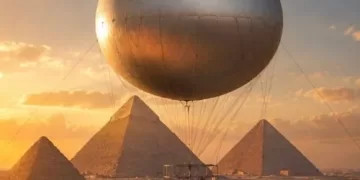
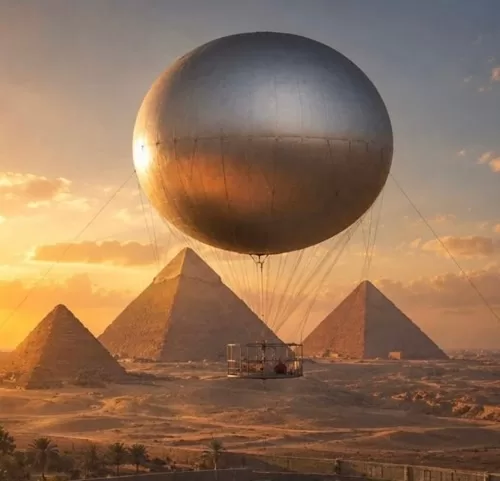
A tethered balloon is set to carry them high above the desert, opening panoramic views of the pyramids, the Sphinx, the Grand Egyptian Museum and the wide landscape that frames them.
The fixed balloon, developed by Egyptian tourism company, Tashereef, with French company, Aerophile, is nearing its trial runs.
It will be the first attraction of its kind near the site, and it arrives as part of a wider push to give visitors more ways to experience one of the world’s great archaeological treasures.
No official opening date has been set, and ticket prices remain undisclosed.
The balloon will rise straight up to 150 metres and stay tethered to the ground.
Each flight lasts 15 minutes. Through headsets and glasses, passengers will hear stories about the pyramids and nearby landmarks, available in 12 languages.
The site sits in the open desert just outside the protected archaeological zone, about two kilometres from the pyramids and 2.2 kilometres from the Sphinx.
Officials have been careful to design the project around strict safety, security and environmental standards so it leaves the monuments and their surroundings untouched.
Every effort is being made to keep the area’s historic character and visual identity intact.
Aerophile project manager, Eric Bachelier, explained that the balloon uses lightweight, prefabricated structures that can be taken apart and put back together.
No digging or concrete work that could disturb the soil has taken place, he said.
The balloon moves only vertically, relying on technology built to international standards of safety and sustainability.

Tourism and Antiquities Minister, Sherif Fathy, described the project as “one more step” in creating fresh tourism experiences around the Giza Pyramids.
Safety, environmental care and heritage protection, he added, remain non-negotiable.
Tourism specialists believe, meanwhile, that the balloon could fit neatly into the larger improvements already under way in Giza, including better roads, stronger infrastructure and richer services.
“The project doesn’t simply give people a new angle on the pyramids,” international tourism expert Hossam Darwish told The Egyptian Gazette.
“It offers a different kind of experience, one that could become part of what Giza feels like to visitors,” he added.
Today’s travellers, he noted, look for moments they can remember, not just photographs.
Seeing the plateau from above adds a quiet new layer to a visit that has long been defined by the ground-level encounter with stone and sand.
Darwish sees the Grand Egyptian Museum, the pyramids, the upgraded infrastructure and these new attractions as pieces of a single living system rather than separate projects.
Together, they could persuade people to linger longer, spend more and discover more of Giza and the rest of Egypt.
The partnership with Aerophile, he added, shows how foreign know-how and investment can strengthen the country’s tourism story, provided tht the historical and cultural value of the sites is always protected.
Egyptologist Hussein Bassir stressed that success would not be measured by numbers alone.
“It has to deliver a safe, high-quality and carefully organised experience,” he said, “while still honouring the cultural and visual landscape of the Giza Pyramids.”
At major archaeological sites, he continued, new projects should enrich the place without dimming its authenticity or disturbing its historic setting.
Collaboration with Aerophile, Bassir observed, highlights the value of specialised international expertise and thoughtful private-sector involvement.
“Private partnerships can work well,” he told The Gazette, “as long as they operate inside a clear framework that puts heritage protection first while still delivering quality, economic return and lasting sustainability.”

