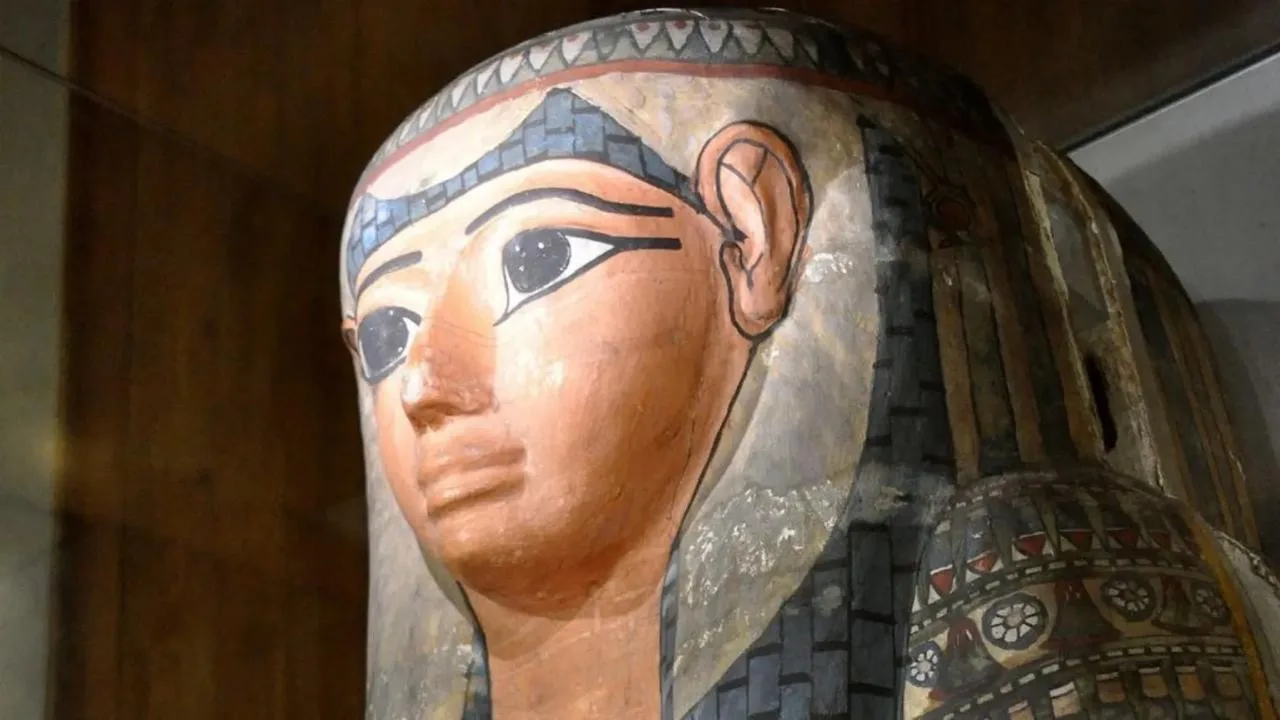







In a Glasgow museum, the remains of a priest who lived nearly 4,000 years ago have been removed from display. A woman’s coffin, exhibited in a museum since 1820, has been covered with a cloth.
The disappearance of both relics from public view has raised a question Egypt has been grappling with for decades: do the remains of ancient Egyptians belong in museum cases?
Kelvingrove Art Gallery and Museum in Glasgow, Scotland, has removed the mummified body of the priest Nekht, who lived between 1985 and 1797 BC.
Excavated at Beni Hasan in Minya, he was donated to the Scottish city in 1923. At the Hunterian Museum in central London, the body of Lady Shep-En-Hor has been covered with a specially designed textile.
Scottish charity Glasgow Life, which manages Kelvingrove Art Gallery and Museum, cited theabsence of consent from the deceased individual or their descendants for its decision to remove the remains of the priest from display.
Officials at the Hunterian said Lady Shep-En-Hordeserves privacy in death. Both institutions say the decisions followed a reassessment of their duty of care towards the deceased, after the International Council of Museums (ICOM) revised its code ofethics to recommend that the inherent dignity of human remains be upheld.
In Egypt, Egyptologists have welcomed the moves taken in Glasgow and London.
Former antiquities minister and renowned Egyptologist Zahi Hawass, a long-time opponent of exhibiting Egyptian mummies in a sensationalised manner, called for giving these human remains their due respect.
He referred to the National Museum of Egyptian Civilisation (NMEC) in southern Cairo as proof that another approach works.
“I believe this facility has succeeded in introducing a unique museum experience that allows visitors to learn about ancient kings and queens within their historical context,” he told The Egyptian Gazette.
Advocating the repatriation of Egyptian mummies, Hawass called for prioritizing royal remains.
Nevertheless, he noted that millions of other mummies sit in storage, but their return would bring no benefit, even as they have value.
“How they are shown matters more,” Hawass said, describing the rethink among international museums as a “good development”.
Egyptologist Magdy Shaker highlighted, meanwhile, the educational value of mummies’ display in other countries.
“The study of these mummies gives insights tochemists and artists, while visitors may find both historical interest and opportunities for moral reflection in the remains of people who once held great power,” Shaker told The Gazette.
He pointed to preserved details, such as Queen Tiye’s hair, traces of henna, hair and beards, and intact fingernails.
He also cited the use of artificial eyes in some mummies, illustrating the care taken in preparing the dead for burial.
Before the royal mummies were moved to the NMEC in a spectacular parade through the streets of Cairo in April 2021, they lay in a hall in the Egyptian Museum in downtown Cairo’s iconic Tahrir Square.
The event, known as the Pharaohs’ Golden Parade,featured 18 kings and four queens, including some of the country’s most prominent ancient rulers.
Among them was Ramses II, one of Egypt’s most famous pharaohs, who ruled during the New Kingdom for 67 years in the 13th century BC and was known for signing the first recorded peace treaty.
However, this was not the mummies’ first journey. After they were laid to rest in lavish tombs in the Valley of the Kings near Luxor some 3,000 years ago, most of these mummies were transferred to secret caches to protect them from tomb robbers.
The caches were rediscovered in the late 1800s, and the mummies continued their journeys, sailing along the Nile on steamships to take up residence in Cairo museums.
In the mid-to-late 1970s, Grand Imam of al-Azhar, Sheikh Abdel Haleem Mahmoud, proposed a grand procession and burial for the mummies.Sheikh Mahmoud derived the proposal from Islamic traditions which honoured the dead by burying them.
Fortunately, Egyptologists succeeded in persuading the government not to proceed with the Grand Imam’s proposal.
The mummies’ hall at the Egyptian Museum in downtown Cairo was later closed and reopened under late President Hosni Mubarak, before the mummies were eventually moved to the NMEC.
Egyptologist Hussein Bassir called for a balance between scientific and historical value and respect for human dignity.
“A mummy is not simply an artefact to be displayed for spectacle or thrill,” Bassir said.
“It’s a person who lived in Egypt, with feelings, dreams, a family and beliefs, buried according to rituals reflecting ancient ideas of life, death and immortality,” he told The Gazette.
He added that respect does not necessarily mean hiding mummies or banning their study.
“Museums should display them through education and scientific interpretation, avoiding commercial sensationalism,” Bassir said.
He defended the public’s right to learn about ancient Egyptian achievements in mummification, medicine and anatomy.
“It’s better for museums worldwide to improve display and interpretation methods, and for indigenous communities and the countries to which remains belong to be involved in decisions about their treatment,” Bassir said.

