








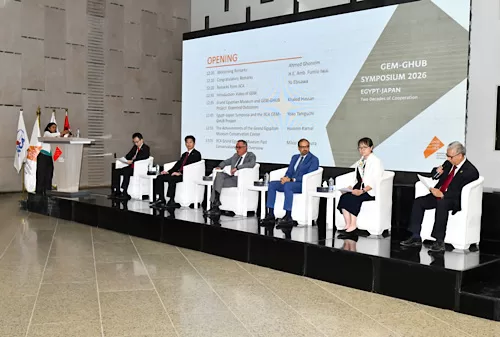
Egypt’s Grand Egyptian Museum (GEM) and the Japan International Cooperation Agency (JICA) held a three-day symposium this week to mark two decades of Egyptian-Japanese cooperation in museum management and heritage preservation.
The event, titled “Two Decades of Egypt-Japan Cooperation: GEM-GHUB Symposium 2026,” brought together specialists from both countries to review achievements in conservation, restoration, scientific examination and documentation, and to discuss future co-operation.
The symposium forms part of the GEM-GHUB project — a Global Centre for Restoration and Scientific Research at the museum — launched in 2025 and running until 2028. Organisers said the initiative aims to build the museum’s capacity and convert expertise gained from earlier joint projects into sustainable institutional systems, focusing on scientific research, collections management, and training heritage specialists across Egypt and the Middle East and North Africa region.
GEM chief executive Ahmed Ghoneim told the gathering that Japan had been a key partner throughout the museum’s development, with cooperation spanning restoration, scientific examination, documentation, training, and the transport and installation of artefacts. He said the museum’s opening marked “not the end of the journey but the beginning of a new phase” in which it seeks to establish itself as a regional hub for research and knowledge-sharing.
The GEM-GHUB builds on earlier initiatives, including the GEM-CC project launched in 2008 to train conservation staff, and the GEM-JC project launched in 2016 to prepare artefacts for display. The new project aims to expand the reach of research and expertise developed at the museum across Egypt and the wider region.
Ebisawa Yo, head of JICA’s Egypt office, thanked Egyptian and Japanese partners for more than 20 years of co-operation, describing the museum project as “a distinguished model of international cooperation” in restoration, research and capacity-building.
During the symposium, Egyptian officials presented case studies including the transport and reconstruction of King Khufu’s first solar boat and the shrines of Tutankhamun, as well as ongoing work to extract, restore and reassemble Khufu’s second solar boat.
The event was attended by senior GEM officials and Japanese representatives, along with Egyptian university archaeology professors.

