



Akhmim is more than an ancient city on the banks of the Nile. It is a place where history seems to reveal a new story with every turn.
Across its streets, archaeological sites, churches and monasteries preserve traces of centuries of Christian history in Upper Egypt. Their walls carry the architectural features of Coptic religious tradition, memories associated with saints, and details that have survived the passage of generations.
In the heart of Upper Egypt, Akhmim can feel like an open book of history. Ancient remains from different periods stand alongside Christian monuments, while the monasteries and churches scattered across the surrounding countryside preserve a distinctive character shaped by simplicity, spirituality and continuity.
Some of these religious sites date back to the early centuries of Christianity in Egypt, while others reflect the religious and architectural traditions of later periods, particularly the 16th and 17th centuries.
At the centre of Akhmim stands Abu Sefein Church, a monument to the Christian heritage of the city. Dating to the 16th and 17th centuries, the church is dedicated to Saint Mercurius, widely known in Egypt as Abu Sefein.
The saint was traditionally associated with the Roman army, and his image inside the church reflects the story surrounding him. He is depicted wearing military attire and riding a horse, with two swords raised above his head. The second sword carries a religious symbolism associated with his struggle for his faith.
About four kilometres east of Al-Hawawish village lies another important religious landmark: the Monastery of the Virgin Mary at Al-Diabat.
The monastery dates back to the 17th and 18th centuries and is surrounded by a square enclosure wall. At its heart stands the main church, whose design includes three semi-circular sanctuaries with apses, together with two side chambers leading toward a rear passage.
The architecture is relatively simple, but that simplicity is part of its character. The monastery reflects a tradition in which religious buildings were designed around practical needs while maintaining the sacred character of the space.
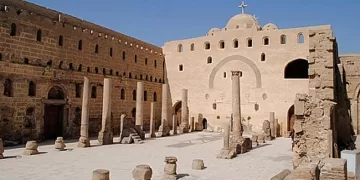
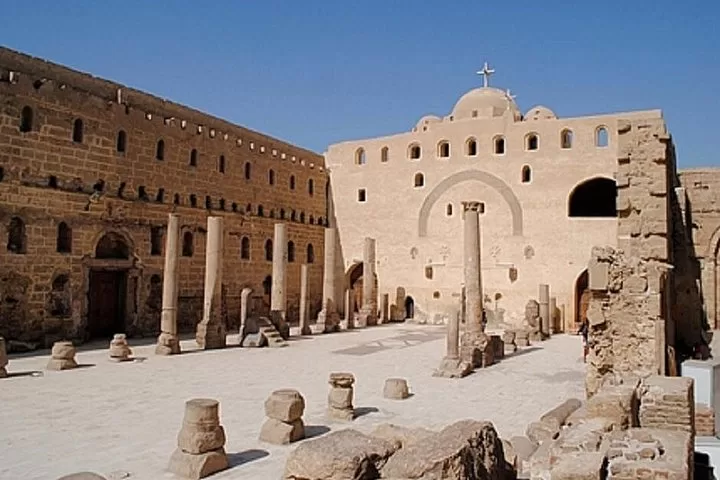
From Al-Diabat, the journey continues toward the wilderness of Akhmim, where the Monastery of the Martyrs stands north of the Monastery of the Virgin Mary.
The monastery is among the notable religious sites in the area and contains five sanctuaries dedicated to the Archangel Michael, Saint Dioscorus, Saint Asclepius, the Virgin Mary and Saint George. Its importance, however, extends beyond its architectural features.
The monastery’s quiet surroundings and spacious grounds have made it a destination during the feasts of the saints, attracting visitors and pilgrims seeking both a spiritual experience and a connection with the Christian heritage of Upper Egypt.

