



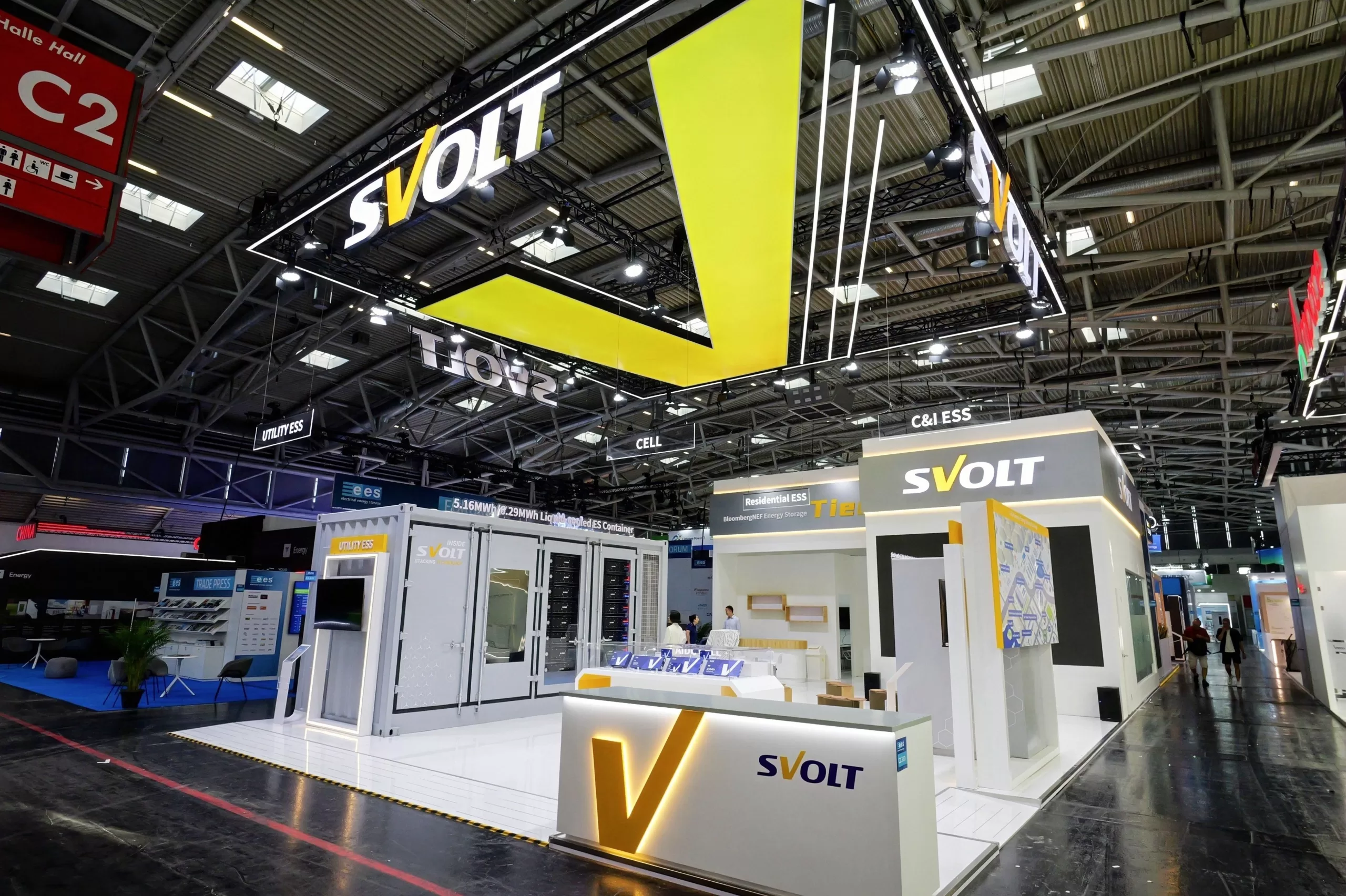
MUNICH, Germany — At EES Europe 2026, SVOLT Energy Technology officially consolidated its global strategic positioning by presenting a unified, full-scenario energy storage portfolio. Marking its most significant international deployment since SNEC 2026, the company’s rollout provides systematic infrastructure solutions for residential, commercial and industrial (C&I), utility-scale, and artificial intelligence data center (AIDC) applications.
Rather than deploying isolated hardware variants, SVOLT’s entire next-generation architecture is integrated upon a singular technological foundation: its proprietary stacked short-blade cell technology tied to predictive hardware-software management systems. This platform-based engineering directly answers the central mandate of modern power grids—transforming raw electrochemical capacity into bankable, certified, and climate-resilient asset value.
AIDC infrastructure: High-rate stacking chemistry mitigating AI grid load volatility

The structural expansion of global AI computing clusters has shifted rack-level power density from traditional 5–10 kW baselines to over 50 kW, exposing localized grids to highly dynamic load fluctuations. Bound by zero-downtime Service Level Agreements (SLAs) and intensifying regulatory frameworks—such as the European Union’s Energy Efficiency Directive (EU EED)—hyperscale data center operators require backup infrastructure capable of instantaneous, millisecond-level transient switching.
SVOLT addresses this grid-edge vulnerability at the cell level with its specialized 90Ah and 102Ah high-power LFP cells, built on an advanced hybrid solid-liquid electrolyte matrix that achieves zero smoke and zero fire propagation under standard nail penetration protocols.By replacing conventional winding with high-precision thermal-composite stacking, SVOLT doubles the internal electrode tabs, shortening the electron current path and lowering internal impedance. Mechanically, the 90Ah cell sustains a 10C continuous discharge rate, while the 102Ah variant delivers 6C continuous discharge, ensuring reliable power security during micro-grid anomalies. Compatible with both traditional UPS and high-voltage direct current (HVDC) topologies, the hardware is managed by an intelligent AI-BMS. By utilizing algorithmic time-of-use (ToU) pricing and predictive load forecasting, the system automates peak-shaving and demand response mechanisms, successfully converting a traditional infrastructure cost center into a predictable revenue-generating asset.
C&I optimization: 285kWh system lowering total cost of ownership (TCO) via CTR Logic
As the global commercial and industrial (C&I) sector transitions from subsidy-reliant economics to pure lifecycle yield performance, asset owners face stringent constraints regarding physical land costs and long-term operations and maintenance (O&M) predictability.
SVOLT’s new 285kWh C&I All-in-One system (offered alongside its 268kWh variant) solves these spatial and financial friction points through an industry-first short-blade, pack-free Cell-to-Rack (CTR) architecture. Eliminating traditional module housings slashes internal structural components by 36% while boosting physical chassis strength by 30%, optimizing spatial energy density within tight boundaries typical of European and Southeast Asian industrial zones.To counteract the uneven cell aging common in standard thermal setups, the system integrates a dual-side liquid-cooled design that reduces cell-to-cell temperature differentials by 50%. This uniform thermal envelope extends total system cycle life by 10%, guaranteeing at least 10,000 cycles per cell. Operating across a wide thermal envelope from -30°C to 55°C, the system’s software layer is anchored by the AI-BMS, which automates complex peak-valley arbitrage and demand charge management—driving a 60% increase in daily O&M efficiency and translating lifecycle asset calculations from mere estimation into precise financial tracking.
Utility-scale resiliency: Structural isolation and layered safety for the 6MWh+ Grid era
For utility-scale grid frequency regulation and large-scale renewable integration, the global market is rapidly scaling into the 6MWh+ container threshold. However, higher capacity concentrations inherently elevate the economic and operational risks associated with single-point thermal runaway propagation.
SVOLT’s 6.29MWh utility-scale ESS container (offered alongside its 5.16MWh model) mitigates these macro-grid risks through a strict triple-compartment physical architecture. By structurally isolating the battery cells, electrical switchgear, and liquid-cooling distribution hardware into independently sealed, fire-resistant zones, the design prevents catastrophic cascading failures. Specialized directional venting pathways ensure fire-electricity separation by routing high-pressure, high-temperature gases entirely outside the container, away from high-voltage circuits.
Thermal stability is further maintained via an innovative L-shaped, upper-and-lower dual-layer liquid-cooled architecture. This symmetrical configuration halves the maximum internal cell temperature differential from the market baseline of 15°C down to under 7°C, extending overall system lifespan by 10% and enabling cells to deliver over 10,000 cycles at 70% State of Health (SOH). Deployed via CTR integration to reduce total site footprint by up to 36%, the container integrates a four-part gas and thermal detection suite ($H_2$, $CO$, smoke, temperature) mapped to a coordinated three-level fire suppression architecture. Transitioning dynamically from early-warning localized aerosol deployment (5 sets per compartment) to automated water-deluge piping, the container holds full international certifications (UL 1973, UL 9540A, IEC 62619, GB/T 36276) and is already scaling across multi-megawatt European grid sites in Bulgaria and Moldova.
Residential scaling: standardized platform defragmenting diversified regional markets
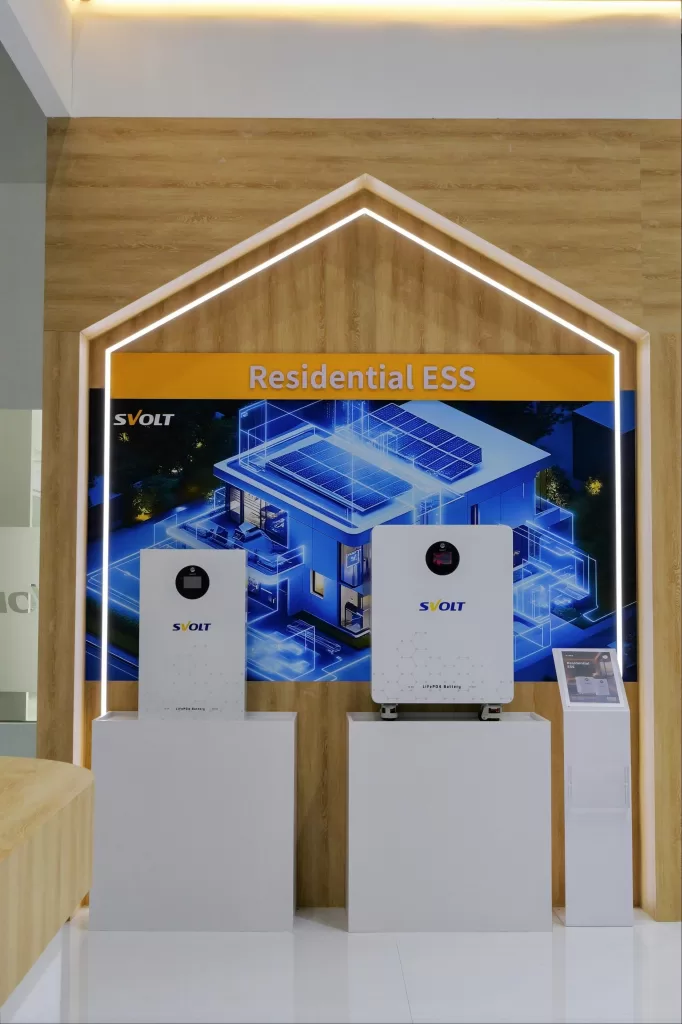
On the residential front, system integrators continue to grapple with a highly fragmented global market landscape, split between high-latitude regions demanding extreme low-temperature winter resilience (Europe) and emerging regions prioritizing rapid-charging economics (APAC/LATAM).
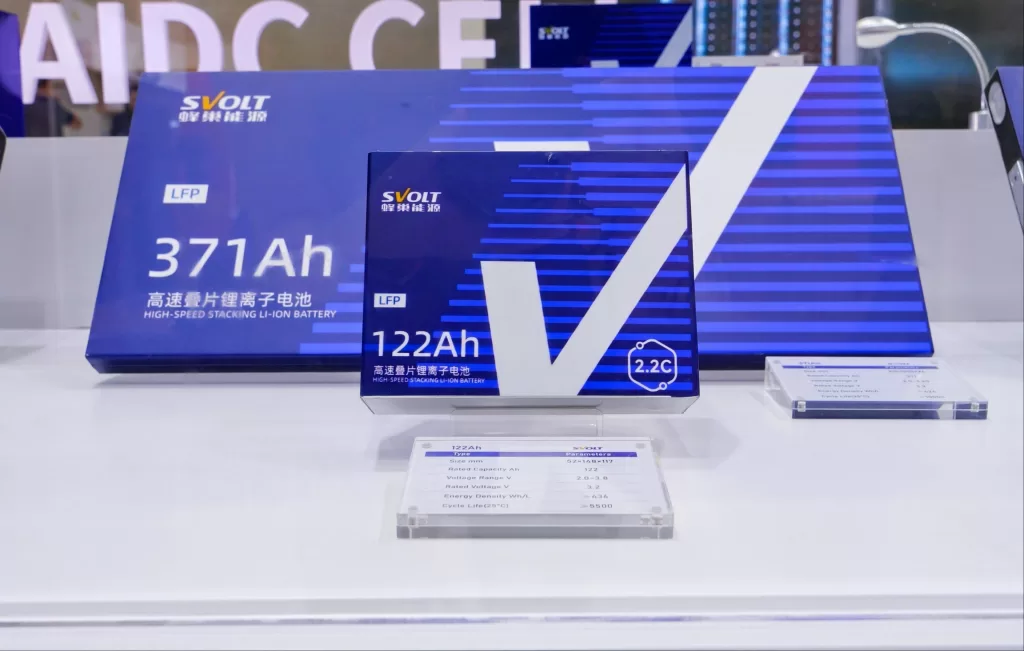
SVOLT addresses this regional divergence through its second-generation 122Ah stacked cell platform (extending up to 350Ah variants), precisely calibrated for the high-volume 7–14 kWh household capacity segment. This capacity footprint ensures immediate policy alignment with premium global subsidy structures, such as Australia’s clean energy incentive schemes that grant full coverage to residential systems below 14kWh.
The technological advantage of the 122Ah platform lies in its “one platform, two variants” modular philosophy. Utilizing an identical mechanical casing and system footprint, SVOLT provides a low-temperature variant fully capable of charging and operating down to -30°C alongside a separate, high-rate fast-charging variant tailored for sudden peak residential loads. Manufactured via SVOLT’s third-generation thermal-composite high-speed stacking process—boasting a 99.5% line yield and an industry-leading cycle time of 0.125 seconds per layer—the 122Ah platform has secured global tier-1 validation, deploying at scale within the supply chain of a top 5 global residential storage provider.
Bridging product export to system solution partnership
SVOLT’s presence across 30+ countries and its consecutive listings in the BloombergNEF (BNEF) Tier 1 energy storage rankings underscore its expanding operational footprint. By integrating its scaling stacking cell manufacturing capacity with a highly responsive “GLOCAL” (Global + Local) delivery and localized field-service infrastructure, SVOLT is successfully transitioning its business model. The company has evolved from a traditional Tier-1 battery component exporter into a long-term, trusted system solutions partner capable of safeguarding global utility, commercial, and digital grid assets.

