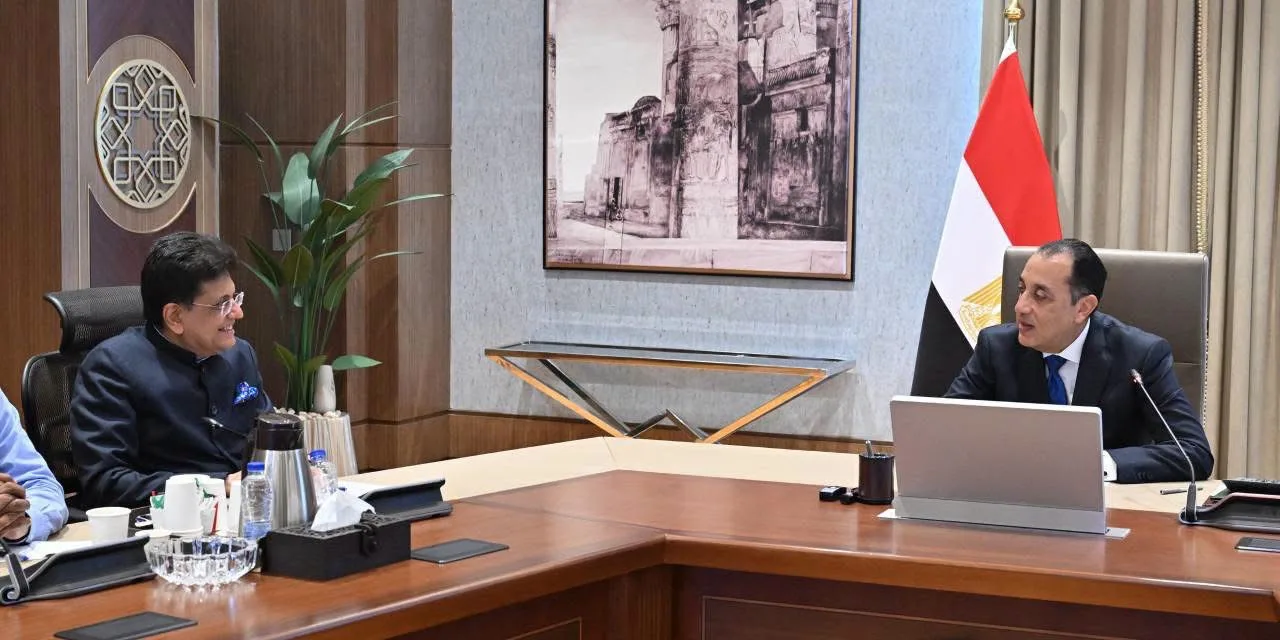





Prime Minister Mostafa Madbouly met on Monday Indian Commerce and Industry Minister Piyush Goyal in the New Capital to discuss ways to strengthen economic, trade and investment co‑operation between Egypt and India.
Madbouly highlighted the significant progress in bilateral relations since the elevation of ties to a strategic partnership in 2023, noting that the strong relationship between President Abdel Fattah El‑Sisi and Indian Prime Minister Narendra Modi has helped drive co‑operation in recent years.
The Prime Minister said bilateral trade reached approximately $6.6 billion in 2025 and expressed Egypt’s ambition to increase the figure to around $12 billion over the coming years through closer co‑operation between the private sectors of both countries.
Madbouly also noted that Indian investments in Egypt currently total around $4.5 billion, citing the presence of major Indian companies including TCI Sanmar, Aditya Birla and Uflex. He reaffirmed the government’s commitment to supporting existing Indian investments and attracting new projects across priority sectors.
The discussions focused on opportunities for co‑operation in food security, information and communications technology, pharmaceuticals, renewable energy, textiles, automotive manufacturing, chemicals and industrial integration. Madbouly stressed that Egypt offers Indian companies a strategic gateway to African and Middle Eastern markets through its network of free trade agreements.
He also welcomed discussions on establishing an Indian industrial zone within the Suez Canal Economic Zone and expanding co‑operation between the Sovereign Fund of Egypt and India’s National Investment and Infrastructure Fund (NIIF).
For his part, Goyal praised the depth of Egypt‑India relations and said both countries possess significant potential to become stronger economic partners. He noted that a target of $12 billion in bilateral trade should be viewed as a first step toward a broader expansion of economic ties.
The Indian minister highlighted potential co‑operation in infrastructure, ports, shipbuilding, railways, renewable energy, green hydrogen, automotive manufacturing and tourism, while stressing the importance of facilitating business travel and investment flows between the two countries.
