



Dina yehya
The main phase of the joint exercise “Medusa-15” was successfully conducted in Greece, bringing together military forces from Egypt, Greece, Cyprus, France and Italy in a series of comprehensive joint training activities involving maritime, air, air defence, border guard, reconnaissance and special operations units.
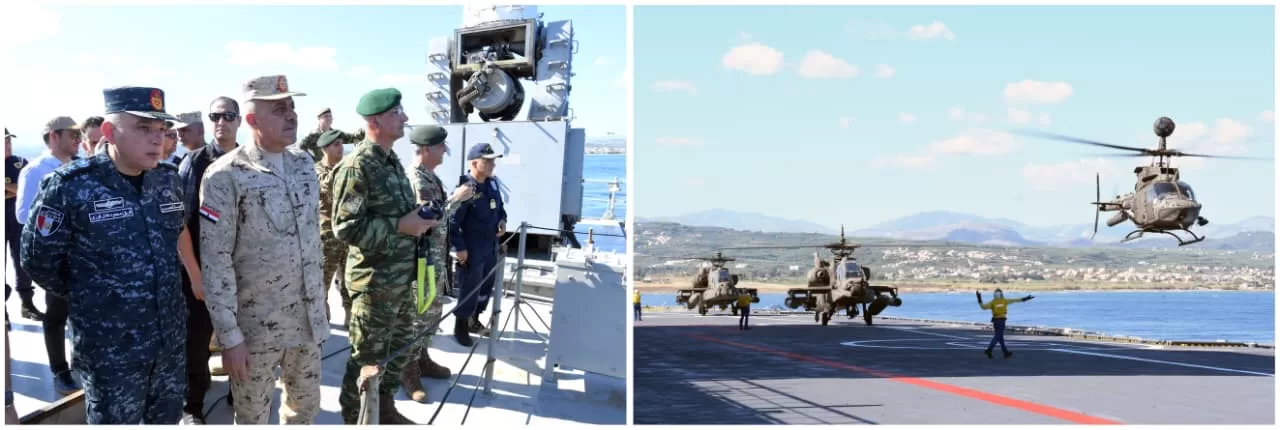
Chief of Staff of the Egyptian Armed Forces Lieutenant General Ahmed Khalifa, Chief of the Hellenic National Defence General Staff General Dimitrios Choupis, Commander of the Cypriot National Guard Lieutenant General Georgios Tsitsikostas, senior commanders from the armed forces of the participating countries, and the ambassadors of Egypt and France to Greece were present during the phase.
The activities commenced aboard the Egyptian helicopter carrier Gamal Abdel Nasser with a briefing outlining the various activities and training events undertaken as part of the exercise.
The operational phase subsequently featured a range of complex joint activities designed to enhance interoperability, co-ordination and operational readiness among the participating forces.
Multi-role combat aircraft conducted offensive and defensive sorties against designated targets, in coordination with Joint Terminal Attack Controller (JTAC) elements to support the execution of precision strikes.
Airborne forces conducted parachute operations to establish a beachhead, alongside free-fall jumps involving the participating nations’ flags, demonstrating the level of co-ordination and integration achieved among the participating units.
Maritime forces also conducted Visit, Board, Search and Seizure (VBSS) operations against a suspected vessel, while special forces carried out raids against designated coastal targets.
These activities were followed by an amphibious assault to secure vital objectives, with landing craft deployed from the Egyptian helicopter carrier transporting special forces from the participating countries.
Attack helicopters provided fire support to protect the approach of the landing craft and support the amphibious operation.Special forces units further conducted a vertical assault, showcasing their ability to execute coordinated operations across multiple domains.
The main activities concluded with naval sailing formations and a final air display by the participating air forces.
The exercise’s preceding training phases included a broad range of specialised activities. Participating naval vessels conducted non-standard live-fire exercises, while special forces carried out advanced firing drills and facility-clearing and storming exercises.
Reconnaissance units also trained in the deployment of swarms of explosive drones against simulated hostile maritime movements, while border guard personnel exchanged expertise and operational experience in surveillance, monitoring and countering illicit activities at sea.
In addition, a specialised cybersecurity training course was conducted to address contemporary cyber challenges and threats and to strengthen the participating forces’ preparedness to respond to emerging security requirements.
The successful conduct of “Medusa-15” reflects the participating armed forces’ continued efforts to strengthen military co-operation, enhance interoperability and exchange operational expertise through realistic and comprehensive joint training.

