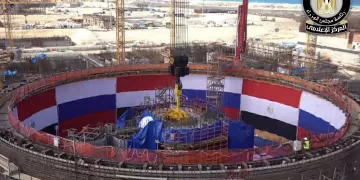




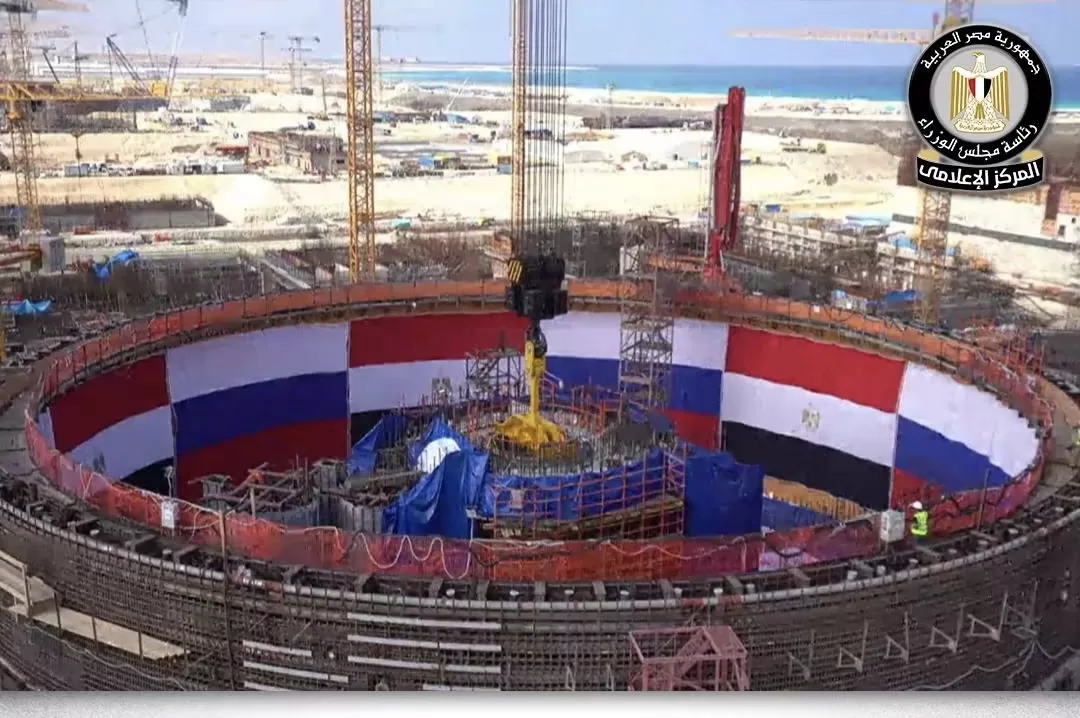
The Cabinet’s Media Center released a statement on Tuesday confirming that the Nuclear Power Plants Authority is fully committed to applying the highest international standards of nuclear safety and quality throughout all stages of the El-Dabaa nuclear power plant project.
The Authority explained that safety procedures are defined through an integrated system of approved documents, including risk assessments, work permits, manufacturer and designer instructions, accreditation certificates, and continuous supervisory records. All safety steps undergo review and approval before any critical lifting operations.
It emphasized that installing the reactor pressure vessel is not an ordinary construction process but one subject to multiple levels of technical oversight. The installation of the Unit 2 reactor vessel was completed successfully and on schedule, with no accidents or injuries reported. Protective barriers and full perimeter security were in place, reflecting effective risk management.
Officials noted that the approach followed is consistent with international practices at other nuclear plants such as Hinkley Point in the UK, Akkuyu in Turkey, and Kudankulam in India. They clarified that manual guidance during equipment positioning does not necessarily constitute a violation, as IAEA standards do not impose an absolute ban on manual handling of heavy nuclear components.
The statement cited Russian national standard GOST 12.3.009-76, which requires lifting operations to be performed by trained personnel with clearly defined responsibilities. Heavy equipment installation is divided into two phases: dynamic guidance using ropes to control movement, followed by precise positioning handled by specialists within very narrow tolerances to achieve exact placement.
The Authority stressed that these measures demonstrate Egypt’s commitment to safe, transparent, and internationally benchmarked practices in building the El-Dabaa nuclear power plant.

