



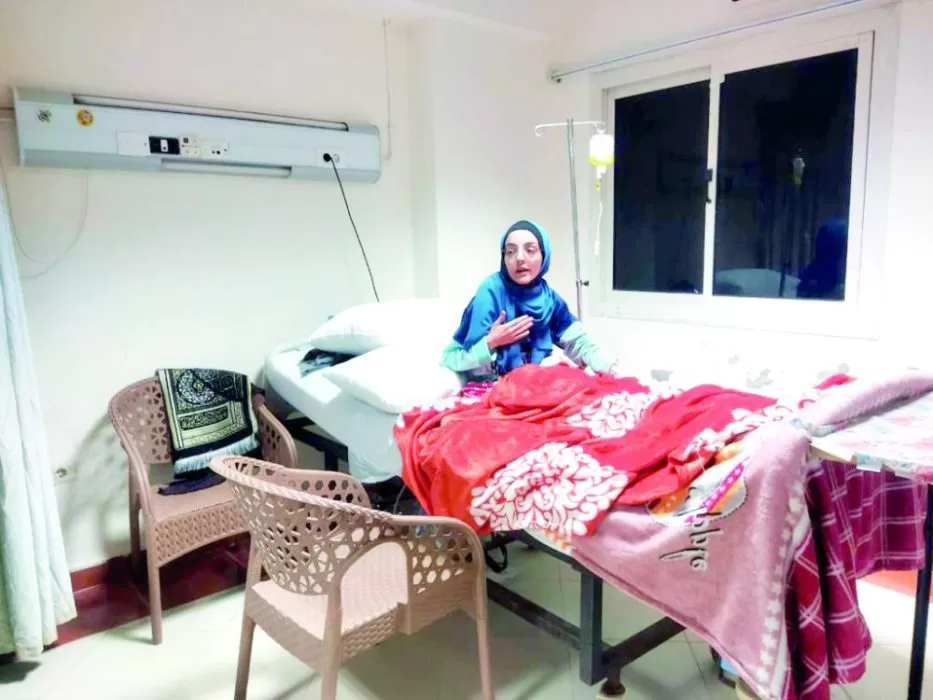
ARISH – Tasneem Abu Khatra was in bed when the fighter jets arrived and attacked her home in northern Gaza.
She can only remember that she was by her niece whom she hugged like she did every night.
“We did nothing wrong,” Abu Khatra, 28, said. “But what we went through was terrible,” she told The Egyptian Gazette.
A dentist by profession, Abu Khatra is one of hundreds of Palestinians from the Gaza Strip who were transferred to Egypt in the past few weeks to receive treatment at the nation’s hospital.
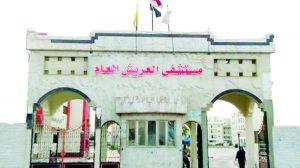
She laid on a bed at al-Arish General Hospital, the main medical facility in al-Arish, North Sinai.
Dozens of other injured Gaza residents receive treatment at the same hospital.
Egypt is rolling out its health capabilities to offer support to injured victims from Gaza. So far, Egypt has received hundreds of these victims and the number is increasing.
The injured victims enter the country through the Rafah crossing point on the border between Sinai and Gaza.
The crossing point has always been a crucial life line for Gaza which has been suffering an all-out Israeli blockade since 2006.
It has become particularly so during the current Israeli campaign on the Palestinian territory, which started on October 7, following attacks by militants from Gaza’s factions, most primarily from the Gaza-ruling Hamas, on settlements in southern Israel.
The injured Palestinians arriving here receive treatment at more than 20 medical facilities, including some of the nation’s largest hospitals.
Soon after they arrive in Rafah, the victims undergo an assessment that determines where they should be sent in Egypt for treatment.
Some of the victims are directly flown to Cairo, especially those with critical conditions. Others stay in al-Arish, by far the nearest urban centre to Rafah. Some of the other patients are sent to hospitals in cities straddling Sinai, including Port Said.
According to Minister of Health and Population, Dr Khaled Abdel Ghaffar, around 30,000 medical professionals, including people in all medical specialities and nurses, are assigned the mission of tending to the Palestinians arriving here.

Nevertheless, the types of injuries Gaza’s victims are coming with speak volumes of the fierce and merciless nature of Israeli attacks on the coastal Palestinian territory, according to Dr Ashraf el-Etribi, the head of the Emergency Section at the Ministry of Health.
“This is a brutal war and the toll it is having on ordinary people can say this very clearly,” el-Etribi told The Gazette.
He said most of the patients arriving have serious injuries. Apart from those arriving with amputated limps, he said, most of the victims have dangerous factures in their bones, deep shrapnel wounds, and third degree burns.
“Some of the patients need skin graft to cover lost or damaged skin,” Dr el-Etribi said.
Egyptian health facilities appear to be on maximum alert to offer services to the injured victims arriving from Gaza. Health officials keep touring the hospitals to ensure that the Palestinian guests get whatever they want.
Dr el-Etribi was at al-Arish General Hospital, checking on the patients and ensuring that they got whatever they needed.
Minister Abdel-Ghaffar pays repeated visits to the Rafah crossing point to oversee the reception of injured victims entering Egypt.
In receiving and treating injured victims from Gaza, Egypt seems to be overstretching its own health capabilities, given heavy demand for health services from the members of the Egyptian public as well as the more than 9 million refugees this country hosts.
Nonetheless, Egyptian medical professionals are heartily offering their services to these victims.
Al-Arish General Hospital is full of activity. Doctors, including some visiting from Cairo, move briskly in the corridors and from one room to another to make certain that everything is done for the patients inside the hospital properly.
Abu Khatra had her leg bones broken and third degree burns in different parts of her body.
She had to undergo skin graft to cover some of the damaged skin. She is certain that the doctors treating her were doing their best and utmost.
Nevertheless, she says she has a wound that will take years to heal.
“This is the psychological wound I sustained because of what happened to me and my family,” she said.


Discussion about this post