



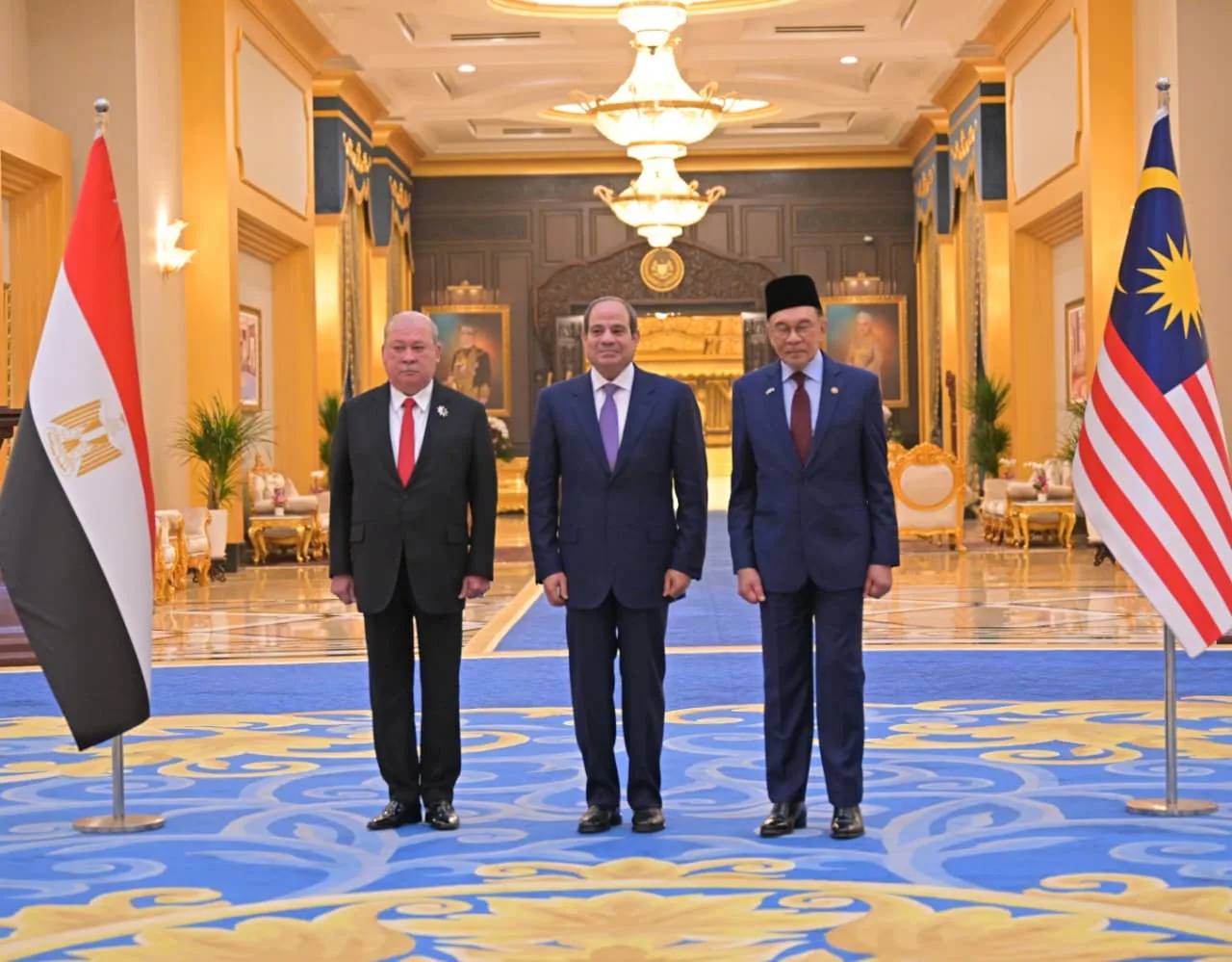
Egypt and Malaysia have agreed to elevate their longstanding bilateral relations to a strategic partnership, marking a significant milestone in their diplomatic engagement and reaffirming their shared commitment to expanding co-operation across a wide range of political, economic, security and development sectors.
The announcement followed the first state visit to Malaysia by Egyptian President Abdel Fattah El-Sisi on October 9–10, 2026, at the invitation of His Majesty Sultan Ibrahim, King of Malaysia.
During the visit, President Sisi was accorded an official state welcoming ceremony and an audience with the King at Istana Negara, Malaysia’s National Palace.
On October 10, 2026, President Sisi held extensive discussions with Malaysian Prime Minister Dato’ Seri Anwar Ibrahim on ways to strengthen bilateral co-operation and advance shared priorities.
The talks covered political engagement, trade and investment, defence and security, digital transformation, energy, agriculture, healthcare, education and tourism, alongside regional and international developments of mutual concern.
Marking decades of diplomatic relations established on November 10, 1959, both leaders reaffirmed their determination to build on the longstanding friendship between their countries and translate the new strategic partnership into concrete achievements.
They agreed to deepen co-operation across various sectors, expedite preparations for the Second Meeting of the Joint Commission and the Second Round of Bilateral Consultations, and encourage stronger business-led partnerships.
Priority areas for enhanced economic co-operation include agriculture, halal industries, technical and vocational education, semiconductors, manufacturing, infrastructure and renewable energy.
The two sides also underscored the importance of strengthening air connectivity, expanding academic exchanges and scholarship opportunities, promoting collaborative research, and enhancing capacity-building through Malaysia’s Technical Co-operation Programme.
The leaders further reaffirmed their commitment to defence and security co-operation, highlighting opportunities for Egypt and Malaysia to serve as strategic gateways to the markets of the Association of Southeast Asian Nations (ASEAN), the Arab world, Africa and Europe.
In this regard, Malaysia welcomed Egypt’s interest in pursuing ASEAN Sectoral Dialogue Partner status and expressed hope for Egypt’s support in advancing co-operation between ASEAN and the African Union.
Both countries reiterated their commitment to multilateral engagement through the United Nations, the Organisation of Islamic Cooperation, the Non-Aligned Movement, the Group of 77 and the Developing Eight (D-8).
Malaysia also reiterated its aspiration to join BRICS, reflecting its commitment to expanding engagement with emerging economies and strengthening international economic co-operation.
On regional and international developments, the two leaders called for peace, stability and freedom of navigation in the Gulf and West Asia.
They reaffirmed their support for a just and lasting resolution of the Palestinian question based on the two-state solution, the pre-1967 borders and East Jerusalem as the capital of an independent Palestinian state.
Additionally, they emphasised the urgent need to ensure unimpeded humanitarian access to the Gaza Strip and categorically rejected the displacement of the Palestinian people.
The leaders expressed concern over escalating violence and the expansion of Israeli settlements in the West Bank and East Jerusalem.
They stressed the importance of implementing United Nations Security Council Resolution 2803 (2025), maintaining support for the United Nations Relief and Works Agency for Palestine Refugees in the Near East (UNRWA), and restoring the Palestinian Authority’s role in Gaza.
In this context, the Malaysian prime minister expressed appreciation for Egypt’s pivotal role in addressing the situation in Gaza, particularly its efforts to facilitate the delivery of Malaysian humanitarian assistance to the Palestinian people.
Regarding Lebanon, both leaders reaffirmed their support for the country’s sovereignty and territorial integrity, as well as the implementation of United Nations Security Council Resolution 1701 (2006).
They called for the withdrawal of Israeli forces from occupied Lebanese and Syrian territories and compliance with the 1974 Disengagement Agreement.
The two leaders also underscored the importance of promoting peace and stability in the Horn of Africa and Sudan, respecting the sovereignty of coastal states in the Red Sea, and pursuing peaceful solutions to disputes within the Nile Basin.

