



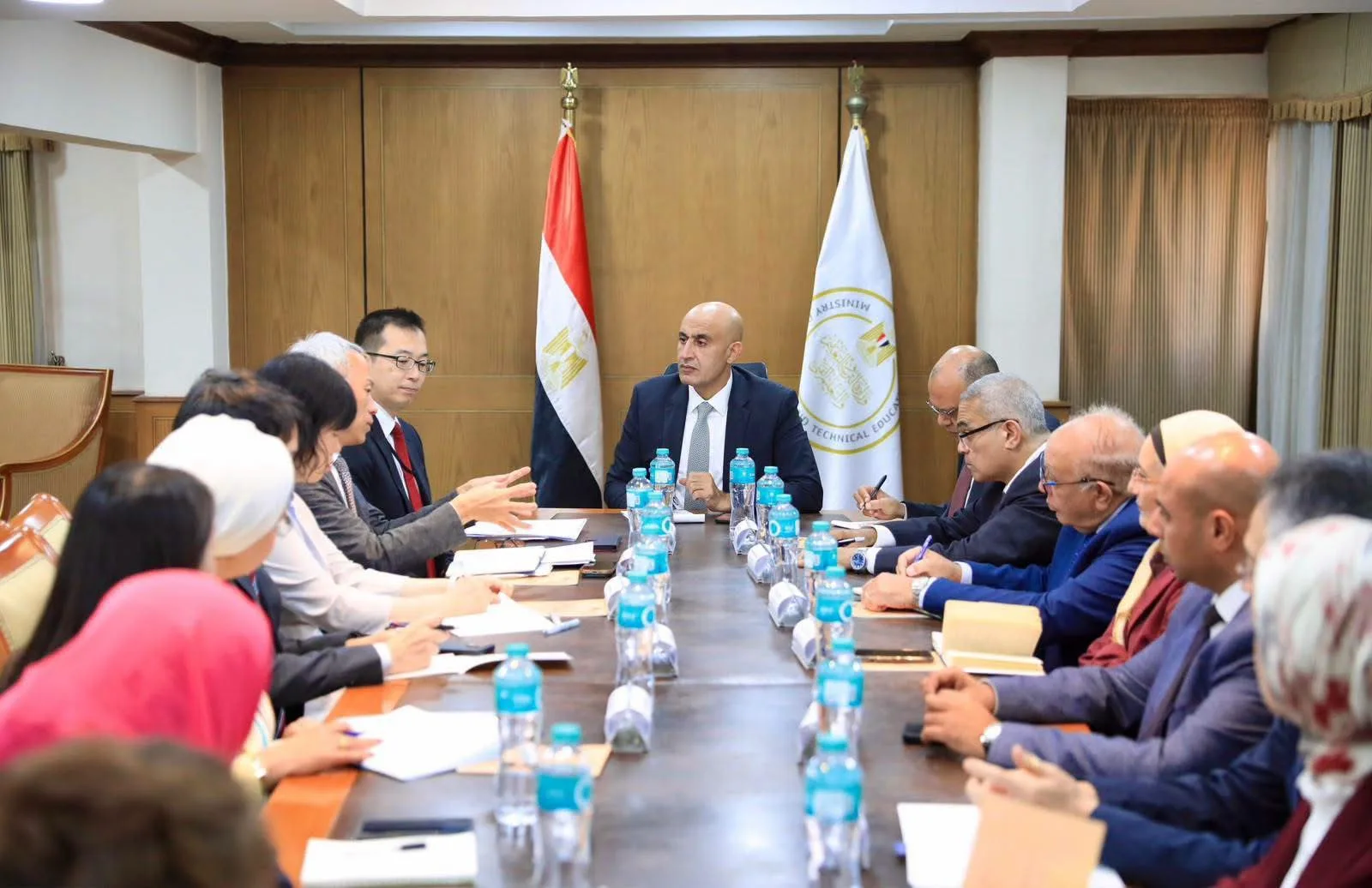
As part of Egypt’s efforts to improve the quality of education and strengthen its strategic partnership with Japan, Minister of Education and Technical Education Mohamed Abdellatif met on Monday with a delegation from the Japan International Cooperation Agency (JICA) to discuss ways to enhance co-operation and expand the application of Japanese educational practices in Egyptian schools.
The JICA delegation included education adviser Dr Shinchiro Tanaka, Egypt Office Chief Representative Yu Ibisawa, Sayako Ishino from JICA’s headquarters education department, and representatives of the agency’s Cairo office. The meeting was also attended by the ministry’s advisers on international relations, agreements and strategic relations, as well as the supervisor of Egyptian-Japanese Schools.
During the meeting, Abdellatif stressed the depth of Egyptian-Japanese relations in education, describing Japan as Egypt’s leading strategic partner in this field. He said co-operation between the two countries had achieved tangible results, reflecting their shared vision and commitment to investing in education and human development.
The minister said the ministry sought to adapt successful Japanese educational practices to the needs and characteristics of Egyptian schools, with the aim of developing a sustainable Egyptian model that benefits from Japanese expertise while preserving the distinctiveness of the national education system.
He added that co-operation with JICA was a key pillar of efforts to develop education through exchanging expertise, training teachers, developing school leadership and transferring effective educational practices to public schools, thereby improving teaching quality and institutional performance.
The meeting reviewed the Egyptian-Japanese Schools network, which now comprises 103 schools nationwide. The schools combine the Egyptian curriculum with Japan’s Tokkatsu activities, which aim to develop students’ personalities, skills and values while promoting teamwork, discipline and a sense of responsibility.
Both sides also discussed expanding teacher preparation and professional development through specialised training programmes in cooperation with Japanese universities, particularly Hiroshima University. These include overseas placements and practical training that allow teachers to gain first-hand experience of Japanese teaching methods, school management systems and the implementation of Tokkatsu activities.
The discussions covered extending training to newly appointed teachers through a gradual, structured approach, providing them with a clear professional foundation in the philosophy of Japanese education, classroom management, teamwork and student development.
The two sides also explored the role of Japanese experts and supervisors in supporting Egyptian-Japanese Schools in line with established standards, as well as increasing their numbers to facilitate knowledge transfer, improve performance and support the expansion of the school network without compromising educational quality.
The meeting also addressed technical education reform, including plans to develop 20 technical schools and convert them into applied technology schools based on Japanese curricula and standards. The initiative aims to improve technical education and training and prepare graduates with the scientific, practical and professional skills required by the labour market.
Both sides concluded by underscoring the importance of building on the positive results achieved through Egyptian-Japanese co-operation and expanding the partnership in the coming period. Priorities include supporting successful projects, developing training programmes for teachers and school leaders, transferring expertise to public schools, ensuring implementation quality and exploring new areas of co-operation to support the sustainable development of Egypt’s education system.

