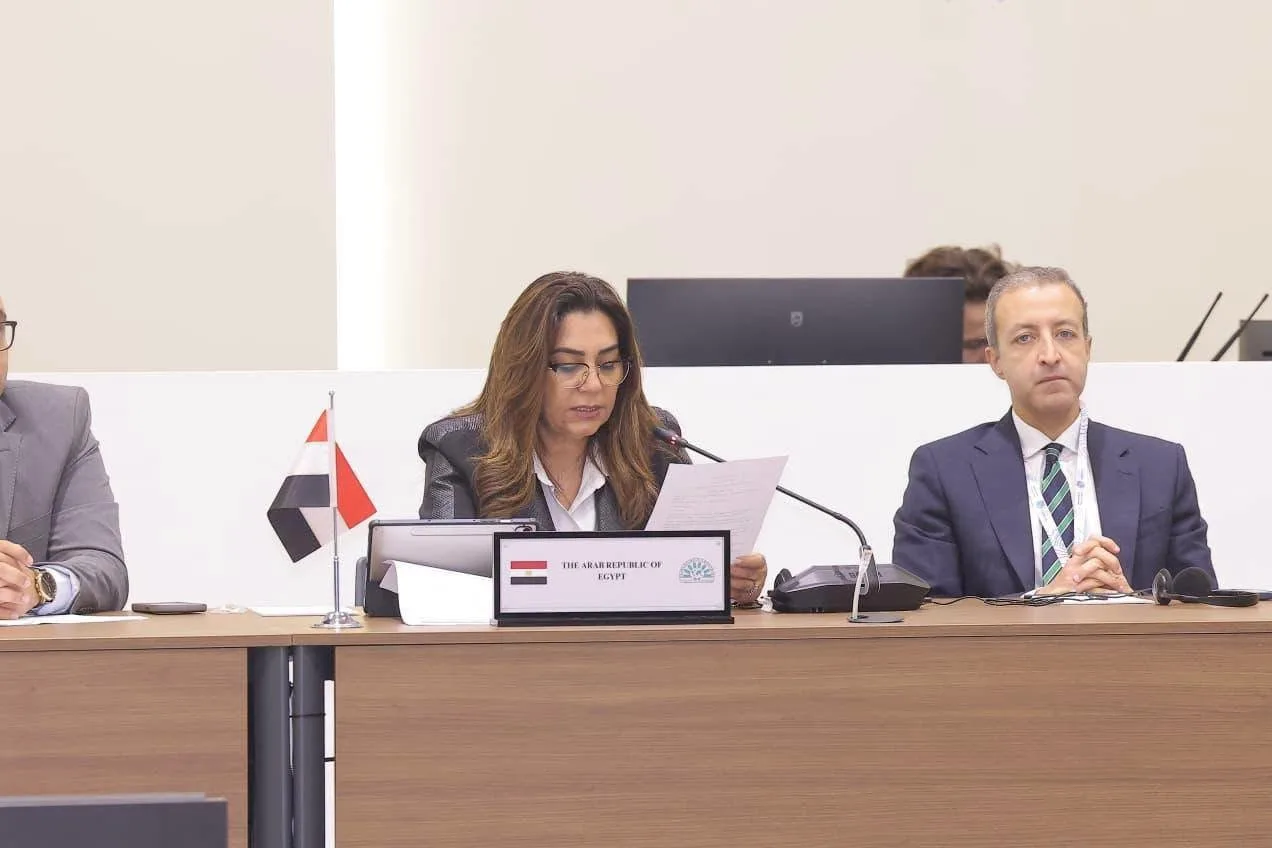



Egypt’s Minister of Local Development and Environment Manal Awad has called for a 2027–2030 roadmap to strengthen co-operation among D-8 member states in climate change adaptation, clean energy transition, biodiversity protection and the circular economy.
The minister made this call during a high-level ministerial session on climate action organised by the Developing Eight (D-8) Organisation for Economic Co-operation during the 31st UN Climate Change Conference (COP31) currently taking place in Türkiye.
Minister Awad stressed the need to move from commitments to implementation through practical partnerships that deliver tangible results and support sustainable development priorities across member states.
The session was attended by Turkish Environment, Urbanisation and Climate Change Minister and COP31 President Murat Kurum, and D-8 Secretary-General Ambassador Sohail Mahmood.
Awad thanked Türkiye for hosting COP31 and its efforts to promote climate and environmental co-operation among countries in the region. She said that the shared climate and environmental challenges facing D-8 countries require stronger joint action and closer co-operation.
She reaffirmed Egypt’s commitment to enhancing coordination among member states at international climate and environmental forums and processes, in a way that advances the priorities of developing countries and promotes South-South cooperation.
Egypt is ready to work with all D-8 member states and the organisation’s secretariat to translate the Antalya Framework into a practical co-operation programme with clearly defined priorities and mutual benefits for the peoples of member countries, she added.
Awad stressed the importance of building on the Istanbul Declaration by activating the D-8 Climate and Environmental Co-operation Platform and developing a roadmap for 2027–2030.
Outlining the priorities of developing countries in climate action, the minister highlighted climate finance as a key concern, stressing the growing need to improve developing countries’ access to funding, particularly grants and concessional finance.
Technology transfer and capacity-building are also essential to enabling developing countries to meet their climate targets, she said.
Awad also highlighted the importance of regional co-operation and joint projects in developing practical initiatives in climate adaptation, sustainable water resources management, climate-resilient agriculture, ecosystem protection, renewable energy and the circular economy.
The D-8 Organisation for Economic Co-operation is an international grouping aimed at strengthening economic and trade relations among its member states and enhancing their position in the global economy.
Its nine members are Egypt, Türkiye, Indonesia, Malaysia, Pakistan, Iran, Bangladesh, Nigeria and Azerbaijan.

