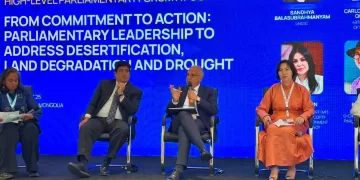





Minister of Water Resources and Irrigation Hani Swailem participated on Wednesday in the high-level parliamentary forum “From Commitment to Implementation: The Parliamentary Role in Addressing Desertification, Land Degradation and Drought” during COP17 in Ulaanbaatar. The event was organised by the G20 Global Land Initiative with UNCCD and UNITAR.
Swailem presented Egypt’s “Water System 2.0” second-generation framework, describing it as a comprehensive transformation in water governance that combines infrastructure modernisation, digitalisation, institutional reform, research, innovation, capacity building, stakeholder engagement and international cooperation. He highlighted the role of AI, satellite monitoring, digital platforms and predictive models in supporting decision-making.
The minister stressed the need for integrated governance of water, land, ecosystems and climate, noting the establishment of Egypt’s National Water Council chaired by the Prime Minister to coordinate policies and oversee the Water Strategy 2050. He underlined the importance of cooperation between government, parliament and society, including engagement with MPs and water user associations, to strengthen resilience against drought, scarcity and land degradation.
Swailem also emphasised the value of “green water”—rainfall and soil moisture—as a vital resource to ease pressure on conventional supplies, improve resilience to drought and support sustainable agriculture. He called for policies that link water management with biodiversity, adaptation and investment strategies.
He further referred to the El Niño phenomenon and its global impacts on temperature, rainfall and drought, stressing the need to incorporate such shifts into seasonal forecasting and water management.

