



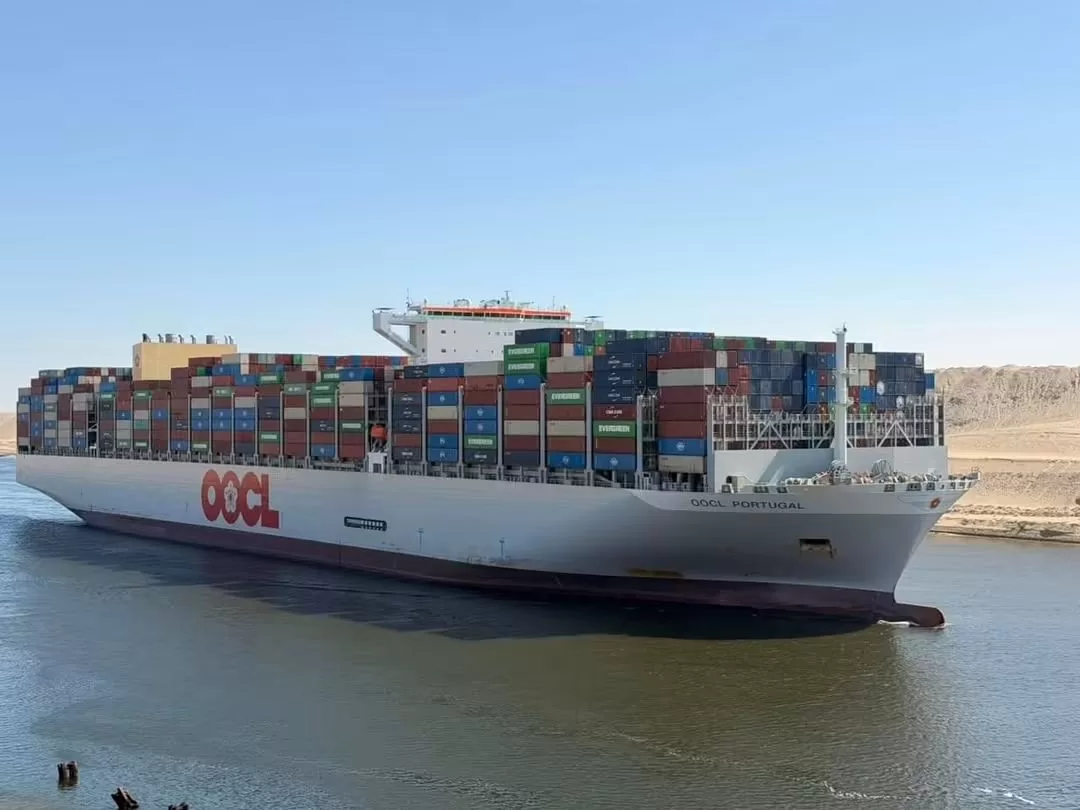
The Suez Canal witnessed on Wednesday the maiden transit of the mega container ship OOCL Portugal, marking the resumption of COSCO Shipping Lines’ transits through the waterway, Suez Canal Authority (SCA) Chairman Admiral Osama Rabie said in a statement.
The vessel, operated by COSCO Shipping Lines, joined the northbound convoy on its voyage from Belgium to China.
Measuring approximately 400 metres in length and 61.3 metres in width, OOCL Portugal has a gross tonnage of 247,000 tonnes and a carrying capacity of up to 24,000 twenty-foot equivalent units (TEUs).
The vessel operates on the NEU2 service, managed by the OCEAN Alliance, which provides a direct link between major ports along the trade route connecting the Far East with northwestern Europe.
Welcoming the vessel’s maiden passage, Admiral Rabie delegated Senior Pilots Captain Saeed Imam, Captain Mohamed Abdel-Jalil and Captain Ahmed Atman to board the ship, welcome its crew and present a commemorative gift to its captain, in line with the SCA’s established protocol for vessels making their first transit.
Admiral Rabie described the transit as particularly significant, noting that it represents the return of COSCO Shipping Lines to the Suez Canal following the escalation of tensions in the Red Sea and Bab al-Mandab Strait.
He said the return of COSCO follows the resumption of services by a number of leading global shipping lines, including CMA CGM, Maersk, MSC and Hapag-Lloyd, along the Europe-Asia trade route.
The development, he added, reflects the continued strategic importance of the Suez Canal as a vital maritime link between East and West.
According to SCA navigation data, the combined net tonnage of container ships transiting the waterway reached approximately 72.1 million tonnes between January and August 2026, compared with 46.7 million tonnes during the corresponding period in 2025, representing an increase of 54.2 per cent.
Wednesday’s traffic further underscored the scale of activity through the waterway, with 39 vessels transiting the Suez Canal carrying a combined net tonnage of approximately 2.3 million tonnes.
The latest developments point to the continued strengthening of traffic through the canal and its role in facilitating international trade and maintaining a direct maritime connection between major markets in Europe and Asia.

