




Banque du Caire’s listing showed that investors will buy state assets. But does that mean the state is stepping aside?
Earlier this month, Egypt sold 45 per cent of Banque du Caire, raising LE36.4 billion. Retail orders came to 27 times what was offered. Investors, in short, are willing to buy state assets when the price is right. At the offer price, Banque du Caire trades near five times its 2025 earnings.
But that raises the question: Who ends up in control?
Banque Misr, itself state-owned, sold the shares, kept 55 per cent and took the cash. Ownership shifted at the margin, but control stayed where it had been.
The deal raises another question. How does the timing fit in?
The answer is simple. The IMF programme ends in December, and the Fund is due to take up its final review by the middle of the month.
Sound valuation
A sound evaluation and a carefully outlined timetable for free floating stakes in state-owned companies are deemed to be the key elements to turn the nation’s initial public offerings (IPOs) into success stories.
In their study entitled “The Effect of Market Conditions on Initial Public Offerings”, Raghuram Rajan and Henri Servaes stated that firm managers and investment bankers bring IPOs to market when sentiment is high, and when feedback risk is small.
“Sentiment is important even when returns are adjusted by returns on matched firms within the same industry. This suggests that sentiment for an industry may have a special influence on the price of IPOs, over and above its influence on the price of seasoned firms,” the study said.
The IMF’s original plan assumed Egypt would net $8.7 billion in proceeds. By mid-2024, the total was only $2.2 billion, and Cairo filled the gap with a $3.5 billion land sale to Qatar. In July, the Fund counted about $520 million more.
IPOs in the pipeline
Egypt’s government once named 30 companies for its IPO programme. Twenty of them hold temporary exchange listings, which is a registration step and not a sale. Hashem El-Sayed, who heads the state companies unit, now talks of 15 or 16 offerings through 2027, drawn from an inventory of about 1,500 state-owned firms.
In the abovementioned study, Rajan and Servaes urge the parties concerned with the IPOs to examine the market conditions well so as to avoid underpricing.
“Underpricing should be positively correlated with feedback risk and it should be negatively correlated with investor sentiment. Also, past work has shown that the degree of underpricing is related to the size of the firm going public,” the study said.
“Sentiment or over-optimism drives price above fundamentals. When prices revert to fundamentals in the long run, returns are more negative for issues that came to market during periods when sentiment was high,” it said.
Rising private investment
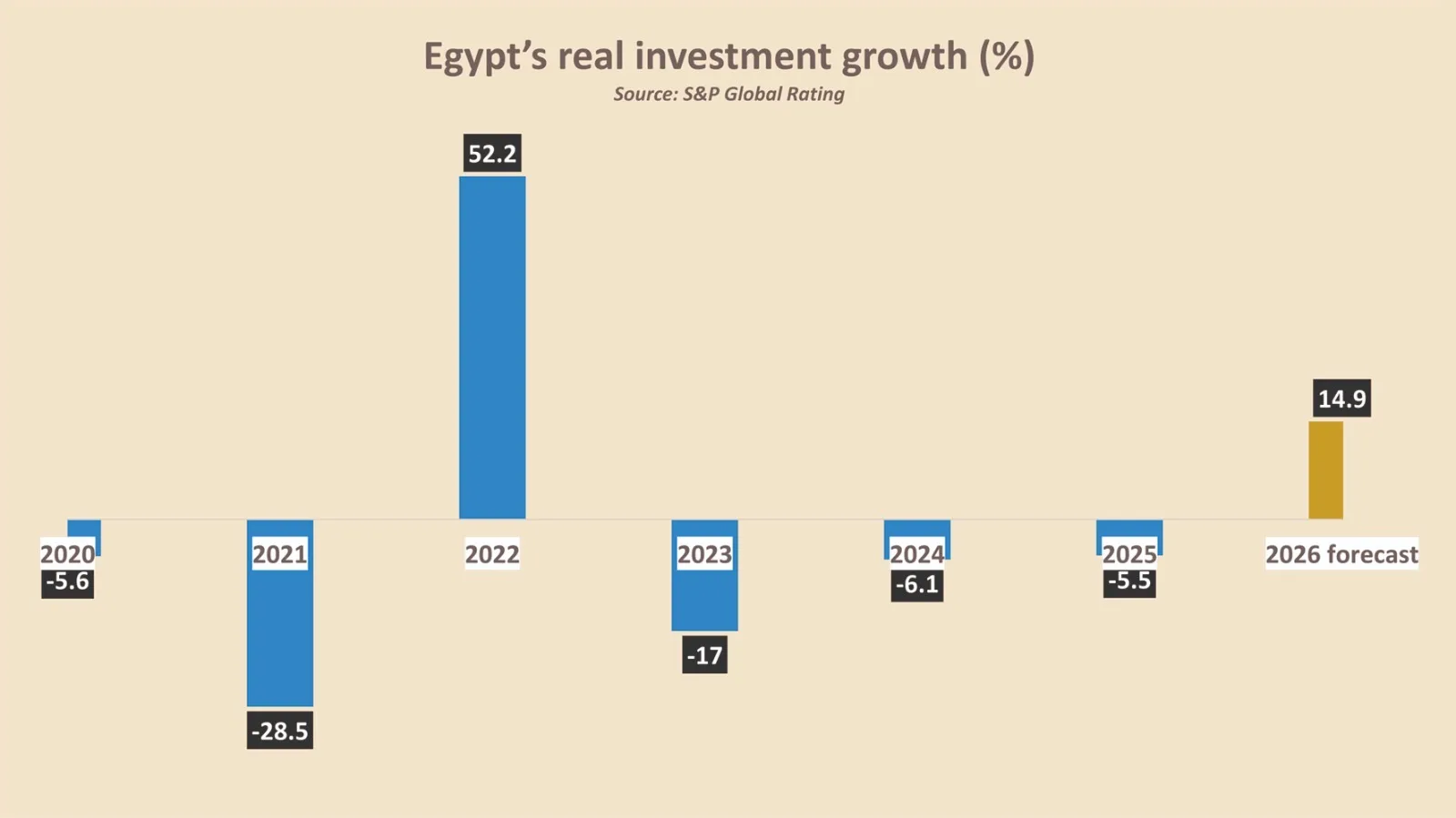
The government targets a private share of 59 per cent in investment for fiscal year 2026/27. Last year’s outturn was 57.7 per cent, against a plan of 62.7 per cent.
The new target, therefore, sits below what was planned last year, and only 1.3 points above what was achieved. The IMF puts public investment at 5.4 per cent of GDP and wants it lower.
Composition matters more than the ratio. IMF staff find that private investment tilts toward consumption-driven activities, and that manufacturing growth is concentrated in those same segments while the higher-value industries contract.
FDI composition matters too
Net FDI reached $18 billion in FY2025/26, up from $12.2 billion the previous year.
Greenfield investment and capital increases stood at $8.8 billion, but $3.5 billion of that was the Alam El-Roum land deal.
Reinvested earnings added $6.2 billion, which is profit that was already earned in Egypt and kept there, not new money. Property bought by non-residents brought in another $2.8 billion. Together, those three items account for about 69 per cent of the total.
If we exclude Alam El-Roum, greenfield FDI was around $5.3 billion, and the IMF expects next year’s inflows to fall about 13 per cent short of what it projected before the war.