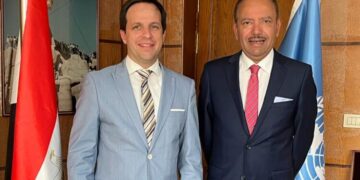





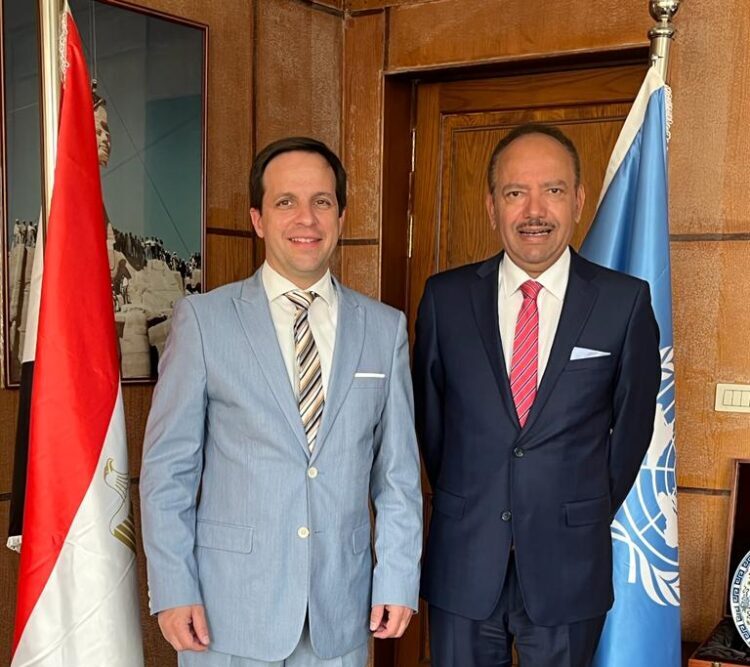
On April 18 2022, the UNESCO Regional Office in Egypt invited the delegate of the University for Peace (UPEACE) established by the United Nations General Assembly to visit its office in Cairo. This was part of the first ever mission of UPEACE to the Middle East, including Israel and Palestine. The excellent cooperation with Dr. Abdulaziz Almuzaini, Director of the UNESCO Office, and the on-going support received by the Permanent Mission of Egypt to the United Nations in Geneva made of this mission an unprecedented success.
On the basis of the agreement signed between the Ministry of Foreign Affairs of Egypt and UPEACE, as well as, previous training programmes, high-ranking representatives of the Diplomatic Academy also met with the UPEACE delegate to identify additional joint programmes for new Egyptian diplomats taking into account the education for peace. Additionally, good practices about the enjoyment of peace and security were also shared by the government representatives. The tailored training programmes will provide Egyptian diplomats with the knowledge and skills needed to engage in contexts related to peacebuilding and regional dialogue.
This initiative led by the Ministry of Foreign Affairs of Egypt and UNESCO Office in Egypt in cooperation with UPEACE in Geneva is an example to be underlined in today’s commemoration of the International Day for Countering Hate Speech, which was declared by the United Nations General Assembly in its resolution on “promoting inter-religious and intercultural dialogue and tolerance in countering hate speech” in 2021. Consequently, the forthcoming trainings will provide Egyptian diplomats with the necessary tools to counter discrimination, xenophobia and hate speech at national, regional and multilateral levels.
On such a day against Hate Speech, it should be emphasised that the manifestations of intolerance based on religion or belief are unfortunately increasing dramatically. In fact, 2021 was the worse year for religious attacks in a decade. Consequently, combating hate speech should be a priority for all governments. Incitement to violence and hatred against all faiths cannot be erased easily and cannot be justified nor legitimised by freedom of expression.
In line of the ‘Plan of Action to Prevent Violent Extremism’ elaborated by the United Nations Secretary-General in 2015, it should be underlined that preserving the values of multilateralism and international cooperation, which underpin the UN Charter and the 2023 Agenda for Sustainable Development, is fundamental to promote and support the three pillars of the UN – peace and security, development and human rights.
On the International Day of Human Fraternity, held on February 4, 2022, the United Nations Secretary General outlined that the declaration ‘Human Fraternity for World Peace and Living Together’ – co-authored by His Holiness Pope Francis and His Eminence the Grand Imam of Al-Azhar Sheikh Ahmed El Tayeb – is a model for compassion and human solidarity. Under the auspices of President Abdel Fattah El Sisi, the Supreme Council for Islamic Affairs organised an international conference on interfaith dialogue on March 13, 2021, in which the Grand Imam of Al-Azhar said: “Islam has established peace as a principle”.
On March 21, 2022, International Day for the Elimination of Racial Discrimination, the Sector for Social and Human Sciences at UNESCO organised a global edition of the ‘Master Class against Racism and Discrimination’ at UNESCO Headquarters in Paris and online. The Global Master Class against Racism and Discrimination: Enhancing Intercultural Dialogue Series aims to raise awareness amongst high school and university students to build their capacities to understand the causes of racism and discriminations. The Master Class Series is part of the Roadmap against Racism that UNESCO is developing to address the Global Call against Racism.
As part of this global edition and within the Arab region, the UNESCO Regional Bureau for Sciences in the Arab States – Cairo Office worked on deepening the understanding of discrimination and racism and empower youth to be active agents of change to fight new forms of racism and discrimination in their own communities through organizing a workshop entitled ‘I can take Action: Youth’s Role in anti-discrimination and anti-racism efforts’.
Today’s digital and media ecosystems can serve as positive elements that promote peaceful coexistence, innovation, equality, creativity, global understanding and mutual respect. Similarly they can also serve to spread disinformation, hatred, discrimination and other threats to societal cohesion. Information can empower citizens to make better decisions, exercise their fundamental rights, support gender equality, build trust in democratic governance and ensure that no one is left behind. For this reason, UNESCO works to enhance information ecosystem by, for example, building the capacity of media professionals to report ethically and with the public interest in mind and to safeguard their right to practice their profession. At the policy level UNESCO supports the implementation of international standards in national information laws. Also, through media and information literacy it empowers citizens to think critically and to click wisely enabling them to distinguish between credible and misleading content and to increase their resilience to misinformation.
Since that peoples of all nations from ancient times have recognized the status of diplomats as agents of peace, the on-going cooperation between Egypt, UPEACE and UNESCO Office in Cairo will stress the importance of the use of multilateral decision-making and diplomacy in achieving peaceful resolutions to conflicts among nations. This cooperation will emphasise the importance of respect for religious and cultural diversity, as well as interreligious, interfaith and intercultural dialogue aimed at promoting a culture of tolerance and respect among individuals, societies and nations.
Dr. David Fernandez Puyana
Ambassador and Permanent Observer of the University for Peace to the United Nations and UNESCO
Dr. Abdulaziz Almuzaini
Director of the UNESCO Cluster Office in Cairo, Regional Bureau for Science in the Arab States and UNESCO Representative in Egypt


Discussion about this post