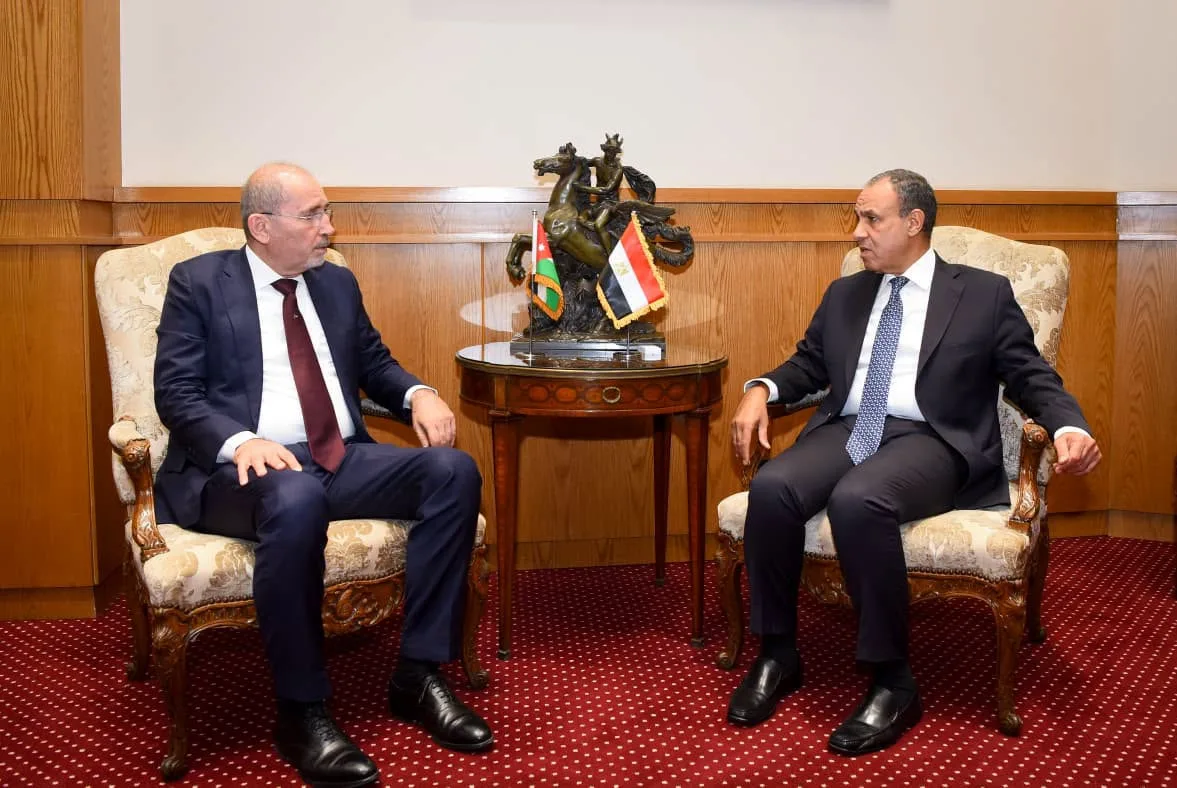
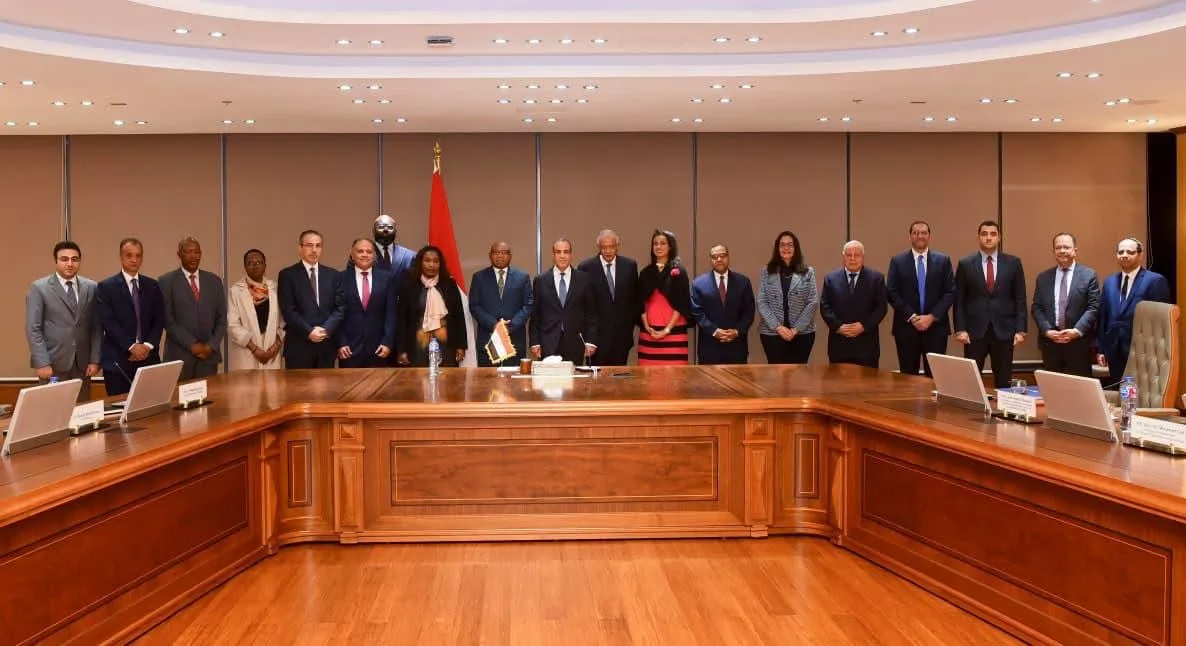









Minister of Foreign Affairs, International Co-operation and Egyptian Expatriates Badr Abdelatty underscored the strength and depth of the historic ties between Egypt and Jordan and the two brotherly peoples.
Abdelatty made the remarks during a joint press conference with Jordanian Deputy Prime Minister and Foreign Minister Ayman Safadi on Tuesday evening, following their talks.
At the outset of the press conference, Abdelatty welcomed his Jordanian counterpart and the accompanying delegation on their visit to Cairo.
He described the talks as constructive, saying they reflected the shared determination of the two countries’ leaderships to strengthen bilateral relations. He added that he had conveyed President Abdel Fattah El Sisi’s greetings and appreciation to Jordan’s King Abdullah II, MENA reported.
The foreign minister explained that the talks covered the full range of bilateral relations across various fields, with both sides agreeing to work toward strengthening cooperation, particularly in the economic, trade and investment sectors.
He noted that enhancing relations between the two countries was particularly important in light of the challenges facing both nations and the region.
Abdelatty also said that he and his Jordanian counterpart discussed regional and international issues.
Abdelatty condemned all Israeli attacks on Lebanon and Syria, stressing the need to implement all relevant international resolutions, halt these attacks and ensure Israel’s full withdrawal from all occupied Syrian and Lebanese territories.
For his part, Minister Safadi said his country was committed to strengthening co-operation with Egypt across all fields, in line with the directives of the two countries’ leaderships.
He stressed that the two countries agreed to activate the work of their joint committees to identify priorities for the coming period.
Safadi added that the situation in Gaza was “catastrophic,” saying Israel continued to prevent the entry of aid and obstruct the implementation of US President Donald Trump’s peace plan, further exacerbating the suffering of the Palestinian people.
He noted that Israel was continuing with its plan to prevent the establishment of a Palestinian state and the creation of a genuine political horizon based on the two-state solution. He added that the West Bank faced serious risks amid settlement expansion and settler terrorism, which threatened the lives of Palestinian civilians.
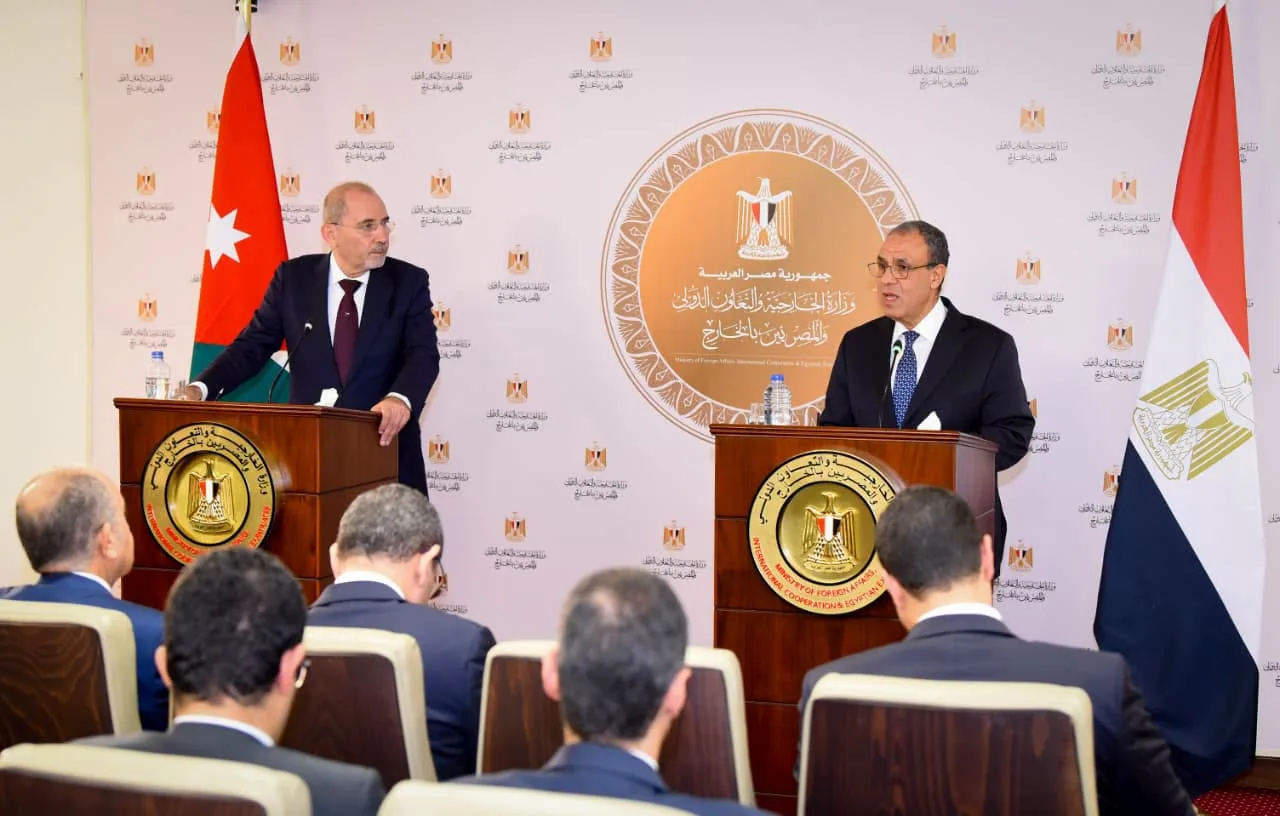
Safadi said Egypt and Jordan had agreed to work toward mobilising international support to pressure Israel to halt these attacks and take measures that could include sanctions.
He praised the roles played by Egypt and Qatar in supporting efforts to reach diplomatic solutions to the region’s crises, noting that any solution must address all the underlying causes of tension and be based on the principles of good neighbourliness and non-interference in the internal affairs of states.
Safadi also affirmed his country’s rejection of all measures that impede navigation in the Strait of Hormuz or Bab el-Mandeb and condemned Iranian attacks on Jordan and Gulf states.
“We stand with our brothers in Saudi Arabia in all measures they take to protect their security and stability. We condemn Houthi attacks and call for a political solution that meets the aspirations of the Yemeni people,” he said.
He also condemned Israeli attacks on Syria and Lebanon, calling on Israel to withdraw from all occupied territories in both countries.
Safadi said the region was witnessing conflicts that could only be addressed through joint coordination.
He affirmed that relations with Egypt were based on solid foundations and the political will of both countries’ leaders to achieve broader prospects for cooperation across all fields.
Responding to a question about efforts to de-escalate the Iranian crisis, Foreign Minister Abdelatty said Egypt was contributing to these efforts through daily contacts, conducted under the directives of President Abdel Fattah El Sisi and in coordination with Jordan.
He added that contacts were ongoing with the US and Iranian sides, as well as regional parties, to stress the importance of returning to the negotiating table and avoiding a resumption of military operations, given their repercussions for the region and the world, particularly the global economy. Egypt, he noted, had been significantly affected by the consequences of military escalation.
The foreign minister said regional efforts were underway to defuse the crisis and seek a deal that addressed and reflected the concerns of all parties. He stressed the importance of strengthening political and diplomatic solutions, affirming that there were no military solutions to the crises facing the region as a whole, including the Iranian crisis.
Asked about Israel’s unilateral policies and the extent to which they could threaten the peace treaty with Jordan, Safadi said his country wanted a just and lasting peace, while the Israeli government sought escalation and wanted the region to remain trapped in conflict, pointing to the situation in Gaza.
He added that, despite a year having passed since the signing of Trump’s peace plan, Israel continued to prevent the entry of aid, tents and food, while escalation in the West Bank was undermining all prospects for reaching a settlement.
Safadi said Jordan, in coordination with Egypt, had worked through the Arab-Islamic Ministerial Committee to mobilize an international position against Israel. These efforts, he said, had led several countries to impose sanctions on Israeli entities and individuals.
“Peace is a strategic choice for all of us, and Jordan will not fall into the trap set by Israeli extremists,” he said.
He added that Jordan remained committed to peace in the interests of both the country and the Palestinian people, and was using all available tools to achieve this goal. Under the political umbrella of the peace treaty, Jordan was seeking to mobilize international support to counter Israel’s inhumane and illegal measures.
He noted that the international community had increasingly come to view Israel as a rogue state.