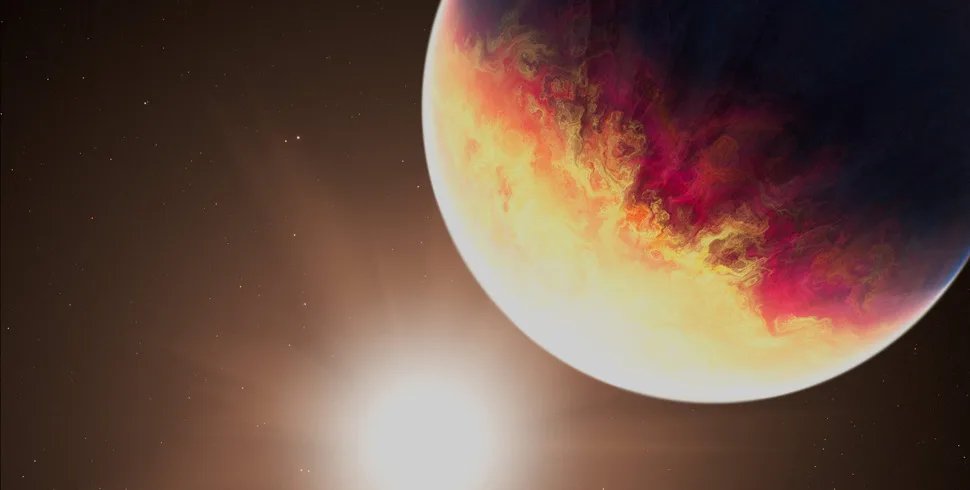










A planet the size of Jupiter that NASA’s TESS telescope tracked for seven years has dropped out of sight, astronomers said, because its orbit is tilting far faster than they thought possible.
The planet, TOI-2535 b, sits about 1,000 light-years from Earth. It is a “hot Jupiter”, a gas giant so close to its star that it completes an orbit in about eight days. Mercury, the closest planet to the Sun, takes 88.
The Transiting Exoplanet Survey Satellite (TESS) does not see planets directly. It detects them by measuring the slight dip in starlight when one crosses, or “transits,” the face of its star.
For years, TOI-2535 b’s transits arrived as much as six hours early or late, and grew shorter and fainter. Earlier this year they stopped altogether.
Astronomers had expected such a shift to take decades or even centuries.
“The planet’s orbit is tilting so quickly that its transit disappeared while we were watching,” said Samuel Yee, a postdoctoral fellow at the University of California, Los Angeles (UCLA) and corresponding author of the study.
The planet has not gone anywhere. It still circles its star, but from Earth’s vantage point it now passes above or below it.
UCLA astrophysicist Erik Petigura, a co-author, compared the effect to eclipses.
“If the moon’s orbit around the Earth was perfectly aligned with the Earth’s orbit around the sun, we would see an eclipse every month,” he said. “But because the moon’s orbit is tilted, eclipses are less common.”
The irregular timing pointed the team to an unseen second planet, likely at least as massive as Saturn, tugging on TOI-2535 b. Combined with measurements of the star’s wobble, the data indicated that this companion also has a tilted orbit, which explains why it has never blocked starlight TESS could detect.
The two planets continue to pull on each other, making their orbits wobble like spinning tops. The researchers expect TOI-2535 b to return to view in 30 to 50 years. Its hidden neighbor could appear sooner.
The findings, published in The Astrophysical Journal Letters, are the most extreme case yet of two planets disturbing each other’s orbits.
They also bear on how hot Jupiters form. Most are thought to have reached their tight orbits violently, for example after a close encounter with another object flung them onto an elongated path, before their star drew them in.
But the study concluded that a violent episode could not have left two giant planets this close together. The pair more likely spiraled inward slowly and together. Such a gentle journey should have left both orbits flat, so something must have tipped them later, though the team does not yet know what.
“This star system may reveal a rare way of forming planets,” the researchers said, according to the study’s findings.
The discovery required patience, as TESS’s first four years of data would not have been enough to reliably detect the change. The team expects to find more planets slipping in and out of view as the telescope keeps watching.

