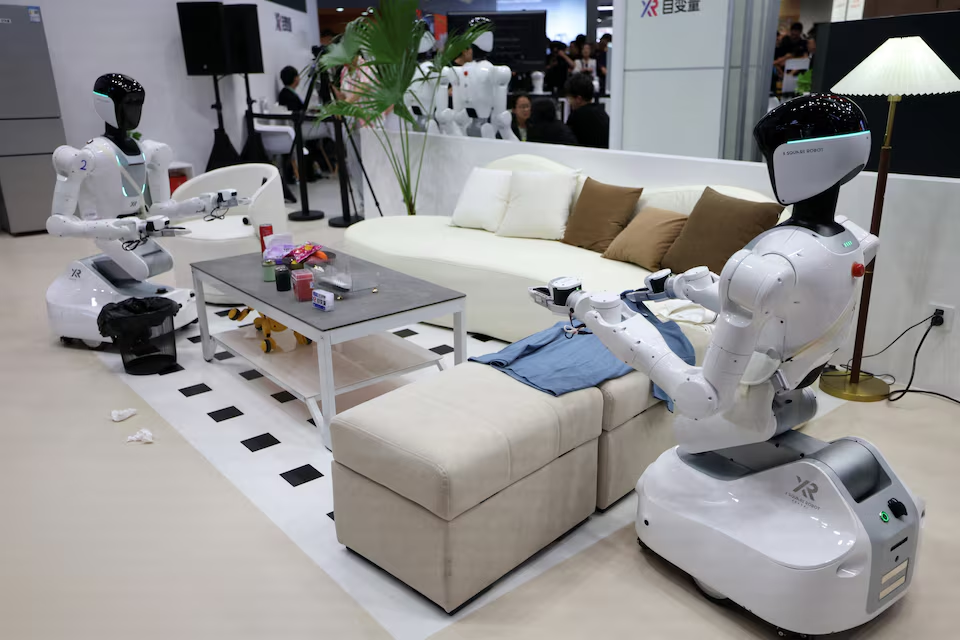












After years of building humanoid robots capable of running, dancing and performing backflips, Chinese companies are pouring resources into a different challenge: developing the AI that could make those machines useful across a wider range of jobs.
The shift is fuelling an investment boom in embodied AI, a field focused on software that allows robots to understand their surroundings, learn unfamiliar tasks and adapt without having to be programmed for every job.
Chinese embodied AI companies raised 93.5 billion yuan ($13 billion) across 322 deals in the first half of 2026, five times the amount a year earlier, according to data research firm ITjuzi.
Funding is increasingly reaching specialist developers of robot intelligence alongside manufacturers.
As competition drives down hardware prices, robot makers have “concluded that the margin won’t come from the hardware but from the brain,” said Dermot McGrath, founder of Shanghai-based technology consultancy ZenGen Labs.
The emerging sector is opening a new front in US-China tech rivalry.
American companies lead in some advanced robot AI systems, while Chinese developers hope their manufacturing strength and access to real-world training data will help them challenge their US competitors, according to Reuters interviews with founders and top executives at five Chinese robotics firms, as well as industry analysts.
The country that best combines AI with machines could gain an advantage in automating factories and logistics, potentially reshaping industrial productivity and the global market for robotics technology.
“The brain is indeed the weakest link in the complete robotics stack,” said Spirit AI co-founder Gao Yang.

